Launching a Customer Experience (CX) or Voice of Customer (VoC) program isn’t about deploying new software. It’s about transforming how your organization listens, learns, and acts. It starts with belief — the conviction that customer experience is not a function, but a shared responsibility embedded in how decisions are made. CX technology is important. But lasting success comes from building a culture that treats customer feedback as fuel for decision-making — not a quarterly scorecard.
Across industries, the companies that outperform on customer loyalty all share one trait: CX isn’t a project; it’s an operating system. They’ve hardwired listening, learning, and action into how they work every day. This guide distills what we’ve seen work with hundreds of Qualtrics customers and pairs it with proven change science
In this guide, you will learn:
- How to build belief in CX as a driver of business outcomes, not an add-on initiative.
- How to rally leaders and teams around a shared story and a powerful internal brand for your CX program.
- How to create the systems, rituals, and rewards that make CX habits stick.
Use this guide if you’re an early-stage CX leader looking to build momentum — or a mature team relaunching your program for sustained impact.
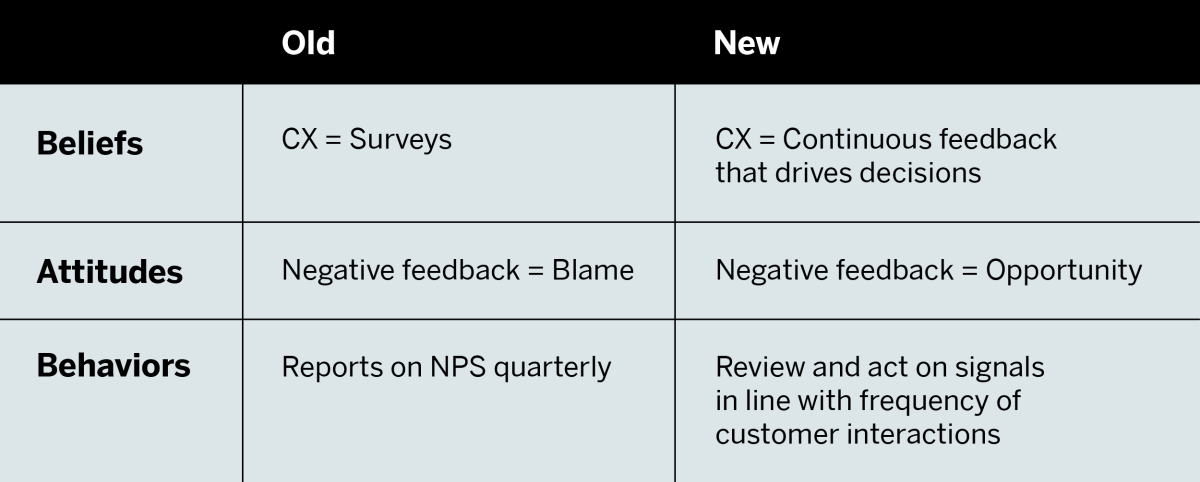
Reframe the work – CX is an operating system, not an app
Before you build new dashboards or feedback channels, align leaders on the mindset shift that underpins sustainable change.
Goal: Shift the mental model from “installing a platform” to “building an organization that responds to customers by default.”
What changes:
Make it Real:
- Map decision moments where feedback should inform action (e.g., root-cause reviews in operations; content updates in digital; coaching in frontline teams).
- Define cadences where CX insights are required inputs (weekly triage, monthly prioritization, customer value propositions, quarterly strategy review).
- Co-create a ‘Ways of Working’ playbook with teams: outline who listens, who decides, who acts, and how fast — then make it visible in every operating rhythm
Tip: Don’t tell people to “act on feedback.” Build the operating rhythms that make it automatic.
Brand your CX program to drive engagement
Goal: Give your CX effort a clear, recognizable identity that signals credibility and purpose.
In the CX and insights world, many of us spend a lot of time assessing marketing campaigns and product effectiveness. Think Byron Sharp and his advice around mental availability and ease of recall and recognition. Inside your organization, your CX program competes for attention just like any other strategic initiative. A strong identity helps people remember it, talk about it, and see themselves in it. A strong brand for your CX program goes beyond a logo; it's about defining what it stands for, how it helps, and what success looks like. This makes the program feel less like an imposed initiative and more like a valuable, integrated part of how your organization operates. A memorable internal brand signals permanence and professionalism, a visual shorthand that tells employees, ‘This is how we work now.’
How to brand your CX program:
Name It Strategically:
- Choose a name that is clear, concise, and reflective of its purpose (e.g., "Customer Compass," "Voice of X," "Client Connect").
- Avoid jargon or overly technical terms.
- Consider names that imply action, insight, or customer-centricity.
Develop a Core Message/Slogan:
- Create a short, impactful phrase that encapsulates the program's value proposition (e.g., "Listening to Lead," "Your Voice, Our Future," "Customers First, Always").
Design a Visual Identity:
- A simple logo or icon can help with recognition. This could be developed internally or with creative support.
- Design internal templates for CX updates, "wins" spotlights, and meeting agendas that feature the program's brand elements.
- Create branded merchandise (e.g., pens, notebooks, stickers) for early adopters or champions to build community.
Launch and Socialize the Brand:
- Officially launch the new brand internally with excitement.
- Incorporate the brand name and visuals into training materials, dashboards, internal communications, and meeting agendas.
- Use the brand consistently across all relevant internal platforms.
Tip: Think of your brand as shorthand for the behaviors you want to see. Make it easy to reference, easy to rally behind.
Lead with a persuasive narrative (and tell it well)
When leaders and teams can tell the same story, in their own words, alignment becomes automatic.
Goal: Build desire and alignment through a story everyone can retell.
Framework: The “Why → Where → What It Means for Me” Story
- Why: “Our customers are changing faster than our processes.”
- Where We’re Going: “We’re becoming an organization that acts on insights in real time.”
- What It Means for Me: “You’ll have clearer signals, faster decisions, and visible impact.”
Storytelling techniques that work:
- Vivid analogies: “Our CX program is moving from smoke alarm to sprinkler system—early detection and rapid response.”
- Before/After day-in-the-life: Show the difference in a frontline manager’s week when customer signals auto-route, actions are tracked, and leaders recognise wins.
- Highlight the cost of CX failures: Use a short, real story (not a statistic) where a missed signal led to churn or rework—and how this program would have changed the outcome.
- Signal → Action → Outcome chain: Illustrate one end-to-end example: feedback arrives, gets triaged, action owner fixes, customer hears back, metric moves.
Tip: Test your story in three sentences. If every stakeholder can explain the “why,” “where,” and “what it means for me” clearly, your story is ready to scale.
Design with, not for – Involvement creates ownership
Goal: Move from “getting buy-in” to “building ownership.”
Like any change within an organization, your program will face many different types of internal stakeholders. Reframe the thinking of your Opposers, turn your Passive stakeholders into co-designers and champions and leverage your Advocates for success.
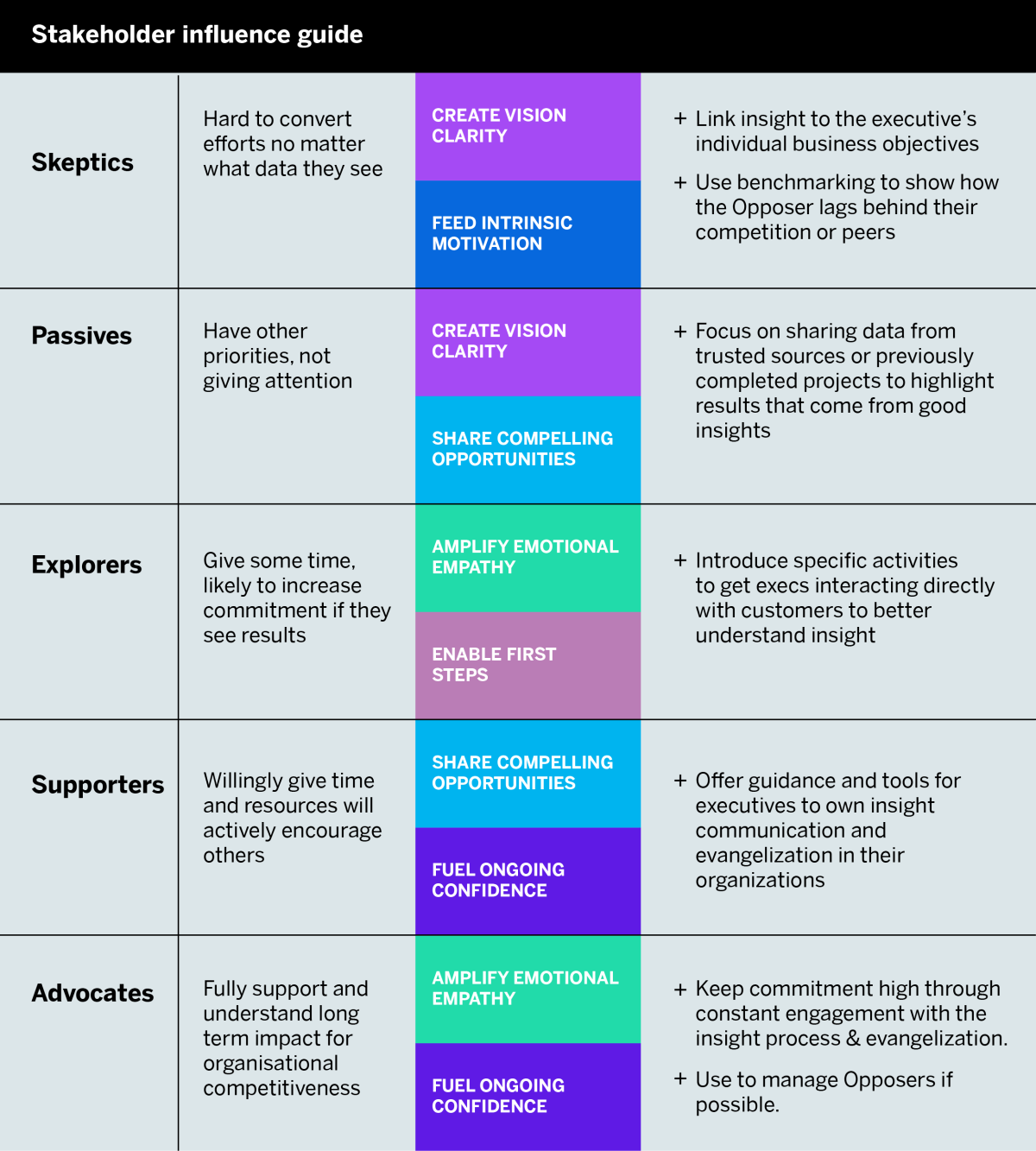
There are many ways to get stakeholders and their teams engaged in your CX program. The approaches below are some tried and tested techniques to drive involvement.
- Listen-in labs: Short sessions where frontline and back‑office teams observe real customers giving feedback and then map pain points together.
- Co‑design workshops: Teams prototype workflows (routing, SLAs, dashboards) that match reality, not organizational charts.
- Pilot squads: Cross‑functional groups run time‑boxed pilots; they own success metrics and share learnings.
- Ambassador network: Named champions who train peers, troubleshoot, and surface wins.
Engage emotion, not just intellect
Facts convince people to agree with you; feelings make them act. Build emotional momentum alongside the logical case.
Goal: Spark motivation that sustains through early friction.
Neuroscientist Antonio Damásio popularized the concept that "We are not thinking machines that feel; we are feeling machines that think.” Emotion is a great way to fuel persistence when a system is new and potentially imperfect.
Ways to build emotional energy:
- Customer voice moments: Read out a powerful verbatim or play a short clip at the start of team meetings; rotate who selects it.
- Make progress visible: Simple dashboards that show issues fixed, customers contacted, thank‑you notes received.
- Personal meaning: Ask teams to write a one‑sentence purpose that relates directly to the work they do: “We help customers ____ by ____.”
- Micro‑celebrations: Applaud the first closed-loop calls, the first product fix, the first detractor turned promoter.
Behavioral science tells us: people persist in change when they feel progress — not when they’re told to create it.
Align and reward the right behaviors
Systems drive behavior. To make customer-centricity stick, design your recognition, metrics, and enablement systems to reinforce the right actions automatically.
Goal: Make customer-centric behaviors the easiest and most rewarded ones.
We know from research (particularly the work of Wolfram Schultz and colleagues) that using rewards can make your desired behaviors the easiest and most recognized path. This isn’t about money, but rather about recognition of those that are displaying the right behaviors that are aligned with your CX vision and goals.
Align the system:
- Role clarity: Add CX responsibilities to job descriptions and onboarding checklists.
- Performance: Include leading indicators (loop-closure rate, time-to-first-response, # of experiments shipped) in team scorecards.
- Recognition: Publicly celebrate the teams modeling desired behaviors.
- Enablement: Equip teams with ready-to-use playbooks, triage agendas, and experiment templates — and remove friction wherever possible.
Recognition cadence example:
- Weekly: Shout‑outs for “Customer Win of the Week.”
- Monthly: “Fix Fast Award” for the fastest path from feedback → improvement.
- Quarterly: “CX Multiplier” for teams whose experiment measurably moved a key journey metric.
Expect (and manage) the messy middle — where most programs stall
Goal: Protect momentum when novelty fades and operations get noisy. After the excitement of the launch wears off, things can get complicated. In any new operating rhythm the first thing people will notice are the mistakes and missteps. This is normal, but it needs careful attention.
Common friction points:
- Noisy signals, unclear ownership, SLAs missed, teams overwhelmed, and “this is extra work” creeping in.
Stabilization plan (first 90 days):
- Day 1–14:
- Staff a CX triage desk (real humans) to fix routing and answer “what do I do now?” questions within hours.
- Run daily stand-ups in pilot areas; track blockers; publish quick fixes.
- Day 15–45:
- Shift to weekly signal huddles per team with a standard 30‑minute agenda: 1) top issues; 2) actions & owners; 3) wins; 4) escalations.
- Launch two‑week improvement sprints focused on the top pain point per journey.
- Day 46–90:
- Move from firefighting to rhythms and roles; tighten SLAs; reduce manual steps; scale what worked in pilots.
Safety nets: publish a “When this breaks, do this” playbook; keep a simple owner‑of‑last‑resort for unresolved signals.
Tip: The messy middle isn’t failure; it’s the signal that new behaviors are taking hold. Your job is to keep energy higher than entropy.
Sustain and scale
Goal: Turn your CX program into a cultural reflex.
- Integrate CX stories and metrics into leadership meetings and onboarding.
- Refresh your brand annually with new success narratives.
- Publish an internal “State of CX” to show progress and celebrate teams.
- Keep experimenting — smaller, faster, repeatable.
🚀 The goal isn’t perfection; it’s progress you can see and celebrate.
The CX reflex: How you know it’s working
Change doesn’t announce itself with a milestone — it shows up in small, consistent shifts across the business.
You’ll know your CX program is taking hold when:
- The language changes. Teams start saying “signals,” “loops,” and “journeys” without being prompted.
- The rhythm changes. CX insights show up in regular team cadences — not as special projects, but as standing inputs.
- The stories change. Wins are told through the lens of customer outcomes, not internal efficiency.
- The decisions change. Roadmaps, hiring plans, and budgets reference customer impact.
- The energy changes. People talk about CX with pride, because they can see the difference they’re making.
When your teams no longer ask, “Should we act on this feedback?” and instead ask, “How fast can we act?”, you’ve built a customer-responsive organization.