
Your organization's numerous customer interactions, from marketing and sales to the website and contact center, generate rich data. However, many CX leaders struggle to connect these insights, resulting in a fragmented customer view, disjointed experiences, eroded loyalty, and increased churn.
The result is a fragmented view of the customer, leading to disjointed experiences that can erode loyalty and increase churn.
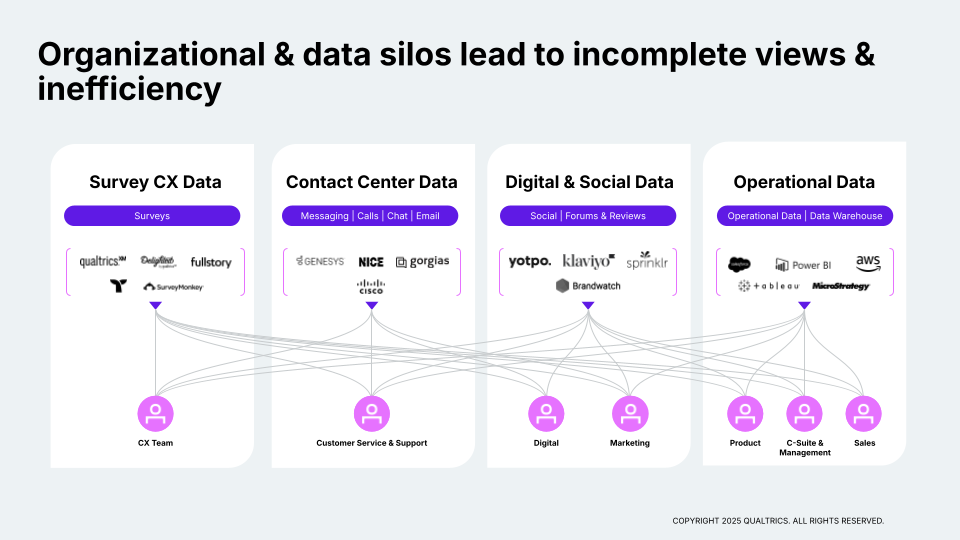
This is a major business problem, not just a data one. Unconnected systems create customer friction: repeating information, irrelevant offers, and frustrating dead ends. These broken expectations harm your brand, carry direct financial and operational costs, and negatively impact key metrics like NPS, CSAT, and customer lifetime value.
This guide offers CX leaders a practical framework to shift from a channel-centric to a holistic, customer-centric strategy.
In this guide, you will learn:
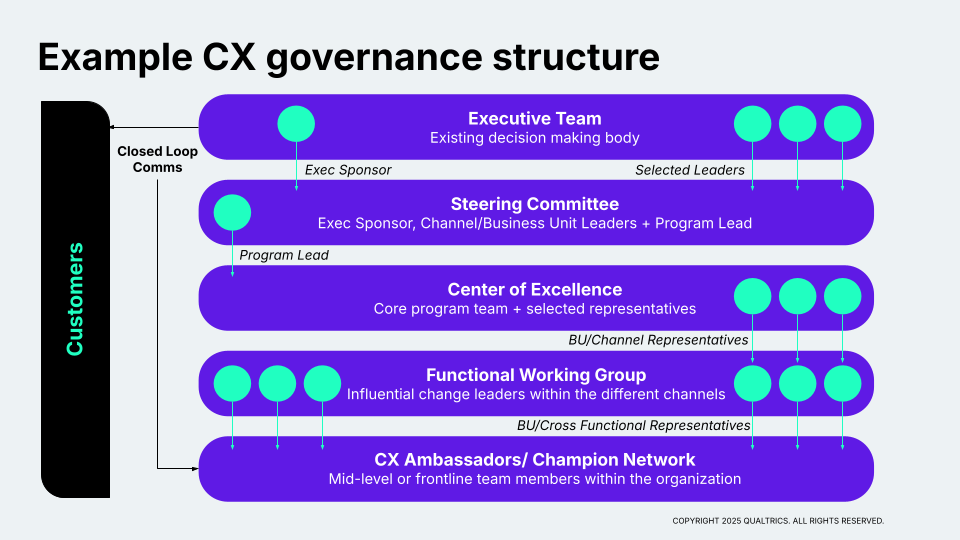
- How to establish a governance model: Build the organizational "engine" needed to maintain a unified customer view and structure governance roles and accountability for omnichannel listening.
- How to identify high-impact friction points: Conduct a structured audit to pinpoint exactly where customer experiences are breaking down and diagnose data silos
- How to prioritize your omnichannel roadmap: Apply a "Crawl-Walk-Run" framework to sequence omnichannel initiatives.
Building the structure for operational success
Creating an omnichannel customer view requires cross-silo collaboration and a framework that includes action and accountability.
Action 1: Form a CX center of excellence (CoE):
This is a small, centralized team (it could even start with one person) that acts as the engine for your program. While the right CoE model is a function of organizational size, how distributed the teams are, and the level of CX knowledge and expertise across these teams, all CoEs have similar primary responsibilities:
- Secure executive alignment: Partner with sponsors to define program goals and unlock necessary resources.
- Own the tech stack: Manage the central CX platform and ensure seamless data integrations.
- Deliver role-based insights: Build and maintain tailored dashboards that drive decision-making at every level.
- Drive program awareness: Lead the communication strategy for launches, updates, and critical alerts.
- Empower business users: Provide the training and best practices needed to turn data into action.
Action 2: Establish ways of working
Achieving an omnichannel experience demands organizational alignment, not just technology. These 'ways of working' offer the governance to turn insights into executive-led action, ensuring all stakeholders commit to one consistent customer vision.
- Create a CX steering committee: This is your executive sponsorship group, composed of cross-functional leaders.
- Set-up a regular meeting cadence: At minimum, meet quarterly to review program performance, key findings, and action plans.
- Have an action-focused agenda for every meeting: The CoE should present a concise summary of insights, focusing on 3-4 strategic issues. The bulk of the meeting should be a working session where the leaders commit to specific actions to address those issues.
- Ensure clear lines of accountability: Actions should be assigned an owner and a deadline, and progress should be tracked at the next meeting.
Assessing your current state: The friction audit
Before you can design the future of your customer experience, you must have a clear understanding of its present state. This phase is about discovery and diagnosis.
Action 1: Conduct strategic stakeholder interviews
Your first step is to gather organizational wide context by identifying and interviewing leaders and key practitioners from every department that influences customer experience. Cast the net wide, for example:
- Marketing: CMO, Digital Marketing Manager
- Sales: Head of Sales, Sales Ops Manager
- Service: Head of Contact Center, Digital Service Lead
- Product: Chief Product Officer, Product Managers
- IT/Data: CIO, Head of Data & Analytics
- Frontline: Head of Contact Center, Head of Branch Network, team leaders
Your goal should be to uncover their priorities, pain points, and existing data sources:
Use these findings to build a business case for an omnichannel program. By surfacing common themes and resolving cross-functional conflicts, you can:
- Secure executive buy-in for a single, cohesive strategy.
- Identify "Quick Wins" by prioritizing the most critical data sources.
- Design a multi-year roadmap for long-term omnichannel maturity.
Action 2: Perform a touchpoint inventory & data assessment
With stakeholder context, you can now map the landscape of your customer interactions.
Gather your "audit team". Assemble a cross-functional group of practitioners (not just leaders) who have hands-on knowledge of customer interactions across all the different channels.
Brainstorm all touchpoints. In a workshop setting, list every single place a customer can interact with your organization. Think chronologically through the customer lifecycle: awareness, consideration, purchase, service, and loyalty. Prompt the team with questions like:
- "How do customers first learn about us?"
- "What happens after they make a purchase?"
- "How do they get help when something goes wrong?"
- ”How would the customer describe the touchpoint or process differently to how it is known internally?”
- “How is the process the same or different by different channels?”
Categorize and detail. Organize the touchpoints and for each touchpoint, document:
- Channels: The channels of interaction available at that touchpoint
- Channel owner: The team responsible for servicing and maintaining the channel (e.g., Marketing, Support).
- Technology: The systems and platforms that power it (e.g., Qualtrics, CRM software, HR platforms, IT service management platforms, etc.).
- Customer data available: What customer information is captured or available (e.g. Customer ID, email, demographic information)
- Interaction data collected: What information is captured about the specific interaction (e.g., CSAT score, chat transcript, call recording, website clicks).
- Analysis and reporting: How is this data being analyzed?
- Data integration: Is it integrated with other systems?
- Data governance: What restrictions are placed on where the data is stored and ingested?
- Data connectivity: What common data points are available to connect the data to other data sources
Assess data availability. For each touchpoint and data source, assign a simple availability score (e.g., 1-3) based on how well it's currently used.
- Level 1 (Siloed): Data is collected but lives in its own system, used only by the immediate team. High level of effort to connect data points from different channels, because client identifiers vary by data source.
- Level 2 (Shared): Data is occasionally exported and shared with other teams in reports. Medium level of effort to connect data points form different channels but client identifiers exist depending on data source.
- Level 3 (Integrated): Data flows automatically into a central system and is combined with other sources for analysis. Low level of effort to connect data because the same client identifier is available in all data sources.
This audit will give you a visual map of your data silos and highlight the biggest opportunities for quick wins.
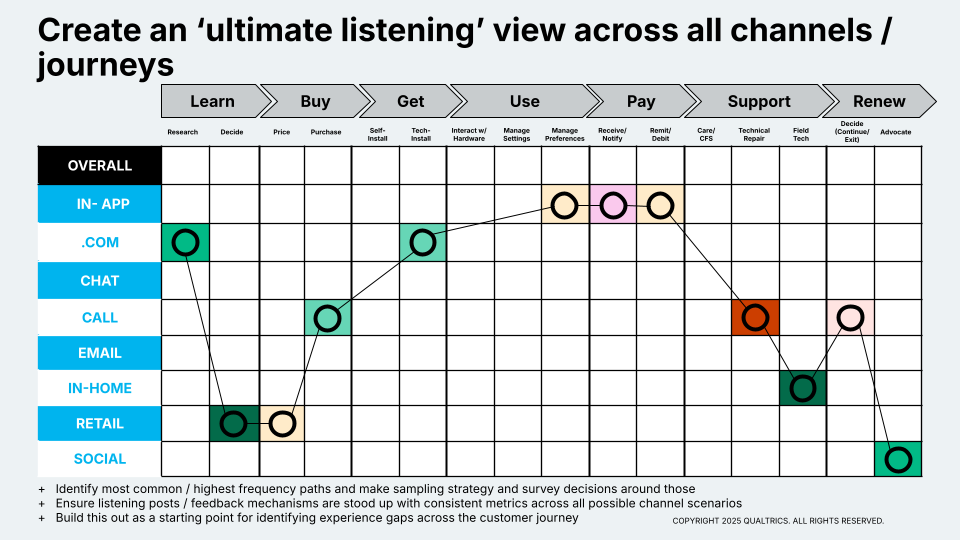
A “crawl-walk-run” framework for building an omnichannel listening
Conclusion: From fragmented data to focused action
Transitioning to an omnichannel listening program is more than a technical integration; it is a fundamental shift in how your organization understands and serves its customers. By establishing a robust governance structure and methodically auditing your experience gaps, you move beyond merely "collecting data" to building a strategic engine for growth.
While the journey from Crawl to Run requires patience and persistence, the payoff is a seamless customer experience that reduces operational friction, protects your key metrics, and provides a sustainable competitive advantage in an increasingly fragmented world.
Your immediate next step
Don't wait for "perfect" data to begin. Use the findings from your initial Friction Audit to identify one high-impact experience gap. Use this as your pilot project to demonstrate the power of integrated insights to your Steering Committee and secure the momentum needed for full-scale transformation.