


Reorganizations. Leadership turnover. Budget cuts. Government agencies at every level face disruption, and experience programs are rarely built to survive it. For leaders inside government agencies, that kind of disruption reaches everything. Who owns the customer experience program? Who approves decisions? Who even knows the program exists?
The pattern plays out in government the same way it does in private sector restructures, mergers, and leadership turnover. Experience Management programs built around a few key people collapse when those people leave. Governance is what keeps a program alive when everything else changes. It lets a program out-execute disruption by building the coalitions that protect the work no matter who comes and goes.
What is governance?
Governance is most useful when thought of as the answer to a simple question: when something needs to happen, does everyone know who does it?
In an Experience Management context, governance defines:
- Who owns what part of the program
- How decisions get made and by whom
- How insights get turned into action
- How leaders stay accountable for results
Without that structure, even a well-resourced customer experience program becomes fragile. Insights pile up. Action depends on individuals remembering to follow through. When those individuals leave or change roles, the program stalls.
Governance distributes that ownership across the organization so the program is more resilient than the org chart around it.
The governance structure that works
Building governance that lasts comes down to three things: the right model, the right strategy, and the right tools, each depending on the others. In practice, that means clear ownership of roles and decisions, work aligned to leadership priorities, and a clear path from insight to action.
The model starts with the right roles connected in the right way.
The Executive Sponsor champions the work at the leadership level, keeps Experience Management on the executive agenda, and builds support across peers.
The Experience Management Core Team sets strategy, manages the program day to day, and coordinates efforts across the organization. This is where subject matter experts, data analysts, project managers, and technical resources sit.
The Steering Committee provides senior-level guidance, aligns the work to business priorities, allocates resources, and holds teams accountable for progress.
The Working Group turns strategy into action. These are cross-functional leaders who partner with the core team to execute initiatives and drive change inside their own departments.
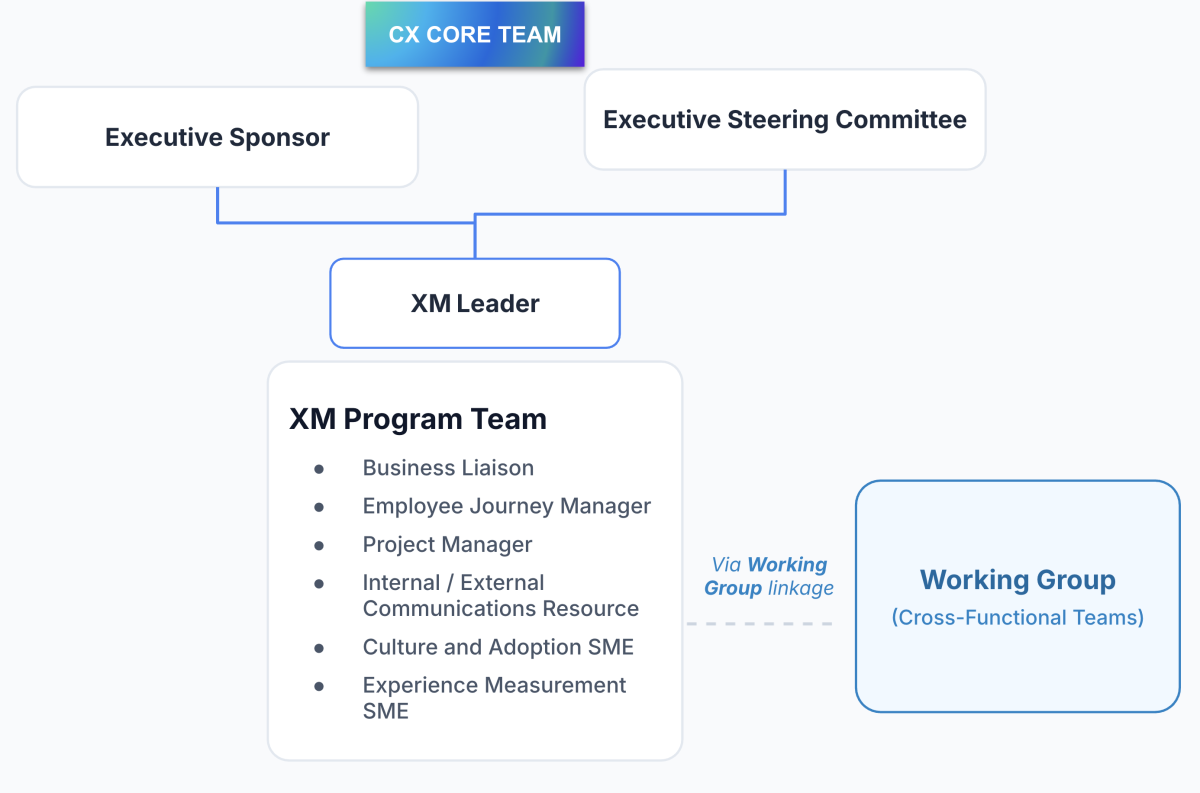
One government agency began with just four things: a dedicated XM lead, an executive sponsor, a cross-functional working group, and one high-stakes customer journey. That was enough. Decisions started moving. Accountability spread across teams. Customer issues had a clear path to resolution. And when the organization around them went through upheaval, the program kept running.
The governance strategy that wins buy-in
The right model only holds if the people in it are willing to act, and people can’t act when they’re paralyzed by fear. So get your stakeholders’ anxiety out on the table early. Map the people who can advance or block the work, name the specific fear each one is wrestling with, and design your governance approach to neutralize it. Neutralization is the most important piece, because in shaky environments, people can’t move forward if they’re worried an initiative appears too risky. You can neutralize these fears by mapping out where you can offer certainty about what an initiative means and how it will positively impact them, or honesty and transparency where certainty isn’t possible. If you can successfully neutralize the threat of change, you turn hesitant stakeholders into committed partners.
When tools meet governance
Data alone doesn't create accountability. A governance model has to connect insights, decisions, actions, and outcomes in a way that's automatically visible to the people responsible for each.
Qualtrics’ role-based dashboards are one practical way to do this. Each governance role sees the information they're responsible for acting on. Everyone works from the same data. Leaders can track whether the actions being taken are actually moving outcomes.
Automated workflows matter here too. When issues are detected automatically and routed to the right owner, the program stops depending on individuals remembering to act. Progress becomes visible. Accountability becomes real.
Where to start
Build governance before disruption forces the issue. That means starting with one leader, one sponsor, one working group, and one journey. Getting those four elements working together teaches you more about what governance requires in your organization than any framework will.
The goal is an experience program that belongs to the organization, survives leadership changes, outlasts budget cycles, and keeps delivering for the people it's meant to serve. A program built on governance becomes part of how the organization runs, no matter what changes around it.
The citizens and communities your agency serves are counting on consistent, quality experiences. That's reason enough to build something that lasts.