


There is a 75-point gap in Net Promoter Score between patients who report high trust in their hospital and those who report low trust.
For a single variable, a swing that size is almost unheard of, and it clearly demonstrates trust is one of the sharpest predictors of patient experience that exists.
Data from Qualtrics’ 2026 Healthcare Experience Trends Report shows three things drive trust above everything else:
- Feeling cared for as an individual
- Seeing staff work well together
- Having easy access to care
Each driver is measurable, actionable, and plays out very differently depending on who the patient is, what they're dealing with, and who they've been their whole lives.
Healthcare organizations building trust analyze their patient experience data by group, by care setting, and by what drives trust for each.
Building trust is not a one-size-fits-all approach
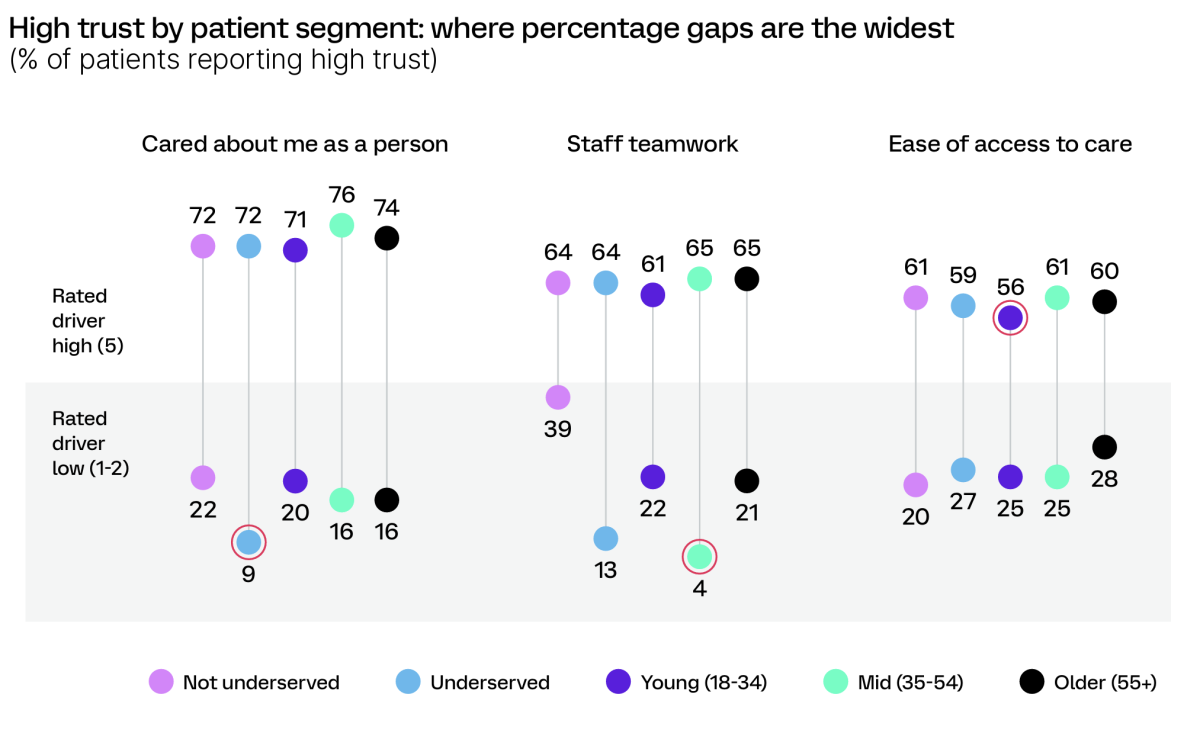
Start with what trust is worth. Low trust drops NPS by 46 points; high trust lifts it by 29. No other variable in the data moves loyalty as far. And trust is built: 74% of patients who felt genuinely cared for as a person reported high trust, compared to just 18% of those who didn't.
That gap widens considerably at the margins. Among underserved patients, high trust collapses to 9% when they don't feel cared for as individuals. Middle-aged patients who gave staff teamwork low marks saw high trust fall to 4%. Younger patients rated access more favorably overall, yet their trust still trailed older groups - a sign that easy access reads as table stakes for that cohort, not a differentiator.
The same investment lands differently depending on who's receiving it. Teamwork drives trust strongly for middle-aged patients and less so for younger ones. Feeling personally cared for matters across every demographic, but its absence is most damaging for patients already furthest from the center of the system.
This creates a compounding problem. A patient experience designed around an average patient will miss the populations whose trust is hardest to earn, and those populations are the least likely to appear in standard survey data. Underserved patients complete surveys at lower rates, which means most experience data is structurally skewed toward patients who already feel comfortable. The data gap and the trust gap point at the same people.
It's really about understanding what matters most to people. We need this understanding when designing patient experiences, because their values will be reflected there.
Denise Venditti, DNP, RN, FACHE, CPXP, Chief Nursing Officer, Qualtrics
Trust has layers. It's not only about whether I trust my hospital — it's also about whether I trust my doctor and my care team. When segmenting your data, focus on understanding what builds or breaks trust within each population. That's where the real leverage is.
Dr. Adrienne Boissy, Chief Medical Officer, Qualtrics
How to build trust in patient experience
Get curious about who answered
Look at the volume of patients you treat and their demographics, then take inventory of who returns surveys and through which channels. The gaps will tell you something your aggregate scores can't. The patients least likely to report high trust are also the least likely to complete a standard survey, which means most listening strategies are structurally skewed toward the patients who are already comfortable with the system. That inventory may reveal that certain groups need a different mode of outreach entirely: in-person feedback, alternative formats, community-based listening. The information you're missing is often the most important information you have.
Design the experience each patient segment actually wants
Trust among underserved patients collapses when they don't feel cared for as individuals. Middle-aged patients react sharply to poor staff teamwork. Younger patients want ease of access, and when they don't get it, trust drops even if everything else goes well. A single experience applied universally will serve some patients well and leave real gaps for others. The organizations building trust most effectively are moving toward personalization at the individual level: demonstrating that they remember and respect patients' preferences, values, and needs.
Obsess over consistency
Trust earned in the clinical encounter doesn't survive a cold bill or an impersonal follow-up. Every touchpoint - the patient portal, the call center, the post-visit message - either reinforces what was built in the room or quietly undermines it. Develop consistent standards not just for what you say, but how you say it. "Your bill is overdue and you need to pay it" makes patients feel something very different than "We know life happens. We want to help get this paid." Same information. Different relationships. Consistency across touchpoints builds trust that compounds over time and shows up in whether patients come back.
Methodology
Data comes from the 2026 Healthcare Experience Trends Report by Qualtrics, based on 60,463 patients aged 18 and over who received care in the US in the 30 days prior to responding, surveyed in November and December 2025.
Qualtrics helps healthcare organizations understand and act on patient and employee experience data to improve care quality, safety, and outcomes.