While artificial intelligence frequently makes headlines for its short-term efficiency gains, its true value lies in how it restructures everyday work.
From the clinic to the factory floor, AI is actively reshaping the bedrock of global industries. Understanding these shifts is crucial for business leaders looking to close the experience gap and maintain customer and employee loyalty in a rapidly changing environment.
To visualize this impact, the team at Qualtrics analyzed current AI trends to learn exactly where these technologies are making a measurable difference in human workflows.
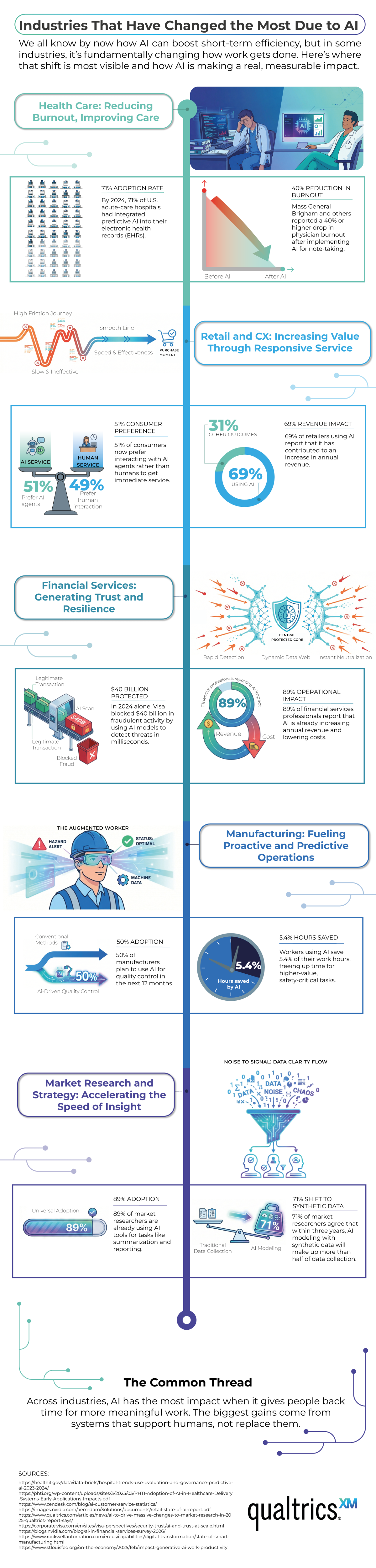
The real impact of AI business transformation
When looking closely at AI statistics across multiple sectors, the narrative shifts away from theoretical disruption toward concrete operational improvements. Across multiple verticals, organizations are using AI to reduce friction, eliminate administrative burden, and secure critical infrastructure.
Here’s a quick look at some of the data driving this cross-industry evolution:
| Industry | Primary Pain Point | Measurable AI Impact |
| Health Care | Administrative overload and physician burnout | 40% reduction in physician burnout |
| Retail and CX | Checkout friction and delayed support | 69% of AI-using retailers report revenue growth |
| Financial Services | Rising digital transaction risks | $40 billion worth of fraudulent activity blocked |
| Manufacturing | Equipment failures and safety risks | 5.4% of work hours saved for safety-critical tasks |
| Market Research | Slow traditional research cycles | 89% of researchers are using AI for summarization/reporting |
Healthcare: reducing burnout, improving care
Physicians currently spend a growing share of their day on documentation instead of patient care, driving industry burnout to critical levels. AI scribes and predictive tools directly address this by reducing the administrative load, giving clinicians their time back to focus on patients.
- 71% Adoption Rate: By 2024, 71% of U.S. acute-care hospitals had integrated predictive AI into their electronic health records (EHRs).
- 40% Reduction in Burnout: Organizations like Mass General Brigham reported a 40% or higher drop in physician burnout after implementing AI for clinical note-taking.
Retail and CX: Increasing Value Through Responsive Service
Modern customers expect speed and efficiency, so friction at checkout and delayed support consistently lead to cart abandonment and lost loyalty. AI adoption in retail is reducing wait times and streamlining the path to purchase, which drives measurable revenue growth.
- 51% Consumer Preference: Currently, 51% of consumers prefer interacting with AI agents rather than with humans for immediate service.
- 69% Revenue Impact: 69% of retailers using AI report that the technology has contributed to an increase in their annual revenue.
Financial services: generating trust and resilience
As the volume of digital transactions increases, so does institutional anxiety and exposure to fraud risks. AI tackles this by monitoring transaction patterns in real time, detecting anomalies fast enough to stop threats before any money actually moves.
- $40 Billion Protected: In 2024 alone, Visa blocked $40 billion in fraudulent activity by relying on AI models to detect threats in milliseconds.
- 89% Operational Impact: 89% of financial services professionals report that AI is already increasing annual revenue while simultaneously lowering costs.
Manufacturing: fueling proactive and predictive operations
In industrial settings, equipment failures and manual monitoring create severe safety risks and operational strain. AI alters this dynamic by anticipating breakdowns before they occur, protecting front-line workers and ensuring continuous facility uptime.
- 50% Adoption: Half of all surveyed manufacturers plan to use AI specifically for quality control in the next 12 months.
- 5.4% Hours Saved: Workers using AI save 5.4% of their work hours, freeing up essential time for higher-value, safety-critical tasks.
Market research and strategy: accelerating the speed of insight
Traditional research cycles are frequently too slow to keep pace with modern market fluctuations. AI allows researchers to test concepts instantly using synthetic data, freeing them from tedious processing so they can focus entirely on strategy.
- 89% Adoption: 89% of market researchers are already using AI tools for tasks like summarization and reporting.
- 71% Shift to Synthetic Data: 71% of market researchers agree that within three years, AI modeling with synthetic data will account for more than half of all data collection.
The common thread: supporting the human element
Across every industry analyzed, AI delivers the most significant impact when it gives people back time for more meaningful work. The biggest organizational gains come from systems designed to support humans, rather than replace them.
Navigating the human impact of AI integration requires a clear understanding of your market and your workforce. Learn how to manage this transition and close the experience gap with Qualtrics Employee Experience and Customer Experience solutions, built to help you measure, analyze, and act on the feedback that matters most.
Sources:
- https://healthit.gov/data/data-briefs/hospital-trends-use-evaluation-and-governance-predictive-ai-2023-2024/
- https://phti.org/wp-content/uploads/sites/3/2025/03/PHTI-Adoption-of-AI-in-Healthcare-Delivery-Systems-Early-Applications-Impacts.pdf
- https://www.zendesk.com/blog/ai-customer-service-statistics/#
- https://images.nvidia.com/aem-dam/Solutions/documents/retail-state-of-ai-report.pdf
- https://corporate.visa.com/en/sites/visa-perspectives/security-trust/ai-and-trust-at-scale.html
- https://blogs.nvidia.com/blog/ai-in-financial-services-survey-2026/
- https://www.rockwellautomation.com/en-us/capabilities/digital-transformation/state-of-smart-manufacturing.html
- https://www.stlouisfed.org/on-the-economy/2025/feb/impact-generative-ai-work-productivity