AI is popping up in more and more places, including our work. For some, it’s implemented inconspicuously in the background of their usual workplace tools, while for others, it’s used more directly to speed up tedious tasks like scheduling. Even so, not everyone is on the same page about whether this new technology belongs in the office.
Conversations about automation have been around since the industrial revolution, but the speed and scope with which AI has been integrated into the workplace has made this topic seem more contentious than ever before. As it turns out, opinions on this matter are also different depending on where you are in the world. Amid all these opinions, Qualtrics decided to look into which countries see AI in the workplace optimistically and which are more skeptical.
Can AI improve work life?
Artificial intelligence is a broad term that covers an enormous range of tools, from predictive text in your email to the complex machine learning models used by Fortune 500 companies to screen job applicants. For example, healthcare providers have recently begun using AI to sift through vast medical data to provide patients with faster, more accurate medical support. On the other end of the spectrum, some companies are experimenting with supplementing their customer service teams.
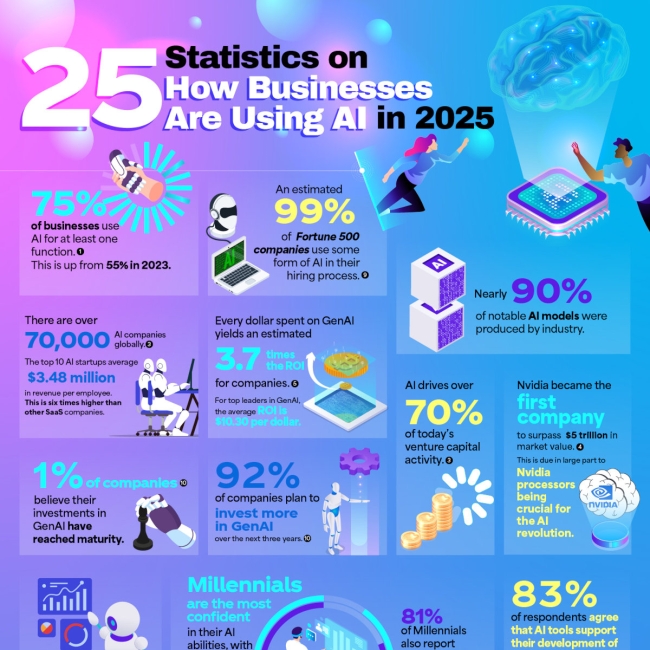
These decisions to implement AI aren’t being made solely because of hype. According to research, using AI in the workplace can improve performance by over 65%, with lower-skilled workers seeing the greatest benefit. No matter the application, the common link between these uses is that AI helps people complete complex or tedious tasks faster and more accurately. In fact, it seems that, regardless of industry, the decision-makers are all-in on AI. Nearly 80% of global companies report using AI in their businesses in some capacity.
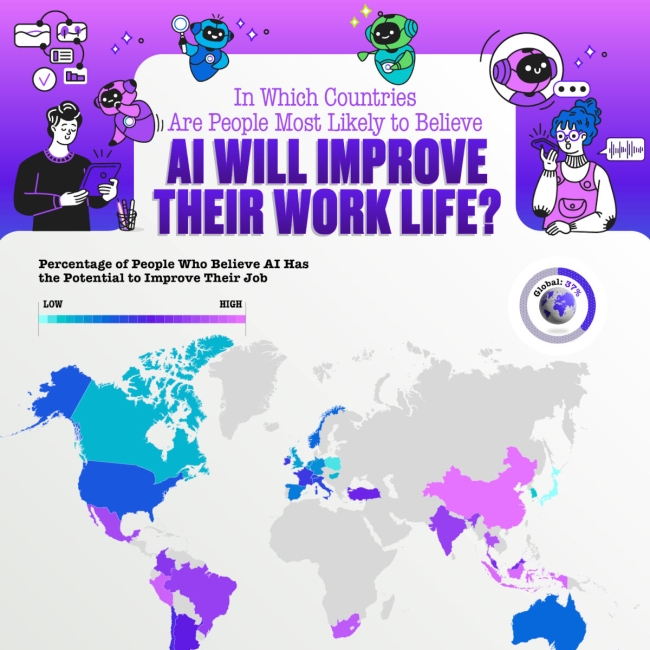
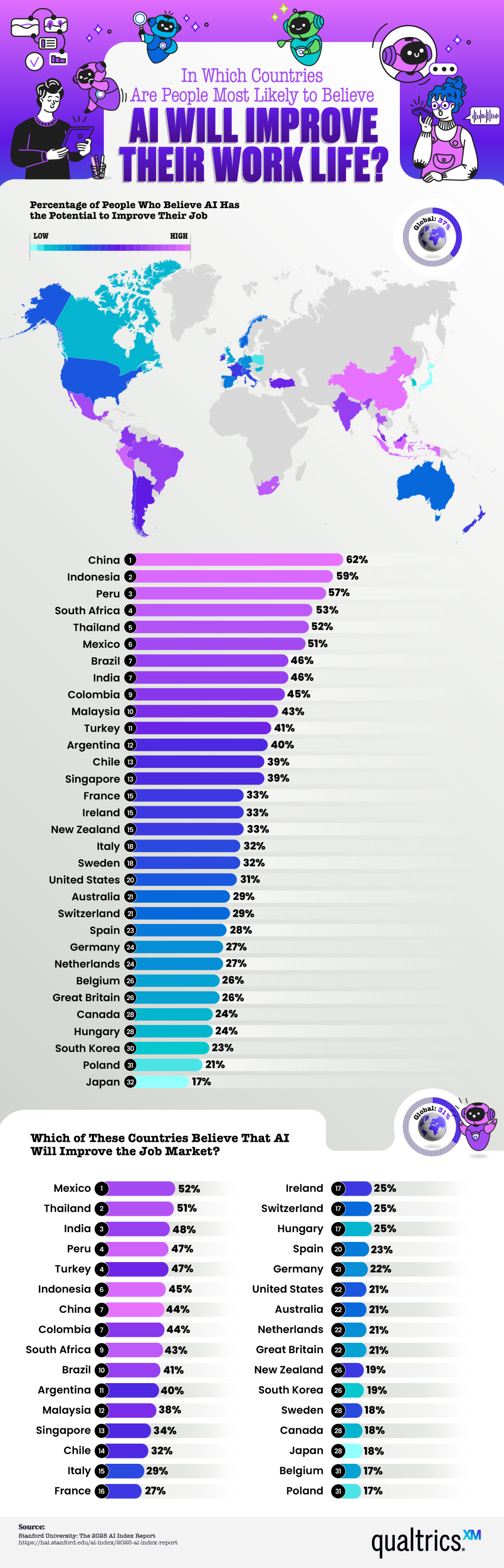
That said, while the case for AI is clear to business owners, sentiment about whether artificial intelligence improves jobs is less consistent among actual employees, especially across countries. In China, Indonesia, Peru, South Africa, and Thailand, there seems to be general optimism for AI, as more than half of respondents say AI could actively improve their jobs. In countries such as Mexico, Brazil, Malaysia, Singapore, and India, optimism also remains relatively high, with support ranging from the mid-thirties to the mid-forties.
In contrast, many respondents from English-speaking countries, including the United States, Australia, Canada, Great Britain, New Zealand, and Ireland, show lower levels of enthusiasm, with scores ranging from 19% to 33%.
Why some countries have more positive opinions of AI in the workplace
Considering broader social and political factors, it’s no surprise that regional attitudes surrounding AI vary so much. For example, countries such as China invest heavily in AI technology and infrastructure, thereby increasing the average person’s exposure to AI across industries. Because workers in these places are more likely to encounter AI in practical forms and even see its benefits firsthand, it makes sense that they’d be more inclined to see how AI could be a boon to them in their careers.
Additionally, as is particularly the case in Southeast Asia and many parts of South America, developing nations may see jobs under AI positively because they believe the tech can help them bridge skill gaps and thereby increase wages and standards of living. In fact, it is these same countries that are the most likely to believe AI will improve the job market, such as Mexico, Thailand, and India, at 52%, 51%, and 48% respectively.
Meanwhile, many English-speaking nations face a different dynamic. In Europe, the U.S., Canada, and Australia, many media outlets have been publishing headlines about automation or expected job loss caused by AI. Although these scenarios rarely match the steady, incremental changes being adopted so far, they’ve heavily influenced people’s perception of AI as a tool for workers. As a result, many of these countries show lower optimism, even when the AI landscape doesn’t differ much from those of the more enthusiastic countries. These same countries all demonstrate relative pessimism about the effect AI will have on the job market, with the U.S. ranking just 21% of people who believe it is a good thing.
What are the effects of AI on the job market?
The effects of AI on jobs continue to spark some debate among economists, business leaders, and employees. That said, research has shown that AI tends to shift the mix of tasks within roles rather than lead to large-scale job losses. Workers may need new skills, and some positions may change, yet many industries actually create more job opportunities than they lose as they adopt digital tools.
The global conversation about AI’s impact on jobs will remain varied and volatile as the technology continues to evolve and take new footholds in our workplaces. Some see AI as just another tool that can improve workflows, while others approach the topic with caution due to its potential repercussions for the broader economy. Regardless of which direction a person falls, it’s valuable for employers to know where their employees stand.
Businesses that want to make thoughtful decisions need clear, timely, and reliable insights from those who keep operations running. That’s where Qualtrics can help. If you’re ready to understand how workers feel about technological advances on the job or want help analyzing employee experience data across your organization, we have the tools you need. Reach out today to learn more about how our AI-powered insights can guide your next move.
Percentage of workers in a country who believe AI will improve work
| Country | Percentage of People Who Believe AI Has the Potential to Improve Their Job | |
| 1 | China | 62% |
| 2 | Indonesia | 59% |
| 3 | Peru | 57% |
| 4 | South Africa | 53% |
| 5 | Thailand | 52% |
| 6 | Mexico | 51% |
| 7 | Brazil | 46% |
| 8 | India | 46% |
| 9 | Colombia | 45% |
| 10 | Malaysia | 43% |
| 11 | Turkey | 41% |
| 12 | Argentina | 40% |
| 13 | Chile | 39% |
| 14 | Singapore | 39% |
| 15 | France | 33% |
| 16 | Ireland | 33% |
| 17 | New Zealand | 33% |
| 18 | Italy | 32% |
| 19 | Sweden | 32% |
| 20 | United States | 31% |
| 21 | Australia | 29% |
| 22 | Switzerland | 29% |
| 23 | Spain | 28% |
| 24 | Germany | 27% |
| 25 | Netherlands | 27% |
| 26 | Belgium | 26% |
| 27 | Great Britain | 26% |
| 28 | Canada | 24% |
| 29 | Hungary | 24% |
| 30 | South Korea | 23% |
| 31 | Poland | 21% |
| 32 | Japan | 17% |
| Global | 37% |
Which of these countries believe that AI will improve the job market?
| Country | Percentage of People Who Believe AI Has the Potential to Improve the Job Market | |
| 1 | Mexico | 52% |
| 2 | Thailand | 51% |
| 3 | India | 48% |
| 4 | Peru | 47% |
| 5 | Turkey | 47% |
| 6 | Indonesia | 45% |
| 7 | China | 44% |
| 8 | Colombia | 44% |
| 9 | South Africa | 43% |
| 10 | Brazil | 41% |
| 11 | Argentina | 40% |
| 12 | Malaysia | 38% |
| 13 | Singapore | 34% |
| 14 | Chile | 32% |
| 15 | Italy | 29% |
| 16 | France | 27% |
| 17 | Ireland | 25% |
| 18 | Switzerland | 25% |
| 19 | Hungary | 25% |
| 20 | Spain | 23% |
| 21 | Germany | 22% |
| 22 | United States | 21% |
| 23 | Australia | 21% |
| 24 | Netherlands | 21% |
| 25 | Great Britain | 21% |
| 26 | New Zealand | 19% |
| 27 | South Korea | 19% |
| 28 | Sweden | 18% |
| 29 | Canada | 18% |
| 30 | Japan | 18% |
| 31 | Belgium | 17% |
| 32 | Poland | 17% |
| Global | 31% |
Source:
Stanford University: The 2025 AI Index Report https://hai.stanford.edu/ai-index/2025-ai-index-report