

SMS Onboarding
What's on this page
About the SMS Onboarding Process
This support page is a guide to the SMS (text message) onboarding process at Qualtrics. Here we cover commonly asked questions and examples of high quality submissions. Once your submission is ready, the Account Services team handles SMS onboarding.
Once your submission has been prepared according to these guidelines, reach out to the Account Services team.
Typical Submission Timelines
Attention: The timelines shown on this support page are subject to change, and are estimates serving as a guide, not strict SLAs. Neither Qualtrics nor Twilio is accountable for these timelines.

- First time submission: 1-2 weeks.
Qtip: Likelihood of a first-time approval increases the more you closely follow the opt-in instructions and provide all the correct information in your initial submission.

- Resubmission, or subsequent approval: Following a rejection from Twilio, the faster you can make the correction to your submitted information, the faster the likelihood of a possible approval.
Qtip: Make sure nothing is missing from your submission and everything follows the guidelines outlined on this support page and in Twilio’s support pages.
The Importance of Opt-in Requirements
It’s required that you ask for people’s consent before you opt them into an SMS communication. When onboarding, we ask that you provide examples of the exact opt-in communications you plan to use. Our SMS partner, Twilio, sets this requirement.
Twilio’s requirements for opt-in collection are based on both industry best practices and legal/regulatory obligations. These standards are designed to protect end users from unwanted or unsolicited messages and to ensure compliance with regulations such as the Telephone Consumer Protection Act (TCPA) in the United States, as well as carrier and industry guidelines globally.
By following Twilio’s initial requirements, your SMS distributions will likely perform better. For example:
- Get improved engagement and response rates from customers.
- Decrease the chances messages are reported as spam messages to carriers, thus decreasing the number of opt-outs and blocks.
General Guidelines for SMS Opt-In Methods
There are currently 5 valid ways you can ask participants for SMS opt-in consent:
- Verbal
- Web Form
- Paper Form
- Via Text
- Mobile QR Code
When you send your examples to your Account Services representative, follow these guidelines:
- No Mockups: Provide the actual form or image that the recipient will complete. Screenshots or images from survey tools like Qualtrics survey builder (builder, not actual survey) are not acceptable.
- Disclosures: Consent must communicate important information such as message frequency, applicable rates, instructions for unsubscribing, how to get help or more information.
- Branded: Consent must clearly specify the exact company name that will send the notifications. Avoid placeholders or generic terms like “[Company name]”.
- Explicit: Consent must be explicit and standalone. It cannot be hidden within or linked to other documents like Privacy Policies or Terms of Service.
- Voluntary: Consent must be provided with a clear question allowing customers to actively opt in to receive SMS notifications. Include an unchecked checkbox that should not be preselected or set as the default.
- SMS-Specific: Consent must be specific to SMS notifications. Combining email and SMS opt-in in a single consent may result in rejection.
- Phone Number: Consent method must explicitly ask for the recipient’s phone number.
Verbal Opt-In Examples
An actual script or transcript of a conversation between your company and the potential recipient must be provided.
Correct example
The following opt-in example would be accepted because, in addition to following all guidelines regarding informed consent, it is an exact script of the consent question used.
Your organization’s representative: As part of our service, we can send you automated monthly text alerts regarding Tread account payment activity. We will send you two messages per month. Messages and data rates may apply, depending on your mobile phone service plan. At any time, you can get more help by replying HELP to these texts, or you can opt out completely by replying STOP. Mobile Terms of Service are available at https://tread.com/terms and our Privacy Statement can be found at https://tread.com/privacy/. Please reply with “yes” or “no” to indicate if you would like this service.
Customer: Yes, please.
Your organization’s representative: Great! We will send you a text message to confirm your enrollment here shortly.

Incorrect example
The following opt-in example would be rejected because it merely describes the consent collection process, and does not include the exact script.
“Customers can agree to receive SMS messages from this number when they open an account or buy a product from us. Accounts may be opened online, over the phone, or in person at a branch. In all cases a new client is informed about potential messages verbally. In case of online registration, this happens during a follow-up call from one of our employees. No message is sent without gathering consent from the customer and the proper opt-out clause is always a part of the message.”
Web Form Opt-In Examples
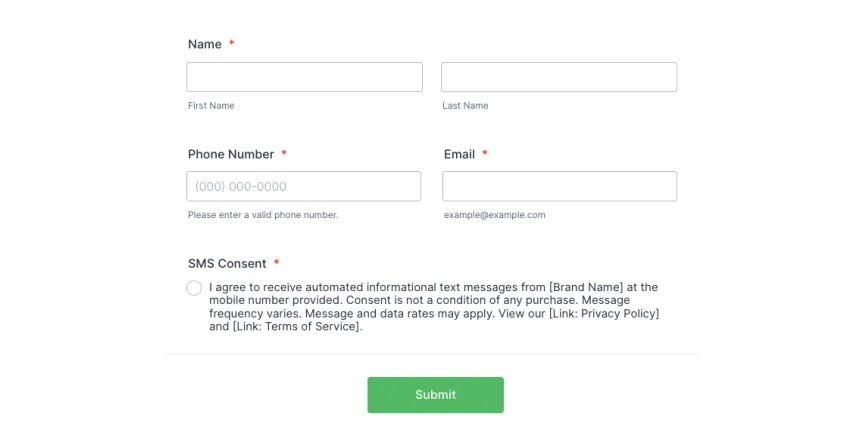
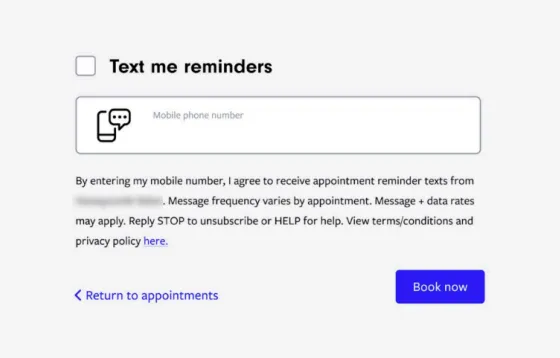
If your opt-in is a web form, you can send your Account Services representative an image or screenshot. The web form must include visible branding in several areas, a clearly unchecked checkbox for SMS notifications, a phone number field, and relevant disclosures.
Correct examples
Incorrect Examples
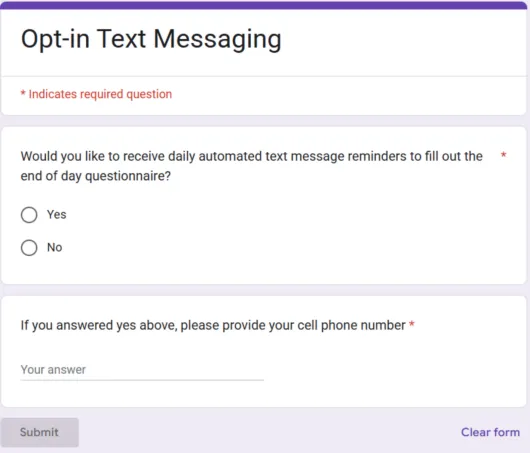
The example below would be rejected due to insufficient branding information. It fails to answer the question, “Who will be sending me SMS messages?”, thus making it non-compliant with current regulations. Additionally, required SMS disclosures are missing.
Although the example below includes branding, it is not an image of an actual web form, but presumably the text that would go inside it. Additionally, required SMS disclosures are missing.
“Thank you for joining the Treadmade team! At Tread, we use SMS messages to keep staff up-to-date on virtual alerts and send out our annual engagement surveys. We ask that you give us your phone number. If you wish to opt into these text messages, please provide your number below.
_____________
If you wish to opt out of text messages in the future, you can reply STOP to a message, or reach out to the Human Resources team via Microsoft Teams to opt out of all text messages.”
Paper Form Opt-In Example
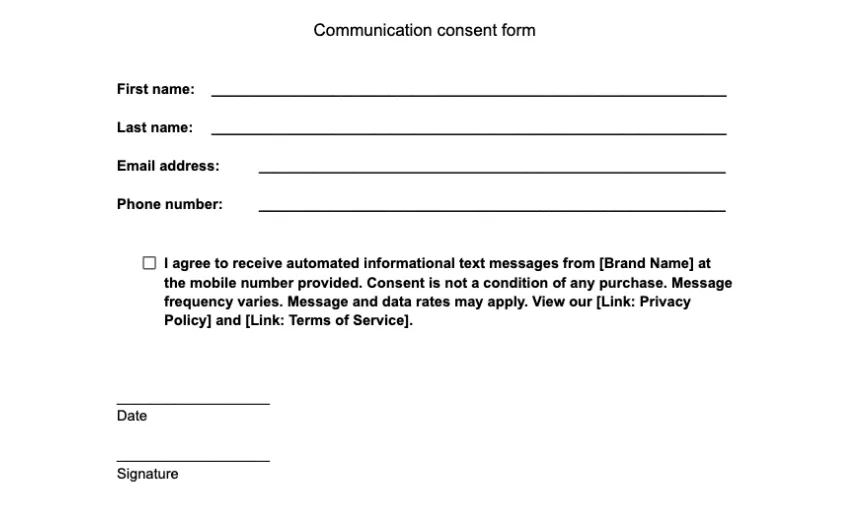
Correct Example
A viable document includes visible branding in several areas, a clearly unchecked checkbox for SMS notifications, a phone number field, and relevant disclosures.
Via Opt-In Text Examples
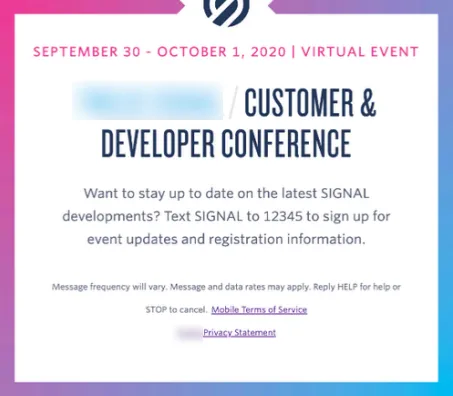
A common misconception is that an opt-in text refers to the first SMS you send to a recipient, such as a message asking, “Reply YES to continue receiving messages.” However, sending any message to the recipient requires existing consent or an established opt-in process.
The proper opt-in text method requires the potential recipient to initiate contact by messaging your company first. For example, an advertisement might instruct recipients to text a specific phone number to subscribe to SMS notifications.
Qtip: For more, see Twilio’s documentation on Opt-in and Opt-out text messages.
Correct Example
Incorrect Example
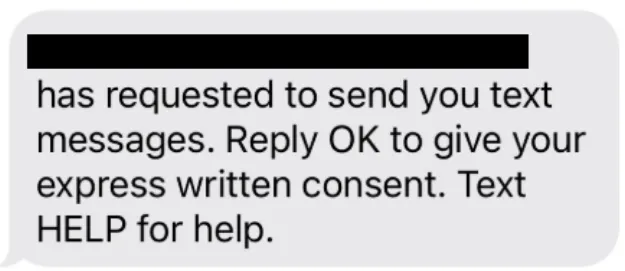
This example would be rejected due to it being an SMS message. It also lacks required SMS disclosures.
Mobile QR Code Opt-In Examples
This opt-in method starts with a QR code®, which takes the recipient to a web form or opt-in text. Thus, the QR Code itself should not automatically opt the recipient in without sending the recipient through an explicit consent process that meets Twilio guidelines.
For examples of eligible QR Code landing pages, see:
Additional Twilio Resources
If you have more questions about SMS guidelines, here are a few recommendations from Twilio’s documentation.
- Consent/Opt-In in Twilio's Messaging Policy
- Why was my Toll Free Verification Rejected?
- Required information for Toll-free verification
- Toll-Free best practices
- SMS compliance in the US
See also CTIA guidelines.
QR Code is a registered trademark of DENSO WAVE INCORPORATED.
That's great! Thank you for your feedback!
Thank you for your feedback!