

Local Listings
What's on this page
About Local Listings
Your customer’s first encounter with your brand often comes down to a specific location. When information is accurate, a customer can confidently choose a location and take the next step. When it is wrong or inconsistent, your customer may abandon the interaction, contact the wrong location, arrive at the wrong time, or choose a competitor. Furthermore, location information maintenance can become difficult as your business grows, with locations using many different systems with information that could conflict.
Our Local Listings product helps you manage the information customers find about each of your locations across search engines, maps, directories, social platforms, and other digital discovery channels. Instead of maintaining location information independently on separate publishers, you can use Local Listings as a governed source of truth for core location data and distribute approved information across supported platforms.
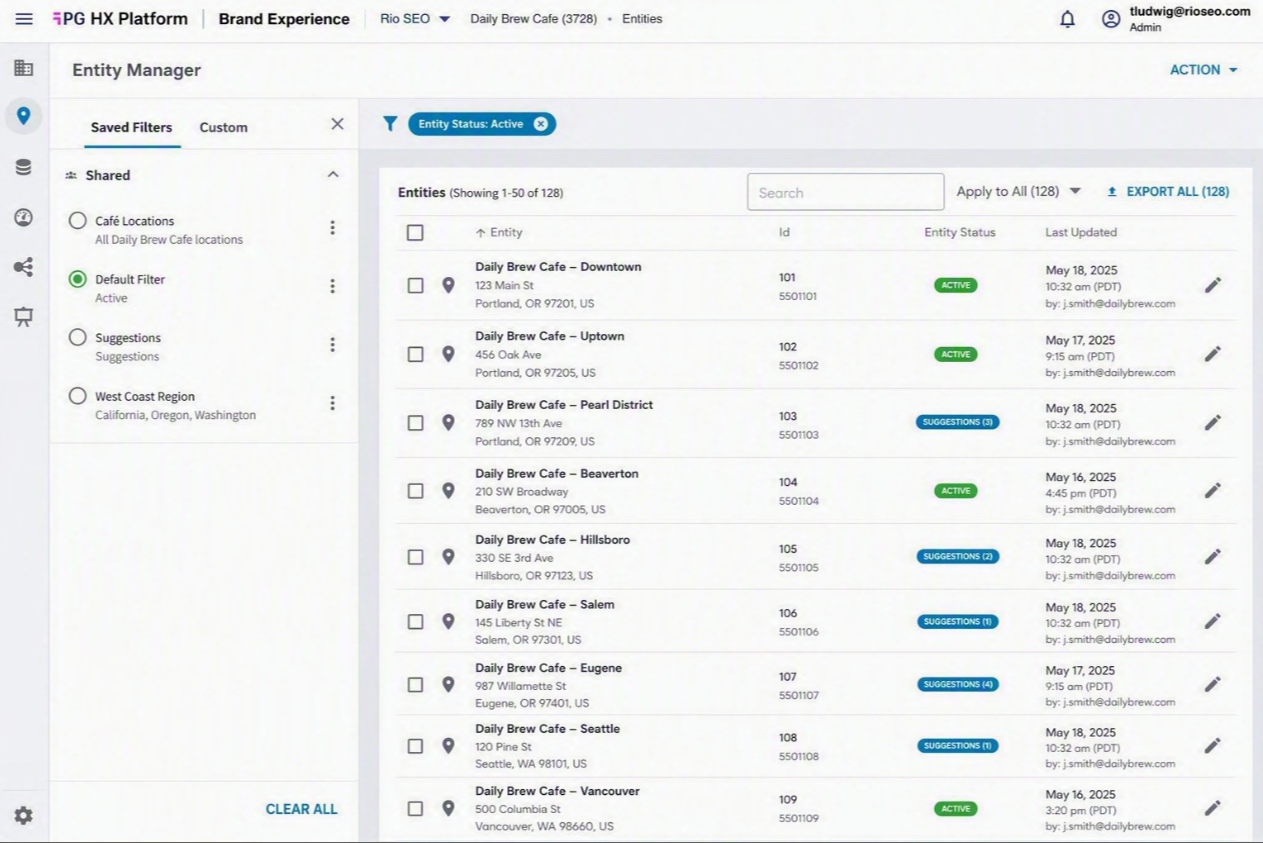
Capabilities of Local Listings
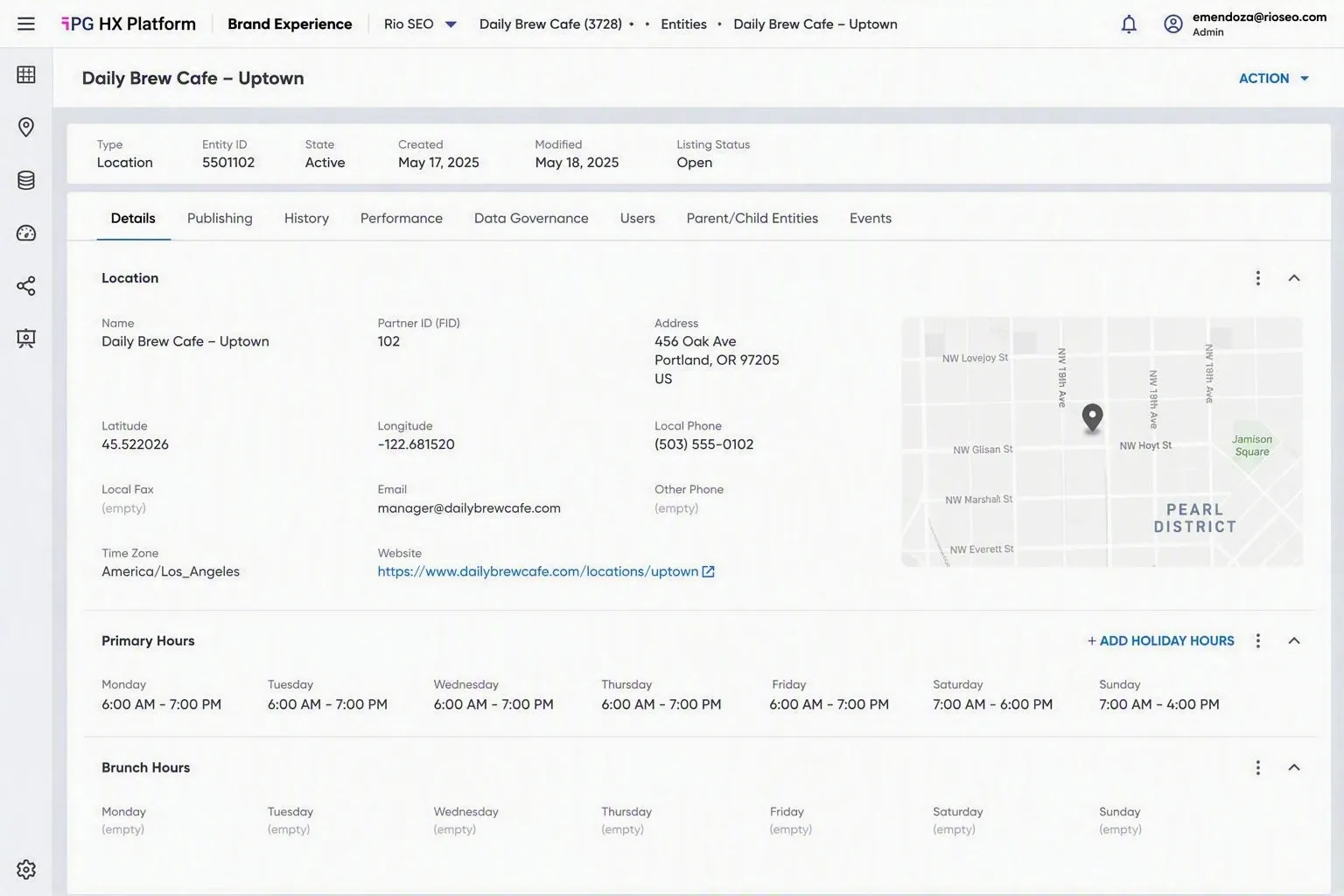
- Establish a single source of truth: Manage approved location attributes, categories, services, operational details, and location-specific information from a centralized environment.
- Distribute data to supported publishers: Publish and maintain business information across major search, map, social, directory, and discovery platforms through direct integrations and supported distribution networks.
- Keep location information current: Update regular hours, holiday hours, contact details, services, attributes, and other fields as business operations change.
- Manage location openings, closures, and changes: Support the full location lifecycle, including new openings, relocations, temporary changes, permanent closures, acquisitions, rebrands, and location portfolio restructuring.
- Identify and resolve duplicate or conflicting listings: Surface duplicate profiles, ownership conflicts, and inconsistent business information that can create customer confusion or weaken data integrity.
- Govern enterprise execution: Apply centralized standards while supporting location-level differences, organizational hierarchy, permissions, workflows, and operating models.
- Monitor listing and publisher status: Review where information is published, identify data conflicts or gaps, and understand where action may be needed.
- Support local search and AI discovery readiness: Maintain structured, consistent, machine-readable location data that can be understood by search, map, and AI-powered discovery ecosystems.
- Measure performance: Use reporting to understand local search visibility, customer engagement, listing interactions, and performance across locations, regions, brands, or business units.
- Reduce manual work: Replace repetitive publisher-by-publisher maintenance with a governed process designed for large location networks.
Information Local Listings Can Manage
- Business and location name
- Address and geographic coordinates
- Primary and alternate phone numbers
- Website and appointment URLs
- Regular operating hours
- Holiday, seasonal, and special hours
- Business categories and subcategories
- Products, services, and location attributes
- Amenities and accessibility information where supported
- Images and publisher-supported media or content
- Location status, opening, closing, and temporary closure information
- Other publisher-specific fields supported by the connected ecosystem
Where Local Listings Information Can Appear
Local Listings distributes and manages location information across a broad digital ecosystem. Availability and functionality can vary by geography, subscription, publisher requirements, and the fields each publisher supports.
Source | Examples | Importance |
|---|---|---|
Search & maps | Google, Apple Maps, Bing | High-intent discovery, directions, calls, hours, services, and location selection. |
Social & local discovery | Facebook and supported local discovery platforms | Customers may discover or validate a location outside a traditional search engine. |
Directories & data networks | Yelp and supported directories / aggregators | Extends location data across a broader ecosystem of applications and consumer touchpoints. |
Voice & AI-powered discovery | Search assistants and AI answer experiences that rely on trusted sources | Consistent structured location signals help machines resolve which business, location, hours, and attributes are authoritative. |
Owned digital experiences | Brand websites and local pages when integrated with the organization’s location data strategy | Keeps owned location experiences aligned with the same authoritative business data. |
Qtip: Local Listings helps organizations control and distribute accurate location information. It does not guarantee a particular search ranking, map placement, AI answer, or publisher display. Individual platforms determine how they rank, display, and interpret business information.

Direct Integrations and Enterprise Distribution
LX supports integrations with major discovery platforms such as Google, Apple, Bing, Facebook, and Yelp, alongside supported directory and data-distribution ecosystems. Rather than just maximizing the number of endpoints, the primary focus is keeping authoritative location data structured, monitored, and governed as it moves across them.
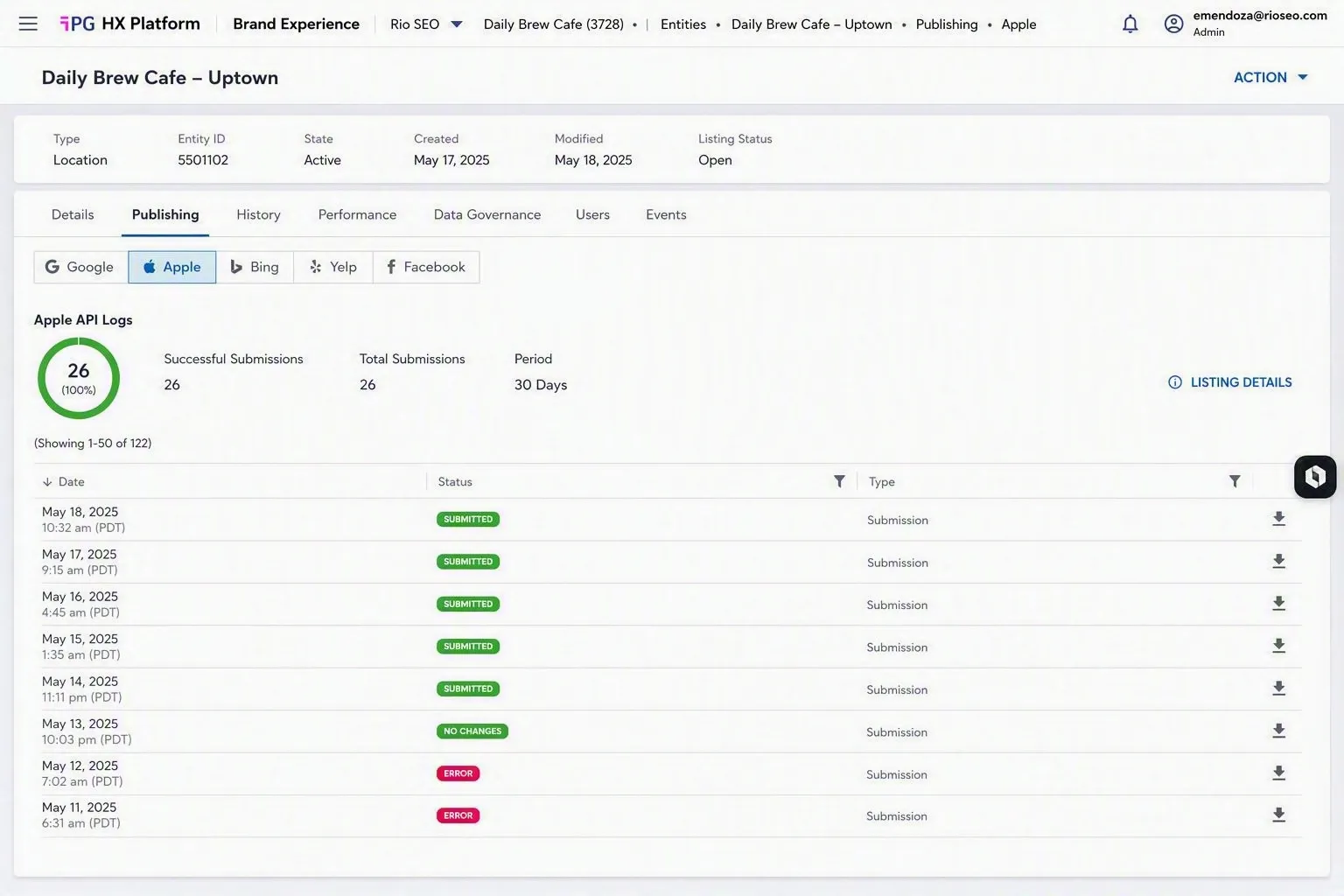
Managing a Large Location Network
A large location network requires more than a way to edit a business profile. Enterprise organizations need a consistent operating model for data ownership, publishing, governance, access, and exceptions. Here are some best practices you can employ with Local Listings to manage a large location network at scale.
- Organizational Efficiency: Locations can be organized in ways that reflect the business, such as brand, geography, market, business unit, region, division, franchise structure, ownership type, or location type. This helps teams analyze and manage the network at the level that matches their responsibilities.
- Governance and Control: This includes:
- Centralized standards for core business information and brand requirements.
- Location-level flexibility where individual hours, services, attributes, or operating details legitimately differ.
- Role-based access and permissions to support corporate, regional, local, and specialist teams.
- Workflows that help reduce uncontrolled or inconsistent changes.
- Auditability and visibility into data health, status, and execution.
- Managed resolution paths for duplicates, ownership conflicts, and publisher-specific issues.
- A Governed Data Lifecycle: Here are some steps to establish this:
- Source: Collect authoritative location data from across your organization.
- Validate: Check required fields, consistency, and data quality.
- Govern: Apply access roles, field specific permissions, and required values.
- Publish: Distribute to supported publishers and discovery platforms.
- Monitor: Track status, conflicts, accuracy, and changes over time.
Common Local Listings Use Cases
To help show the benefits of Local Listings, we’ve outlined some familiar location management scenarios from across the industry, and the needs Local Listings can help fulfil.
Scenario | How Local Listings helps |
|---|---|
Hours change frequently | Retail, restaurant, hospitality, healthcare, and service organizations need regular and special hours to remain current across locations. |
The organization is opening or closing locations | New locations need to become discoverable quickly, while closed or moved locations need to be handled consistently to reduce customer confusion. |
Location information differs across platforms | A customer sees one phone number on a map, another on a directory, and different hours on the brand website. |
Duplicate profiles exist | Duplicate or rogue listings can split engagement, create uncertainty, or result in outdated information remaining visible. |
Data is fragmented across teams | Marketing, operations, digital, SEO, field teams, and franchise owners may each maintain pieces of location data in different systems. |
A brand is rebranding or acquiring locations | Names, categories, URLs, hours, and other location attributes may need to change across a large footprint in a controlled sequence. |
Leadership needs location-level visibility | Executives and operators need to understand which regions or locations have data-quality gaps, engagement changes, or performance opportunities. |
The business wants to improve AI and search readiness | Teams want clean, structured, consistent local entity data across authoritative sources as search and AI discovery continue to evolve. |
Local Listings, Search, and AI-Driven Discovery
Search and discovery are changing, but the foundation remains familiar: platforms need reliable information about a business, its locations, its attributes, and its operating status. The Local Listings product helps maintain that foundation across the local discovery ecosystem.
Local Listings provides supports search readiness by providing the following:
- Consistent business identity and location details across authoritative sources.
- Structured categories, attributes, services, hours, and other machine-readable fields.
- Current information that reflects real-world operational changes.
- Reduced conflicts caused by outdated, duplicate, or inconsistent location records.
- A governed source of truth that can align owned local pages with third-party discovery platforms.
AI-powered search and answer experiences may synthesize information from multiple sources rather than sending a customer to a single webpage. As a result, entity consistency and trustworthy source data become increasingly important. Local Listings helps organizations maintain the clean, structured location signals that these systems may rely on when interpreting a brand and its locations.
Qtip: LX can help strengthen the underlying location-data foundation for AI and answer-engine discovery. However, neither we nor any connected integrations control how an AI system cites, ranks, recommends, or selects a particular business.
Analytics and Reporting
Local Listings reporting can help organizations understand the performance and health of their local presence across the network. Reporting may be organized by hierarchy, region, location group, market, brand, or business unit so that different stakeholders can focus on the locations they own.
Local Listings reporting supports a lot of different use cases, such as:
- Listings performance and status.
- Location data accuracy and completeness.
- Search and map engagement.
- Customer actions such as calls, website visits, directions, or other publisher-reported interactions.
- Performance trends by location, group, market, or region.
- Operational issues or opportunities requiring attention.
- Executive-level summaries and recurring performance reviews (where included in the customer engagement).
Launch Checklist
Your Qualtrics / Local Experience team will work with you to define the right onboarding, governance, and operating model for your organization. However, below, we’ve included the steps these specialists follow to ensure success.
- Understand the location network: Confirm brands, location counts, countries, hierarchy, ownership model, and operating requirements.
- Identify the authoritative data source: Determine where approved location information is maintained and how it will flow into LX.
- Map and validate location data: Review required fields, categories, attributes, hours, identifiers, and other publisher-specific requirements.
- Connect applicable publisher accounts: Establish the permissions and connections required for supported publisher management.
- Review existing listings and issues: Identify duplicates, ownership conflicts, inconsistent records, missing profiles, or other data-quality concerns.
- Define governance: Establish roles, permissions, approval expectations, escalation paths, and responsibilities across corporate and local teams.
- Publish and monitor: Begin distribution, monitor publisher responses and listing status, and resolve exceptions.
- Optimize over time: Use ongoing data, reporting, and strategic support to improve quality and performance as the location network changes.
Support for Local Listings
If you're an existing customer that needs technical or product support:
Contact your assigned Qualtrics or Local Experience Customer Success Manager or Account Executive. They will help connect you with the appropriate Local Experience team.
If you're interested in Local Listings or another Local Experience solution:
Contact your assigned Qualtrics or Local Experience Customer Success Manager or Account Executive to discuss your needs and available solutions.
If you do not know your account team or do not currently have a Qualtrics account:
FAQs
What is a local listing?
What is a local listing?
A local listing is a digital business profile for a specific location. It can include the business name, address, phone number, hours, website, categories, services, attributes, images, and other information a publisher supports.
Can Local Listings help with duplicate listings?
Can Local Listings help with duplicate listings?
Local Listings includes capabilities and managed workflows designed to identify and resolve duplicate or conflicting business profiles across supported ecosystems.
Can different locations have different hours and services?
Can different locations have different hours and services?
Yes. The platform can maintain location-specific information while the organization preserves centralized governance and standards.
Which publishers are supported? / What platforms can Local Listings integrate with?
Which publishers are supported? / What platforms can Local Listings integrate with?
We support major platforms, including Google, Apple, Bing, Facebook, Yelp, and a broader supported directory ecosystem. Exact availability depends on geography, configuration, subscription, and publisher requirements.
Can Local Listings support hundreds or thousands of locations?
Can Local Listings support hundreds or thousands of locations?
Yes. Local Listings is designed for multi-location organizations and supports enterprise operating models, hierarchies, governance, and large location networks.
Why is listings management important?
Why is listings management important?
Customers rely on search engines, maps, directories, social platforms, and other discovery tools to find and evaluate locations. Accurate information reduces friction and helps create a consistent experience.
How does Local Listings relate to reviews?
How does Local Listings relate to reviews?
Listings and reviews are distinct, but closely connected. Listing accuracy helps customers find a location, while reviews and ratings help customers evaluate and trust it. LX can support both parts of the journey through separate features.
Is Local Listings the same as Local Pages?
Is Local Listings the same as Local Pages?
No. Local Listings manages information distributed across third-party discovery platforms. Local Pages provides owned web experiences such as store locators and individual location landing pages. They are complementary features.
Does Local Listings guarantee that an AI tool will recommend my business?
Does Local Listings guarantee that an AI tool will recommend my business?
No. AI systems control their own answers and recommendations. Local Listings supports the underlying data integrity and entity consistency that can improve a brand’s readiness for AI-driven discovery.
Does Local Listings guarantee higher rankings?
Does Local Listings guarantee higher rankings?
No. Search engines and discovery platforms control their own ranking and display systems. Local Listings helps maintain accurate, structured, consistent location information that those platforms can use.
Where should I go for help or to learn more about LX?
Where should I go for help or to learn more about LX?
Existing customers should contact their assigned Qualtrics or Local Experience Customer Success Manager or Account Executive for product assistance or questions about additional Local Experience capabilities. If you do not know your account team or are not currently a Qualtrics customer, learn more and contact Qualtrics here.
That's great! Thank you for your feedback!
Thank you for your feedback!