

Emoji and Emoticon Support (Discover)
What's on this page
About Emoji and Emoticon Support (Discover)
XM Discover recognizes a variety of emojis and emoticons used in customer feedback and lets you leverage them in your analysis. You can tune the sentiment values for these characters and use them in category rules, filters, and sentiment exception rules.
Emojis vs Emoticons
Emojis are unicode characters that represent images of things, emotions, or activities, while emoticons originated as ASCII character combinations primarily used to indicate emotions. Some emojis and emoticons are equivalent—for example, a winking face emoji 😉 and a winking face emoticon ;).
Qtip: The particular emoji character presentation depends on the font being used and may differ between applications and devices.

Each emoji is treated as a separate master entity. Emoticons are also treated as master entities, but they unite stylistic or regional variations of the same emoticon. Both emojis and emoticons are rolled into derived attributes “CB Emotion” and “CB Detected Features.”
Qtip: Emoji-to-emoji associated words are not allowed, but word-to-emoji associated words are.
Using Emojis and Emoticons in Discover
This section covers the main way to use emojis and emoticons in XM Discover.
Category Rules and Filters
You can use emojis and emoticons in category rules and filters along with other words.
Select the CB Emotions attribute to see a list of possible entities. You can then drag and drop the desired entities into the rule box.
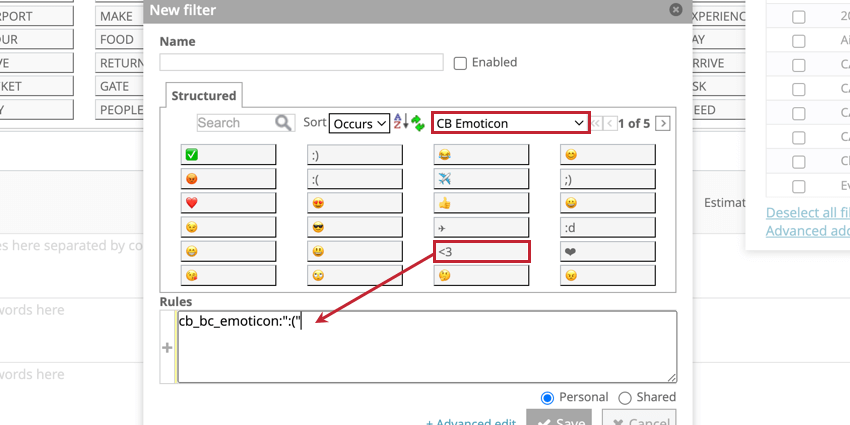
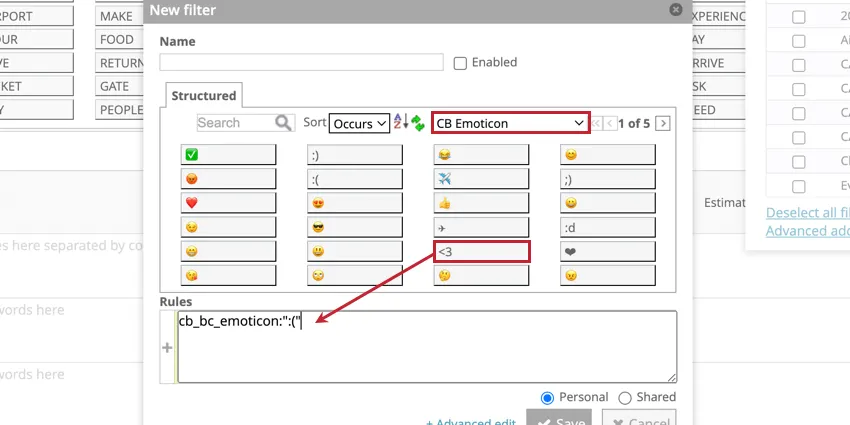
Qtip: Unlike emojis, emoticon variations need to be enclosed in double quotes when used in category rules and filters.
Sentiment Exception Rules
You can use emojis and emoticons in sentiment exception rules just like any other master entity.
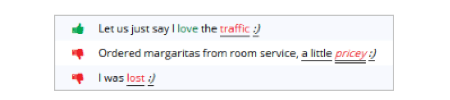
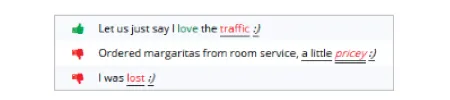
For example, it’s possible to create a rule to handle phrases where a negative word is followed by a smiley. Assuming such smileys are often sarcastic in nature, you can tune them to be neutral or even negative.
This is possible using a simple positional rule with the following parameters:
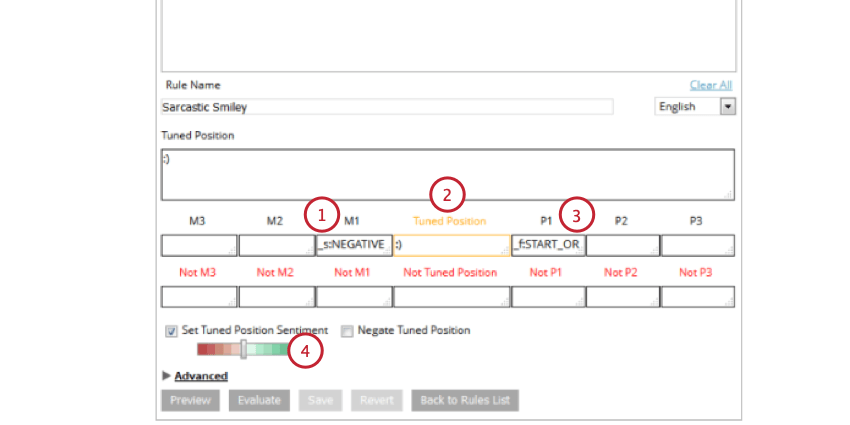
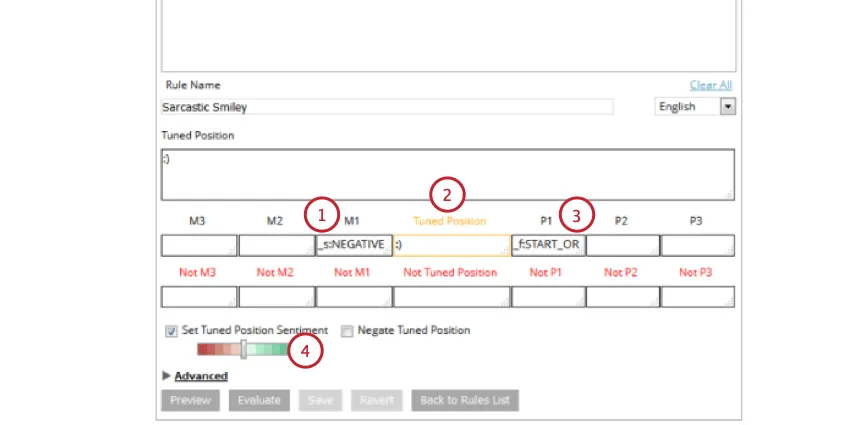
Qtip: This parameter ensures that the tuned position is immediately preceded by a negative word.
:) Qtip: The basic smiley emoticon is used since it is the master entity. Sentiment exception rules are always defined using master entities, not variations.
Qtip: This parameter ensures that the tuned position is located at the end of the sentence.
Qtip: This changes the tuned smiley’s sentiment from positive to neutral. To assign a negative sentiment, use -1 instead.
After this rule is enabled, smileys after negative words will be treated as neutral.
Emoji Master Entities
The table below lists some of the most common emoticons, their Master Entities and out-of-the-box sentiment.
Qtip: This is not a complete list of emoticons recognized by Designer.
Qtip: Designer does not recognize emoticon patterns if they are used inside a word (for example, “:3” in “3:30” will not be recognized as a smiley).
| Master Token | Emoticon Variations | Default Sentiment |
|---|---|---|
:) | :-) :) :o) :] :3 :c) :> =] 8) =) :} :^) :?) (: | +1 |
:D | :-D 8-D x-D xD X-D XD =-D =D =-3 =3 B^D :D | +2 |
:)) | :-)) | +2 |
:( | >:[ :-( :( :-c :c :-< :?C :< :-[ :[ :{ ): | –1 |
>:-( | :-|| :@ >:( | -2 |
:'( | :'-( :'( | –1 |
:') | :'-) :') | +1 |
D: | D:< D: D; D= DX v.v D-': | –2 |
:O | >:O :-O :O :-o :o O_O o-o O_o o_O o_o O-O | 0 |
:* | :* :^* | +1 |
;) | ;-) ;) ;-] ;] ;D ;^) | +1 |
:P | >:P :-P :P X-P x-p xp :-p :p =p :-? :? :? :-? :-b :b d: | 0 |
:/ | >:\ >:/ :-/ :/ :\ =/ =\ :L =L :S >.< | –1 |
<3 | N/A | +1 |
</3 | N/A | –1 |
That's great! Thank you for your feedback!
Thank you for your feedback!