Marketers, researchers, and experience designers constantly ask: What is attention span worth in today's hyper-fragmented media environment?
As customers navigate multiple devices and platforms, attention becomes a new form of currency. Capturing those meaningful, high-attention moments (rather than just passive impressions) requires a deep understanding of user behavior.
To analyze this evolving "attention equation," the team at Qualtrics researched how users engage with digital touchpoints, what drives their focus, and what causes them to abandon a brand entirely.
From browsing to auditing: the new baseline
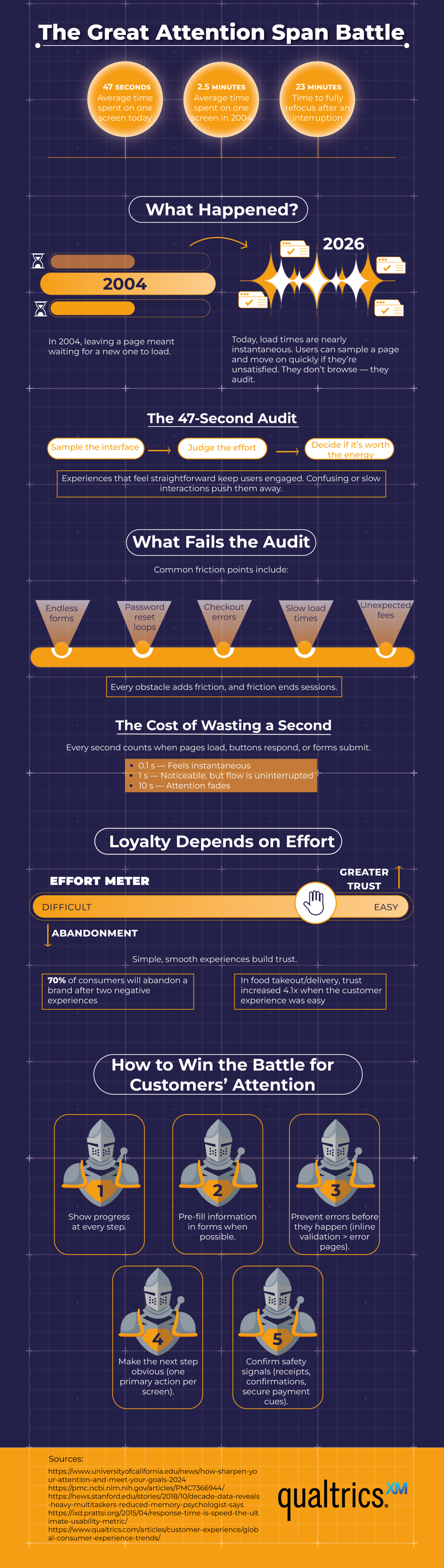
In 2004, the average attention span on a single screen hovered around 2.5 minutes. During that era, leaving a web page meant waiting for a new one to load, inviting users to commit to the content in front of them. Today, the digital space operates on nearly instantaneous load times, dropping that average screen duration to just 47 seconds.
Customers no longer browse; they audit.
When a user lands on a page, they execute a rapid, subconscious attention span test based on three distinct steps:
- Sample the interface
- Judge the effort
- Decide if it is worth the energy
Experiences that feel straightforward keep users engaged, and confusing or slow interactions push them away.
Friction points and the cost of interruption
A short attention span during a digital experience is most commonly a reaction to friction. Every obstacle introduced into an interface depletes user energy, and that friction ultimately ends sessions.
Common friction points that fail the 47-second attention audit include:
- Endless forms
- Password reset loops
- Checkout errors
- Slow load times
- Unexpected fees
The cost can be severe when an interface breaks a user's flow. Data shows that it takes a user 23 minutes to fully refocus after an interruption.
The Reality of Response Times
Every second counts when pages load, buttons respond, or forms submit. How long a user is willing to wait determines whether they stay engaged or abandon the task:
| Delay | User Perception and Reaction |
| 0.1s | Feels instantaneous. |
| 1s | Noticeable, but the flow is uninterrupted. |
| 10s | Attention fades. |
When a process takes 10 seconds or more, the symptoms of a short attention span are more likely to creep up, making it easier for users to abandon the page in search of faster alternatives.
Effort, loyalty, and the attention equation
Simple, smooth experiences build trust and secure commercial value. Conversely, frustration destroys brand loyalty. Current data indicates that 70% of consumers will abandon a brand entirely after just two negative experiences.
When brands reduce the effort required to complete a task, however, trust scales quickly. In the food takeout and delivery sector, trust increased 4.1x when the customer experience was easy.
Success, then, requires matching the customer's specific "job to be done" — whether that is education, connection, or entertainment — with their current level of focus, eliminating unnecessary steps along the way.
Five rules for engagement
Experience designers can’t alter human neurology, but they can optimize their interfaces for better results. If you are examining how to fix attention span attrition on your platforms, start by addressing these five structural areas to help win the battle for customers' attention:
- Show progress at every step: Keep users oriented throughout the process so they know exactly how much remains before they reach their goal.
- Pre-fill form fields when possible: Reduce manual data entry and conserve user energy.
- Prevent errors before they happen: Use inline validation rather than routing users to separate error pages.
- Make the next step obvious: Designate one primary action per screen to prevent decision fatigue.
- Confirm safety signals: Display receipts, confirmations, and secure payment cues clearly to reassure the user.
Optimize your digital experience
Winning the modern attention equation requires active listening and rapid adaptation.
To capture high-value moments and eliminate the friction points driving your audience away, explore Qualtric’s customer experience management platform, which can help you measure user sentiment, analyze behavioral drop-offs, and design digital interactions that respect your customers' time and energy.
Sources:
- https://www.universityofcalifornia.edu/news/how-sharpen-your-attention-and-meet-your-goals-2024
- https://pmc.ncbi.nlm.nih.gov/articles/PMC7366944/
- https://news.stanford.edu/stories/2018/10/decade-data-reveals-heavy-multitaskers-reduced-memory-psychologist-says
- https://ixd.prattsi.org/2015/04/response-time-is-speed-the-ultimate-usability-metric/