XM technology maturity doesn’t happen overnight
The goal of experience management is to build a foundation for agility, innovation, and competitive advantage in an era where human experience is the ultimate differentiator. Long-term XM success requires a systematic focus on driving enterprise-wide change over multiple years. To help guide these efforts, XM Institute created the XM Operating Framework, a blueprint organizations can follow to master the discipline of experience management by maturing their XM Technology, Culture, and Competencies. The Technology element – which refers to the platform that allows XM practices to scale consistently across an organization – is essential for generating and disseminating the XM insights that fuel this experience-centric transformation. Without it, the organization won’t be able to create a shared, holistic understanding of people’s experiences, which provides the necessary foundation for XM-centric Culture and Competencies to flourish.
However, building a successful, sustainable experience management program does not happen overnight. It requires a multi-year strategy focused on simultaneously maturing XM Technology, Culture, and Competencies – along with the continued support of strong executive Ambition. As an organization progresses up the maturity curve, its XM program will increasingly deliver on the business value and transformative potential of experience management efforts.
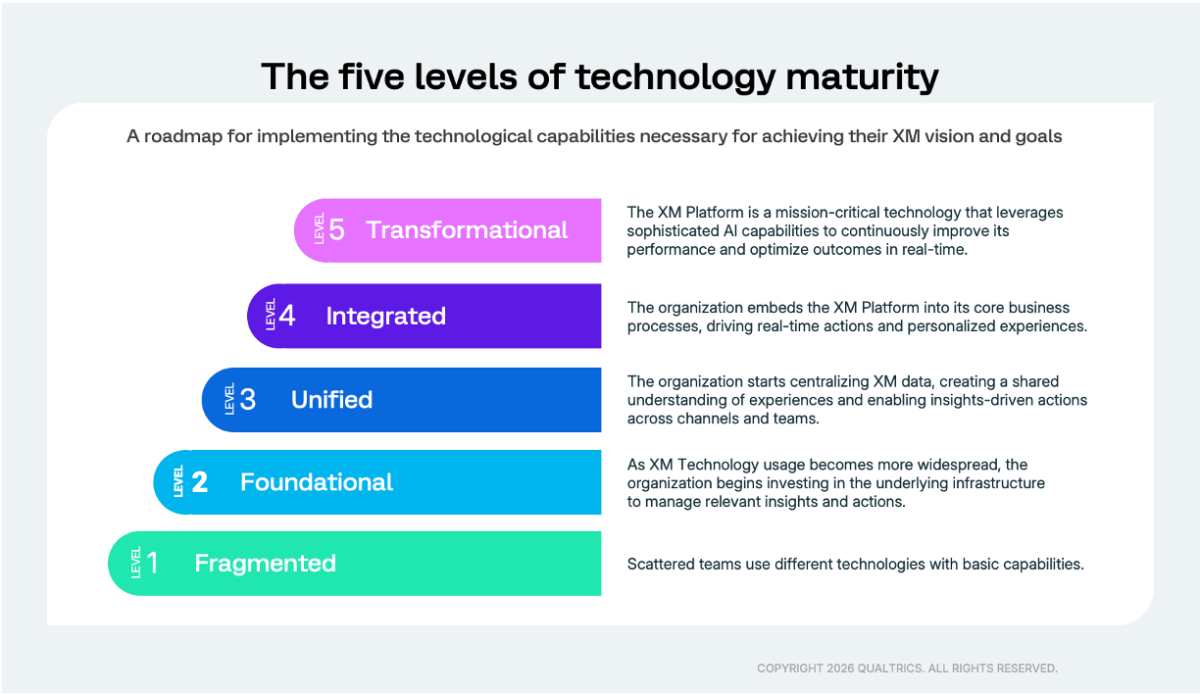
To guide organizations along this journey, we’ve defined five levels of XM Technology maturity, which they evolve through as their capabilities become progressively more sophisticated and integrated into their operations. This framework provides organizations with a roadmap they can follow to implement the technological capabilities necessary for achieving their XM vision and goals. It offers a structured approach for evaluating their XM Technology’s current strengths and weaknesses, and it provides XM professionals with a communication tool they can use to build buy-in and alignment with stakeholders. While not a rigid blueprint, the five levels of XM Technology maturity we’ve commonly observed organizations advance through are:
- Level 1: Fragmented. Scattered teams use different technologies with basic capabilities.
- Level 2: Foundational. As XM Technology usage becomes more widespread, the organization begins investing in the underlying infrastructure to manage relevant insights and actions.
- Level 3: Unified. The organization starts centralizing XM data, creating a shared understanding of experiences and enabling insights-driven actions across channels and teams.
- Level 4: Integrated. The organization embeds the XM Platform into its core business processes, driving real-time actions and personalized experiences.
- Level 5: Transformational. The XM Platform is a mission-critical technology that leverages sophisticated AI capabilities to continuously improve its performance and optimize outcomes in real-time.
Level 1: Fragmented
Scattered teams use different technologies with basic capabilities.
The organization does not yet understand the financial or strategic value of experience management. So although isolated teams may be working on some experience-adjacent activities (like customer service, user experience, or employee engagement studies), each group uses its own technologies and vendors to capture and share data. This results in a fragmented XM Technology ecosystem, where relevant information remains isolated in siloed business systems that are owned by different teams.
The XM technologies that are used mostly offer basic capabilities designed to help analysts create, deploy, and interpret surveys. These surveys capture structured feedback – often in the form of multiple-choice responses – at predetermined points along someone’s journey, like a post-event satisfaction survey or an annual NPS or engagement study. Results are manually analyzed and distributed to just a few stakeholders through static dashboards, decks, or spreadsheets.
Common obstacles we see organizations encounter as they try to derive business value from their XM Technology at this level include:
- Insufficient information. The scattered nature of XM technologies and data leads to an incomplete and narrow understanding of people’s experiences, making it difficult to uncover issues and opportunities, allocate resources effectively, and make data-driven decisions.
- Delayed fixes. Reliance on manual processes and anecdotal evidence creates a reactive, delayed approach to problem-solving, leading to slow issue resolution, experience gaps, and suboptimal fixes.
- Difficulty scaling improvements. Disconnected XM technologies make it hard to scale experience improvements across departments or touchpoints, limiting the impact of these changes and creating inconsistent experiences across channels.
-
Operational inefficiencies and risks. Manual processes, data fragmentation, and the absence of centralized controls lead to wasted resources, duplicated efforts, and increased risks related to data quality, security, and compliance, which can negatively impact the organization’s bottom line and reputation.
Level 1: Fragmented Scattered teams use different technologies with basic capabilities.
TECHNOLOGY PILLAR DESCRIPTION EXAMPLE IDENTIFIERS LISTEN
the capability to capture and aggregate XM data about people's experiences from various touchpoints and channelsOrganizations rely on ad-hoc and manual data collection methods, leading to fragmented and siloed data. The focus is primarily on structured feedback, with low capability to capture unstructured data or insights from diverse channels. - Fragmented and siloed XM data stored across different systems
- XM data limited to structured, survey-based feedback (e.g., multiple-choice survey responses) collected through a few basic channels (e.g., email surveys, paper feedback forms)
- Data collection is ad-hoc and infrequent, often driven by specific events or projects
- Basic segmentation exists, but it's based on limited demographic or transactional data
UNDERSTAND
the capability to transform XM data into actionable insights tailored to specific usersAnalysis is basic, often confined to descriptive statistics and simple reporting. Insights are shared manually and periodically. - Basic calculations and visualization options included, but often created manually
- Insights driven by surface-level observations and gut feelings rather than statistical analysis
- Distribution of insights is manual via email or shared documents
- Limited customization or filtering of insights offered
ACT
the capability to drive impactful actions across an organization based on XM insightsThe organization informs actions without the inclusion of experience-related data or uses XM data selectively to validate preferred solutions. - Response to feedback or issues, if it exists, is manual and ad hoc
- No automated actions or workflows in place
- Manual tracking and management of issues done through spreadsheets or email
- Basic collaboration tools used (e.g., email, shared documents) but lack integration with the XM Platform
OPERATE
the underlying technical foundation that enables an XM Platform to scale from small feedback programs to complex environmentsInconsistent use of XM technology exposes the organization to risks associated with data management, security, and scalability, hindering the impact of XM initiatives. - No centralized platform limits scalability and performance
- Lack of data governance processes lead to inconsistencies and data quality issues
- Manual and ad hoc user management is decentralized across departments
- Basic access controls and limited data privacy measures in place
Level 2: Foundational
As XM Technology usage becomes more widespread, the organization begins investing in the underlying infrastructure to manage relevant insights and actions.
Teams are starting to recognize the value of XM. As a result, pockets of the organization have adopted a preferred XM Platform dedicated to capturing and managing their XM data. While their scope remains limited – often only serving a single department or channel and housing only experience data – these platforms do enable a more formalized and consistent approach to XM. For example, data collection has become more regular and now expands across multiple channels, such as post-support surveys sent through email and SMS or digital feedback collected through passive listening tabs and active intercepts.
Teams use these platforms for basic analytics (like descriptive tools) and statistical techniques that provide insights into key metrics and trends. They then share these insights out through static dashboards and simple alerts with a limited set of users, such as the frontline or people managers. Basic workflows are in place but designed to trigger notifications rather than drive action. However, basic integrations with other business systems start laying the groundwork for more automated, cross-functional responses to XM insights in the future.
Common obstacles we see organizations encounter as they try to derive business value from their XM Technology at this level include:
- Data silos and gaps. The inconsistent adoption of the XM Platform(s) and continued focus on capturing periodic, structured feedback create data silos and gaps in understanding, limiting organizational visibility into people’s end-to-end journeys and impeding cross-functional collaboration.
- Surface-level analysis. Basic analytics and reporting capabilities provide a limited understanding of key metrics and trends but fail to uncover deeper, predictive insights or identify root causes of issues, leading to superficial fixes that may not address underlying problems or drive significant improvements.
- Limited access to insights. Static dashboards and limited reporting options restrict access to and usability of XM insights, limiting their impact on decision-making and preventing broader organizational engagement with XM data.
- Resource inefficiencies. The use of multiple XM technologies, manual processes, and lack of standardized feedback loops create inefficiencies in resource allocation, both in terms of financial investment and employee time.
| TECHNOLOGY PILLAR | DESCRIPTION | EXAMPLE IDENTIFIERS |
|---|---|---|
| LISTEN the capability to capture and aggregate XM data about people's experiences from various touchpoints and channels |
A preferred XM platform is adopted by different groups, enabling more structured and consistent data collection through surveys across multiple channels (web, mobile, email). Some open-ended feedback might be captured, but the focus remains on structured data. |
|
| UNDERSTAND the capability to transform XM data into actionable insights tailored to specific users |
Basic statistical analyses are performed to generate insights into key metrics and trends over time. These insights are shared through static, role-based dashboards, using simple group segmentation. |
|
| ACT the capability to drive impactful actions across an organization based on XM insights |
Organizations use data-driven XM insights to drive improvements in some areas, but most actions remain largely reactive and manual. Basic workflow automations are in place for simple tasks. |
|
| OPERATE the underlying technical foundation that enables an XM Platform to scale from small feedback programs to complex environments |
A preferred XM Platform establishes a technical foundation with centralized user management and rudimentary security measures. Restrictions in scalability and integrations hinder broader adoption and cross-functional collaboration. |
|
Level 3: Unified
The organization starts centralizing XM data, creating a shared understanding of experiences and enabling insights-driven actions across channels and teams.
Once the organization views XM as a strategic priority, it starts bringing all its disparate XM data together in one place, creating a single source of truth across touchpoints. Here, XM data includes experience, behavioral, and operational data in structured and unstructured formats from a range of listening channels, both solicited and unsolicited. This serves as a foundation for personalized interactions, communications, and recommendations. Creating this single source of truth often entails aggregating XM data from different business systems onto a single, enterprise-wide XM Platform – although the exact architecture will depend on things like the organization’s structure and tech stack.
Once the organization has this comprehensive, omnichannel view of people’s experiences, it accelerates their capabilities across a number of different dimensions. It enables teams to cross-functionally coordinate their listening strategies, collecting data more continuously and proactively with some more sophisticated personalization capabilities. The XM Platform’s advanced analytics – including some AI and ML capabilities – uncover deeper, predictive insights. These insights are shared through customized, automated reporting mechanisms, like dynamic dashboards or personalized alerts. They also automatically trigger workflows (like closed-loop follow up) and initiate timely XM-centric actions across the entire organization. All these capabilities are supported by the XM Platform’s increasing number of integrations with other systems, which allow for inbound and outbound flows of data. This is where the organization will begin exploring AI and ML use cases through some of the AI-owered capabilities under Listen, Understand, and Act.
Common obstacles we see organizations encounter as they try to derive business value from their XM Technology at this level include:
- Data overload. The sudden increase in the volume of XM insights, often without clear prescriptive guidance, can overwhelm organizations, leading to challenges in identifying and prioritizing the most critical signals, analysis paralysis, and unrealized improvement or innovation opportunities.
- Limited real-time personalization. While the unified XM platform enables some more advanced personalization, reliance on static, rule-based segmentation constrains its ability to dynamically adapt experiences and insights in real-time based on individual context, needs, and behavior, which results in less relevant and impactful interactions.
- Incomplete integrations. The XM platform, though centralized, is still primarily used by frontline teams and not yet fully integrated into the entire technology ecosystem. This results in missed opportunities to leverage data from other systems, trigger automated actions in those systems, and create truly seamless and connected experiences.
- Nascent AI and ML adoption. Although the organization has begun exploring AI and ML use cases (like conversational analytics, simple predictive models, and rules-based automations), these efforts remain limited in scope and sophistication. They still require significant manual oversight and don’t yet harness the full potential of these technologies for deeper insights, advanced automation, and hyper-personalization.
| TECHNOLOGY PILLAR | DESCRIPTION | EXAMPLE IDENTIFIERS |
|---|---|---|
| LISTEN the capability to capture and aggregate XM data about people's experiences from various touchpoints and channels |
XM data is centralized, often on a single platform, enabling a more holistic journey-centric view of experiences. Data collection includes both structured and unstructured data from solicited and unsolicited channels, with some personalization in surveys to gather specific feedback. |
|
| UNDERSTAND the capability to transform XM data into actionable insights tailored to specific users |
Advanced analytics, including some AI and ML capabilities, uncover deeper insights into the drivers of key metrics and predict future trends. Insights are shared through customized reporting mechanisms, improving accessibility and timeliness. |
|
| ACT the capability to drive impactful actions across an organization based on XM insights |
Across the organization, actions are informed by XM insights. The platform triggers automated workflows and real-time actions based on insights, enabling a more proactive and efficient response to feedback. Integrations with some other systems facilitate coordinated action-taking. |
|
| OPERATE the underlying technical foundation that enables an XM Platform to scale from small feedback programs to complex environments |
The XM Platform offers enhanced scalability and robust security and compliance features to support its role as a centralized hub for XM data. Expanded systems integrations support cross-functional collaboration and a more holistic view of people's experiences. |
|
Level 4: Integrated
The organization embeds the XM Platform into its core business processes, driving real-time actions and personalized experiences.
In this later stage of maturity, the organization deploys an integrated and scaled XM Platform that infuses XM insights into all its core systems and processes. This enables real-time, data-driven actions and the delivery of proactive, personalized experiences at scale. Through its extensive integrations, the platform is able to provide a comprehensive, continuously updated view of individuals and their end-to-end journeys, drawing on real-time XM data streams from diverse sources. It can also dynamically adapt its listening activities to capture the data that is most relevant at a given moment for both the organization and respondents, such as tailoring survey questions based on someone’s unique behaviors, preferences, or context.
Organizations at this level are strategically deploying numerous AI-Powered capabilities for XM. Advanced, AI-powered analytics transform XM data into predictive, prescriptive, and personalized insights. The platform here goes beyond just sharing scores; it delivers contextual guidance and actionable recommendations through various reporting mechanisms (e.g., dynamic dashboards, real-time alerts, and AI-generated summaries), all designed to accelerate and support an employee’s decisions. Automated workflows, triggered by XM insights or events, streamline processes, while AI-powered segmentation enables the personalization of experiences at every touchpoint – from tailoring marketing communications to individualized employee coaching. The platform is capable of addressing the complexities of all these different AI deployments, ensuring things like data security, insight reliability, and effective model management.
Common obstacles we see organizations encounter as they try to derive business value from their XM Technology at this level include:
- Challenges with emerging data integration. The rapidly evolving data landscape presents difficulties in proactively identifying and seamlessly integrating new data sources or signals into the platform, potentially limiting the depth and breadth of insights available for decision-making.
- Residual manual processes. Despite extensive automation, certain platform functionalities or processes may still require manual intervention or lack real-time responsiveness, hindering the organization’s ability to fully capitalize on the potential for proactive and predictive actions.
- Interpretability of AI and ML models. As AI/ML models become more complex, their inner workings can become less transparent, making it difficult to understand why certain insights or recommendations are generated. This can lower trust and adoption of XM insights, especially in critical decision-making scenarios.
- Organizational barriers to agility. Even with a highly integrated XM platform, organizational structures, processes, or mindsets may not be fully aligned for rapid adaptation and innovation at scale, slowing down the ability to respond to market shifts and tap into the platform’s full potential.
| TECHNOLOGY PILLAR | DESCRIPTION | EXAMPLE IDENTIFIERS |
|---|---|---|
| LISTEN the capability to capture and aggregate XM data about people's experiences from various touchpoints and channels |
The XM Platform is embedded into core business processes, facilitating real-time data collection and analysis from diverse sources, including advanced listening techniques like conversational surveys. AI facilitates advanced personalization techniques. | + Data collection is continuous and highly adaptive, incorporating real-time streams and unstructured data from diverse channels + Advanced sampling techniques with dynamic adjustments are utilized for optimal data collection + Seamless integration of data from diverse sources creates a comprehensive view of individuals, enabling dynamic segmentation + AI is leveraged to personalize surveys and feedback requests based on individual preferences, behaviors, and business needs + AI-powered validation and enrichment ensure high data quality and generate synthetic data for advanced analysis |
| UNDERSTAND the capability to transform XM data into actionable insights tailored to specific users |
Advanced and AI-powered analytics generate predictive, prescriptive, and personalized insights. These insights are shared through tailored, interactive reporting mechanisms, and the platform provides contextual guidance to employees in real-time. | + Comprehensive suite of statistical and predictive modeling tools, coupled with interactive visualizations and customizable dashboards, offer in-depth data exploration and analysis + AI powers automated discovery of deep insights from structured and unstructured data and automates the generation of summaries and reports + Insights are delivered through multiple channels and tailored to user needs and preferences + Powerful predictive models and forecasting with high accuracy, coupled with AI-driven prescriptive recommendations and actionable guidance, enable proactive decision-making + AI/ML-powered segmentation creates dynamic segments based on range of data points (incl. personal, behavioral, and contextual), enabling targeted actions & personalization |
| ACT the capability to drive impactful actions across an organization based on XM insights |
The platform triggers automated workflows and personalized experiences at scale, enabling proactive issue resolution and experience optimization. Seamless integration with other enterprise systems creates a unified ecosystem for data-driven action. | + AI-powered, hyper-personalized automated responses are triggered in real-time based on feedback and sentiment + Sophisticated workflows and integrations enable seamless, real-time actions based on feedback and events + Advanced case management and action planning leverage AI for routing, prioritization, and collaboration + Robust performance development capabilities leverage AI for personalized coaching and recommendations + Sophisticated experimentation methodologies are supported, enabling data-driven innovation and optimization of experiences |
| OPERATE the underlying technical foundation that enables an XM Platform to scale from small feedback programs to complex environments |
The platform is highly scalable and adaptable to emerging needs. It is capable of handling large volumes of data from many sources, complex organizational hierarchies, and diverse integrations, with robust security and compliance measures in place. | + Mature data governance framework ensures data quality, integrity, and compliance + Efficient and automated user management with self-service capabilities and integrations + Extensive configuration options allow deep customization and tailoring of the platform + Robust security and data privacy measures protect sensitive information + Scalable architecture and seamless integrations enable interoperability with a wide ecosystem of systems |
Level 5: Transformational
The XM Platform is a mission-critical technology that leverages sophisticated AI capabilities to continuously improve its performance and optimize outcomes in real-time.
At this pinnacle of XM maturity, the organization fully embraces XM as a strategic imperative, with the XM Platform becoming a self-learning, AI-driven engine for proactive and predictive experience management. It is able to continuously collect and analyze real-time data from all channels, generating deep insights into perceptions, behaviors, and trends. This empowers the platform to trigger immediate, personalized actions and adapt feedback mechanisms on the fly, ensuring high levels of relevance and engagement. Deep integrations with other enterprise systems facilitate seamless data flow and automated responses, which ultimately creates a truly unified ecosystem.
The platform also transcends traditional analytics, acting as a strategic advisor that proactively recommends actions and predicts outcomes based on complex scenarios and simulations. Because its AI models continuously learn and adapt, the platform is able to provide increasingly accurate and nuanced insights that anticipate future needs and trends. This produces a holistic XM system that not only optimizes experiences in real-time but also drives continuous innovation by proactively identifying and addressing emerging issues. The organization, empowered by this intelligent platform, achieves unparalleled agility and consistently exceeds people’s expectations, securing the competitive advantages crucial for success in today’s rapidly evolving business landscape.
| TECHNOLOGY PILLAR | DESCRIPTION | EXAMPLE IDENTIFIERS |
|---|---|---|
| LISTEN the capability to capture and aggregate XM data about people's experiences from various touchpoints and channels |
Advanced AI and ML capabilities enable continuous, real-time data collection and curation from all channels. Feedback collection is adaptive and personalized, adjusting in real-time based on individual behaviors and preferences as well as specific business needs. | + Cutting-edge AI/ML leveraged to intelligently and continuously collect the most relevant data, anticipating needs and uncovering emerging sources + The experience database becomes a self-learning, intelligent system that continuously refines profiles and segments in real-time, enabling hyper-personalization and predictive modeling at an individual level + AI employed to continuously optimize data collection, validation, and enrichment, proactively identifying and addressing biases or gaps to ensure the highest level of insight accuracy and relevance |
| UNDERSTAND the capability to transform XM data into actionable insights tailored to specific users |
The platform acts as a strategic advisor, proactively recommending actions and predicting potential outcomes based on complex scenarios and simulations. The platform's AI models continuously learn and adapt, providing increasingly accurate and nuanced insights that anticipate future needs and trends. | + AI/ML and statistical modeling leveraged for proactive identification of trends, risks, and opportunities, enabling agile, data-driven decision-making and strategic planning + The platform anticipates insights user needs, proactively surfaces key findings, and provides tailored recommendations through dynamic, AI-generated reports and visualizations, ensuring accessibility and actionability for all users + AI/ML-powered segmentation used to create nuanced segments in real time based on a wide range of personal data points, like anticipated future behaviors and needs |
| ACT the capability to drive impactful actions across an organization based on XM insights |
The platform autonomously optimizes experiences and drives continuous innovation. It leverages AI to personalize experiences at scale and proactively identify and address emerging issues before they impact people. | + Personalized actions and responses autonomously triggered, ensuring immediate and proactive issue resolution, while enabling hyper-personalization at scale + The platform proactively recommends actions and predicting outcomes based on complex scenarios + AI-powered automation, coupled with real-time guidance and coaching, streamlines processes, fosters a culture of learning, and drives continuous innovation and improvement across the organization |
| OPERATE the underlying technical foundation that enables an XM Platform to scale from small feedback programs to complex environments |
The platform is a mission-critical engine of proactive and predictive Experience Management, with deep integrations creating a unified ecosystem for seamless data flow and automated actions. The platform continuously learns and adapts, refining its models and algorithms to improve insight accuracy and relevance. | + Automated processes and AI-driven insights ensure data quality, compliance, ethical usage, and proactive privacy protection + Fully automated, self-service user management, extensive configuration options, and scalable architecture enable seamless customization, adaptability, and optimal performance + Transparent governance, ethical guardrails, and autonomous model management ensure AI is used effectively and responsibly |
Bottom Line: Use the Five levels of XM technology maturity as a guide to help you understand which technological capabilities you need in place to achieve your XM vision.
Isabelle Zdatny, XMP, CCXP, is Head of Thought Leadership for Qualtrics XM Institute
Dr. Juliana Smith Holterhaus, Ph.D., is a Senior Product XM Scientist with Qualtrics, specializing in Digital XM
Drew Green, XMP, Senior XM Scientist & Global Digital Advisory Lead
Dr. Cecelia Herbert, XMP, PsyD, is a Principal Behavioural Scientist with Qualtrics XM Institute