


As companies embark on their Experience Management (XM) journey to better serve customers, they must build and optimize three core areas: listening, understanding feedback in context, and acting on that feedback in time to matter.
Although organizations are effectively listening and understanding feedback from their customers, research consistently highlights a significant gap: while 72% of organizations are listening more regularly to their customers, only 33% are successfully acting on that feedback.
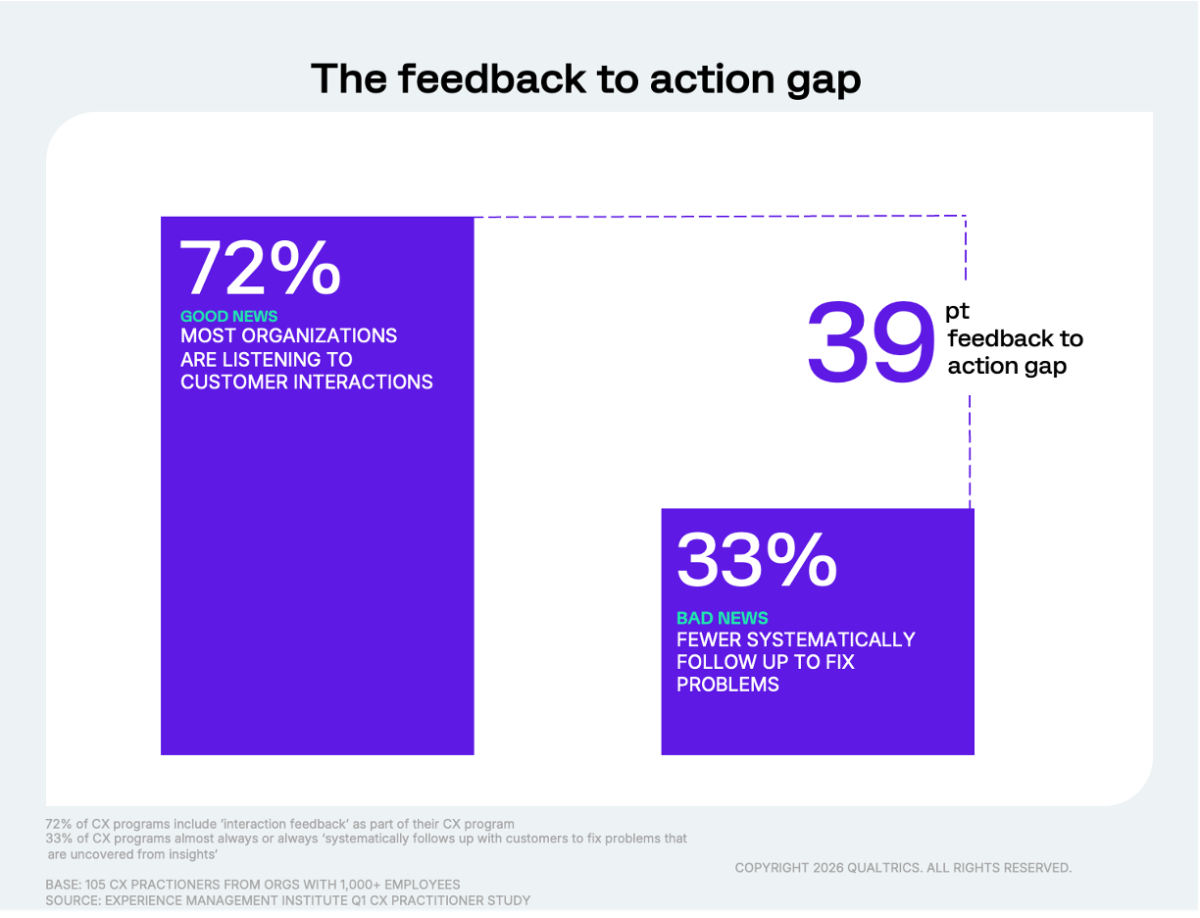
The reality is simple: great insights are useless without effective action. How can you close this gap? By implementing an inner and outer loop system.
In this guide, you will learn:
- How to recognize common patterns in your data that signal systemic issues that should be solved with outer loop action
- How to apply the outer loop to resolve systemic issues at their source
- How to establish governance structures to ensure cross-functional accountability for systemic fixes
How inner loop insights inform outer loop actions
To dig a little deeper into how the inner and outer loop work together, we must first define each loop and think through examples of how they provide a comprehensive system of action. There are many different ways to approach and apply the inner and outer loop in your organization. We’ll be using Bain’s Net Promoter System ®.
- Inner Loop (Listen & Learn): Reactive, fast-paced phase focused on understanding and responding to individual customer feedback. Its primary goal is to close the loop with the individual customer and gather initial data on systemic issues.
- Outer Loop (Plan & Fix): Proactive, strategic phase focused on taking the aggregated insights from the inner loop and translating them into large-scale, sustainable organizational change.
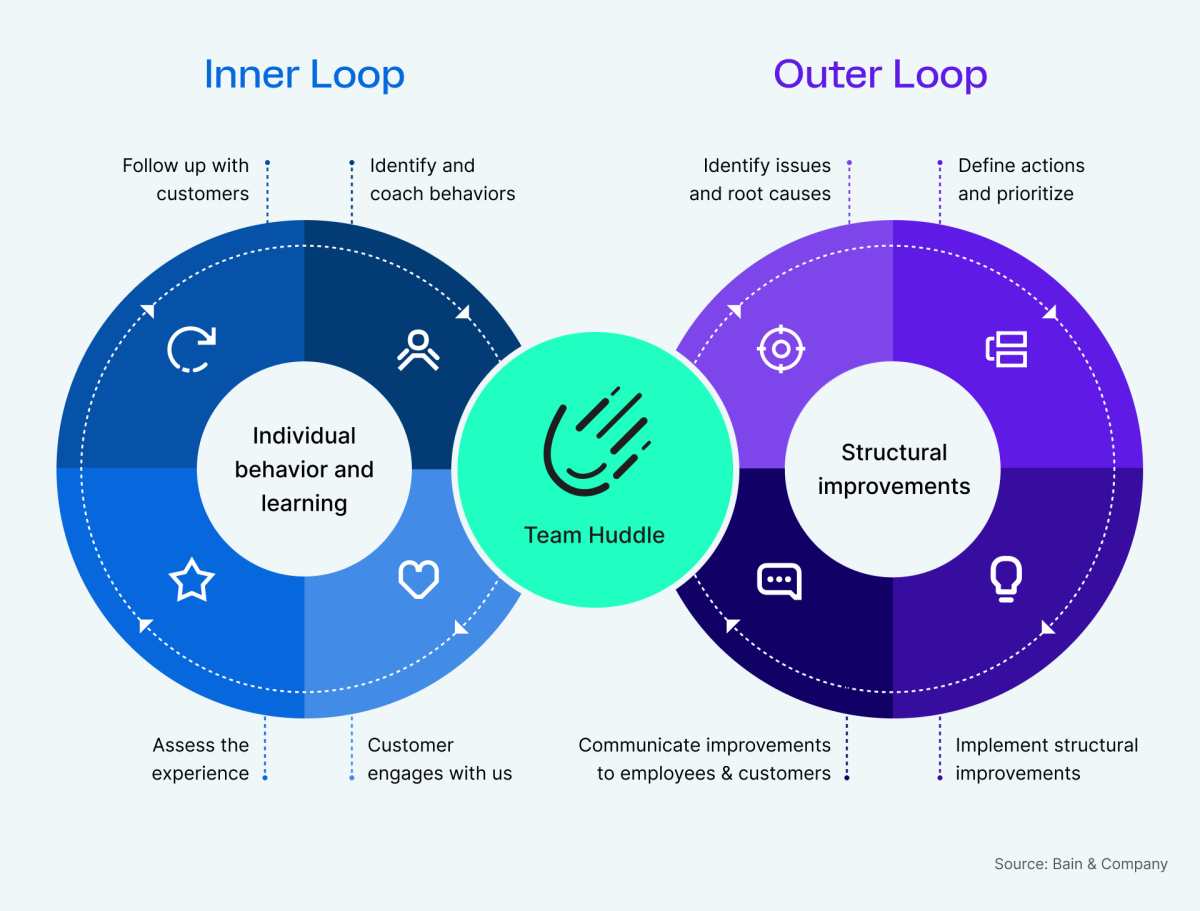
Typically, organizations begin by implementing the inner loop system. Think of this as immediate conflict resolution. For example, a customer orders a new television. When the package arrives, it’s in rough shape and the customer opens it to find the screen has been shattered. The customer calls customer service to report and resolve the issue and a representative offers an apology and orders a replacement television to be sent. The individual interaction has been resolved.
Most organizations are already doing these activities whether or not they call it ‘inner loop’ or consider it part of their customer experience program.
As organizations embed the inner loop into their operations, opportunities for systemic improvements will naturally start to surface as trends emerge in individual interaction data. These trends will help pave the way to specific areas the organization should focus their time and efforts.
Continuing the example, multiple customers have reported receiving damaged televisions, indicating a broader issue. Not only is this a poor experience, but a costly one. The organization gets to work to identify the root cause – poor packaging – and takes action to design better packaging that reliably protects the screen in transit.
When we think about how to leverage inner loop findings to inform outer loop actions, below are a few examples across industries that speak to trends identified, followed by root causes of those trends and the resulting improvement action:
The outer loop process
Effective outer loop planning transforms broad insights into actionable steps for improvement. In Bain’s model, organizations move through six phases to ensure they have what is needed for a robust and effective outer loop process. We will walk through these six phases via a 3-step approach.
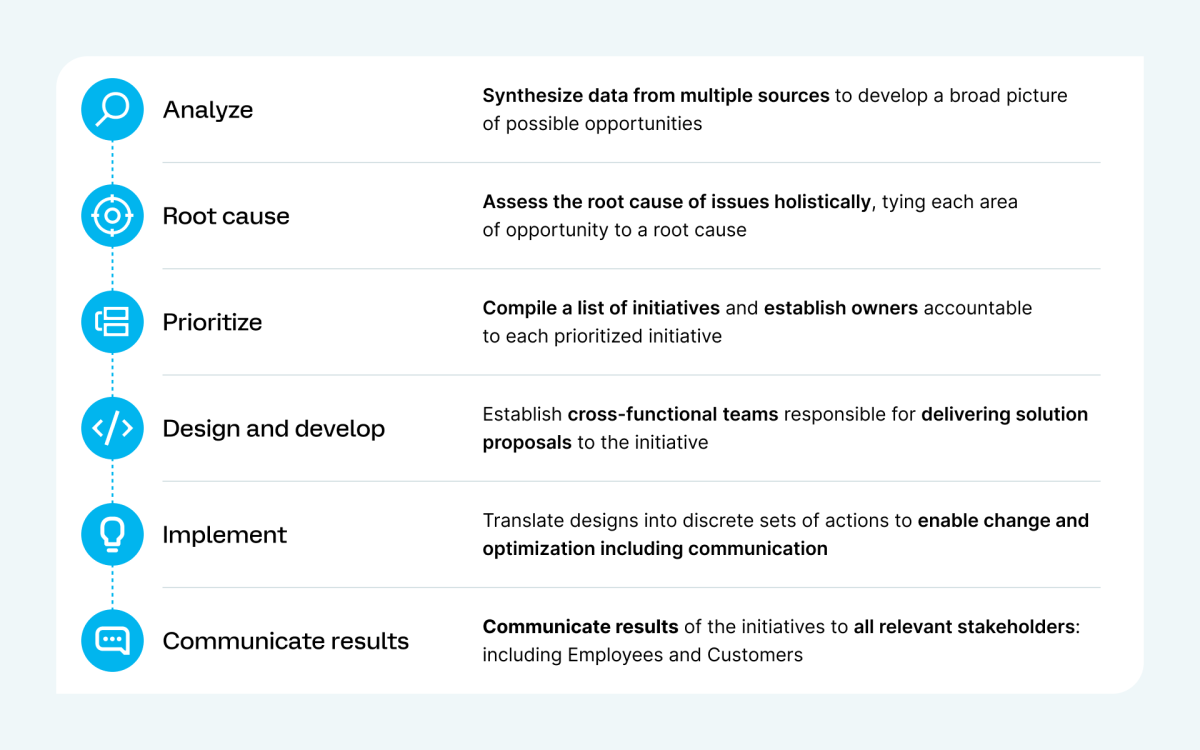
Step 1: Identify patterns from inner loop data and determine the root cause
Start by analyzing the data you’ve collected from individual experiences in the inner loop to define patterns and trends. These data could come from many sources, including but not limited to: transactional surveys, operational data, customer interviews, employee feedback, benchmarks, etc.
Once you’ve identified clear insights and emerging trends, you can determine impactful focus areas for improvement. There will always be opportunities for improvement. The challenge is determining and prioritizing based on which actions will make the most impact. We’ve identified some common triggers organizations should take into account when identifying specific focus areas for outer loop actioning.
After identifying opportunities for outer loop focus, organizations must get to the root of why these process failures are happening.
For example, it is not enough for a healthcare organization to identify nurse communication as the area of opportunity. It must identify the root cause of why nurse communication is consistently trending as an opportunity for improvement. Tools like the 5 Why’s Technique or the Fishbone Diagram help pinpoint root causes. An organization will know when they have identified the root cause when they have identified a systemic leadership or policy failure which requires the outer loop to fix instead of a quick tactical fix.
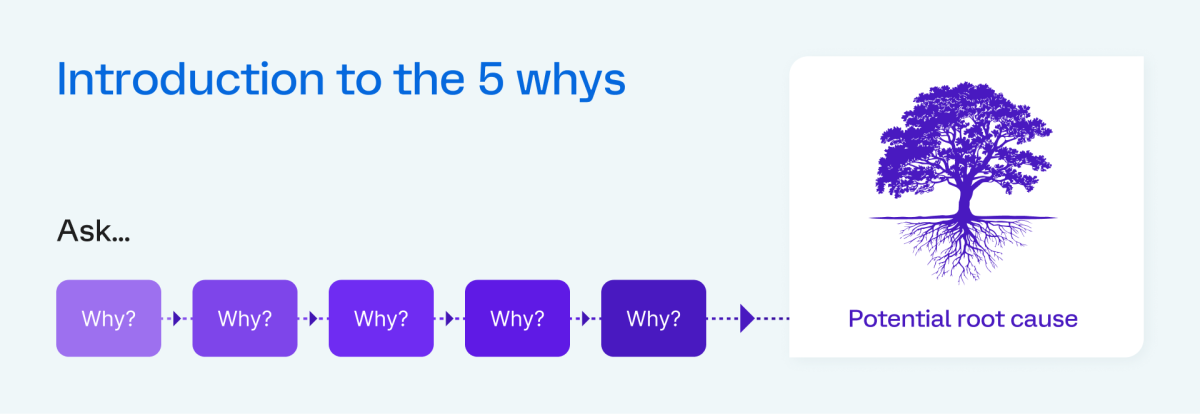

Below is an example of a case study that works through the 5 Why’s Tool to identify the root cause of an identified opportunity.
Step 2: Prioritizing efforts and assigning cross-functional ownership
As organizations often have multiple root cause improvement opportunities, effective prioritization is key to avoiding resource strain. Utilizing frameworks like the Impact vs. Effort Matrix allows teams to objectively identify which initiatives offer the best value-to-resource ratio:
- Quick Wins (High Impact, Low Effort) should be tackled immediately.
- Strategic Projects (High Impact, High Effort) require formal scheduling and resource planning.
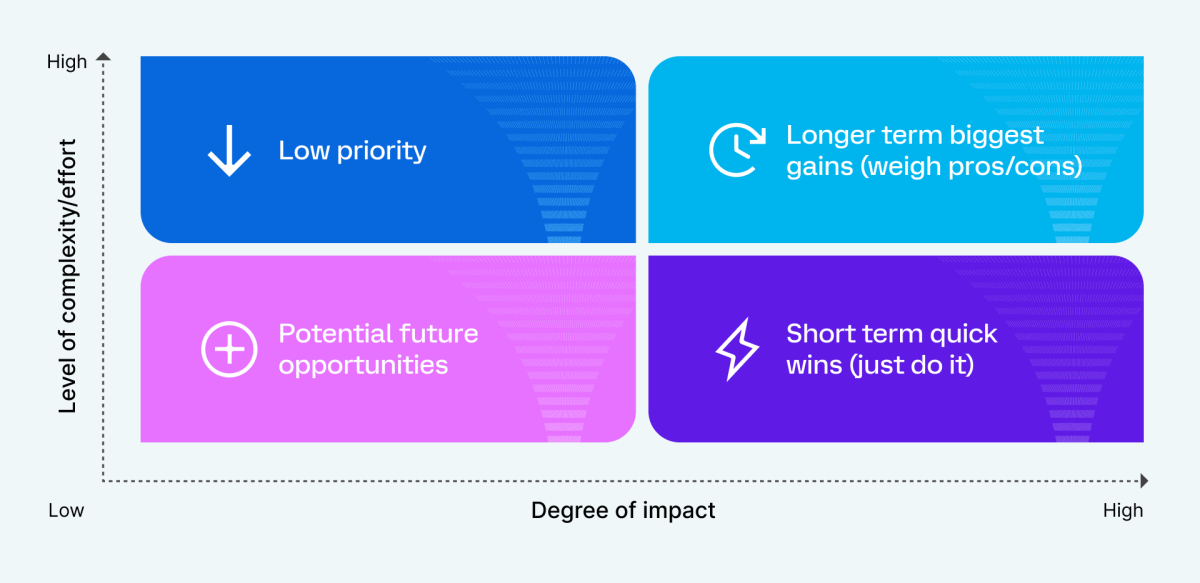
Start by tackling quick wins – high impact, low effort actions. Then, focus on longer term projects – high impact, but high effort. These projects will likely be cross-functional collaboration and require formal scheduling and resource planning.
For each root cause identified, you’ll need to identify the specific stakeholders involved in order to develop a solution. Start by establishing a governance structure to ensure ownership and accountability from specific stakeholders within the organization. This team will be responsible for developing potential solutions to the root cause.
Step 3: Implement a pilot, validate impact, and close the loop
Identifying insights trends, working through a root cause analysis of those trends, prioritizing root causes based on impact and level of effort, and setting a governance framework all leads to the actual implementation of the improvement effort or action plan.
Starting with small pilot cycles is a best practice. This approach maximizes the chance of a successful rollout because it allows the organization to test, refine, and prove the initiative's value under controlled, low-risk conditions.
One tool to utilize for piloting an improvement effort is the PDSA Cycle, also known as Plan, Do, Study, Act. It is a fundamental, iterative, four-stage model used to test changes quickly and learn what works before implementing them broadly. The cycle is meant to be run rapidly and repeatedly, building knowledge with each iteration until a reliable, effective solution is found.
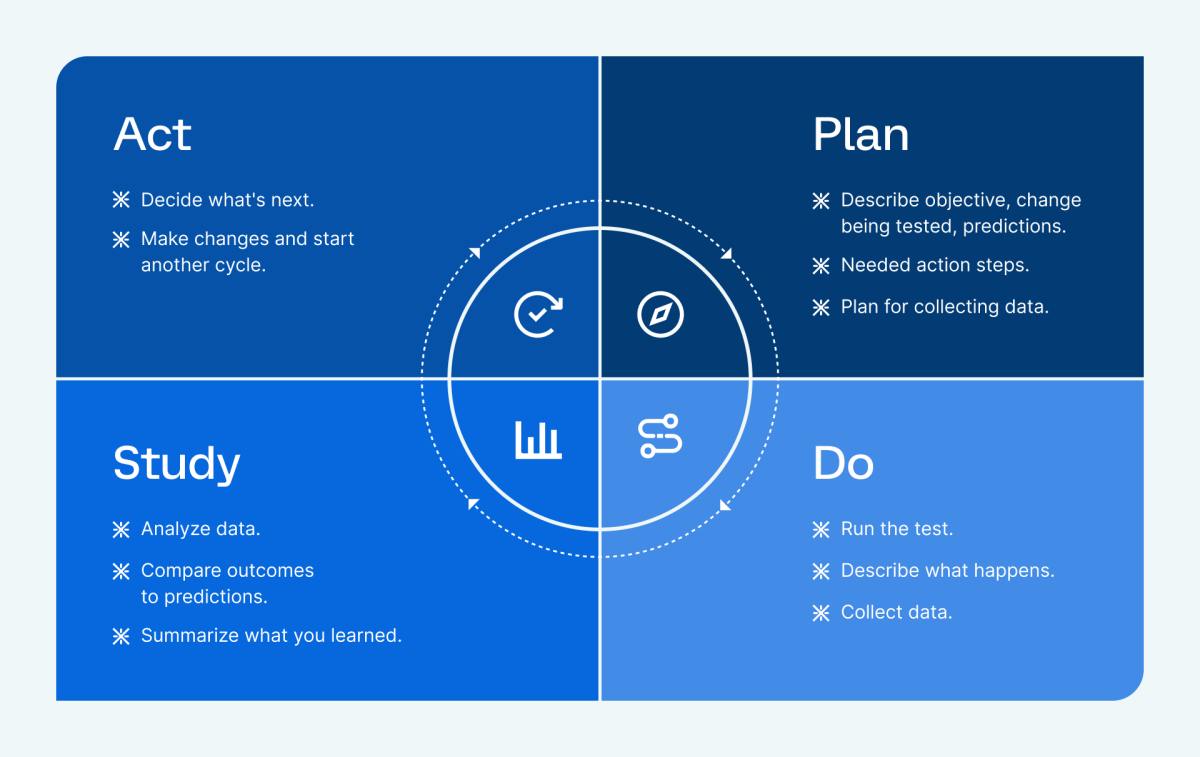
Specific metrics to track during improvement initiatives include outcome and process metrics; the outcome metric will show whether the goal was met or not, whereas the process metrics will show the successful completion of an action, therefore showing the direct connection between effort and result. Process metrics are the behaviors/steps that are acted out daily to impact the outcome metric. For example, in the healthcare case study above. The outcome metric is Nurse Communication – it is the KPI that is either met or not met. The process metric is Bedside Shift Report – it is a discrete action that drives the outcome. Using just an outcome metric may negatively impact front line engagement and sustainability into the future as it does not connect the “why” or the “how” to the success of meeting goals.
Last but not least, once you’ve implemented a successful improvement, use storytelling to effectively close the loop with employees and customers. Start by defining the challenge using data points and verbatims. Then, define the solution, using outcome and process metrics and qualitative customer data to tell a compelling story of impact.Share this with internal stakeholders to illustrate improvement, but also with the organization’s customer base to let them know “we heard you and we acted on your feedback,” effectively closing the outer loop.
Get started by starting small
The outer loop journey is one that demands a methodical and detail-oriented approach to execution. It is because of this rigor that organizations often struggle with utilizing the outer loop, and/or don’t complete the full process to ensure sustainability.
However, the customer experience landscape is becoming more and more competitive, showcasing the importance of organizational differentiation. By investing in the resources and time required to implement the outer loop process into daily operations, organizations will achieve sustained, long-term success in customer experience and overall business performance.
So, how do you begin on this outer loop journey? Start Small.
- This week: Review the last three months of closed loop data and identify the top three recurring issues using the threshold criteria from this guide.
- This month: Of the three, pick one high-impact issue via the Impact vs. Effort Matrix. Work through the 5 Whys to identify the root cause. Assign an owner to pilot the fix.
- This quarter: Run a pilot fix. Measure both process and outcome metrics. Communicate the results with both employees and customers.
Net Promoter ScoreSM and Net Promoter SystemSM are service marks of Bain & Company, Inc., NICE Systems, Inc., and Fred Reichheld.