


Every year organizations measure customer experience without managing it, leaving retention, growth, and market share on the table. The gap between measuring and managing is where most CX efforts stall, and closing it is one of the highest-leverage moves a CX leader can make right now.

The gap between measuring and managing
If your program is generating insights that don't reach the people who can act on them, you're not alone.
The pattern is predictable: your track scores, identify themes, and write recommendations. Then they sit. Not because leadership doesn't care, but because the connection between what your program measures and what the business is accountable for hasn't been made explicit. Without that connection, CX competes for priority against everything else—and rarely wins.
This isn’t a measurement problem that better tooling can solve. It is an organizational one. The shift that matters is connecting your CX metrics to the outcomes leadership is already accountable for—revenue protected, cost reduced, risk mitigated—and building the infrastructure that makes that connection visible and repeatable.
What's at stake for your program's maturity
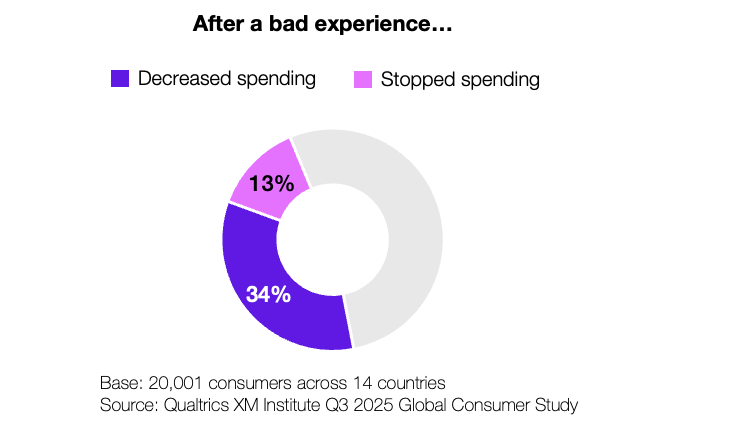
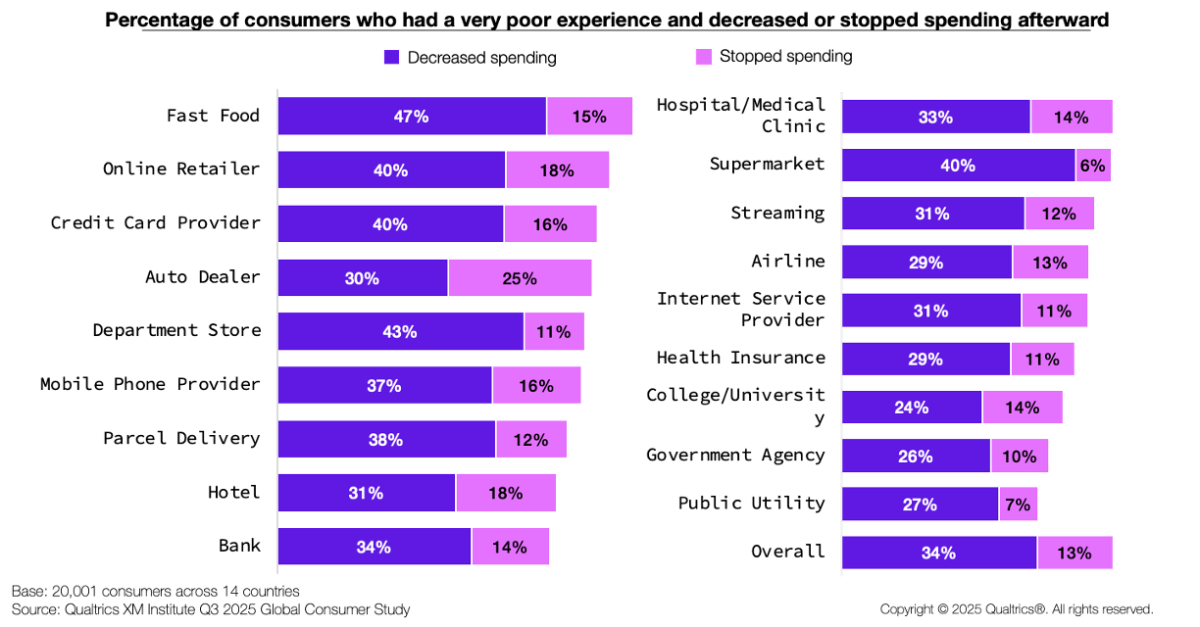
The competitive environment your customers are operating in right now makes the urgency concrete. Research shows that 47% of consumers decrease or stop spending with a brand after a single negative interaction. With consumers reporting that over 10% of recent experiences were very poor, that means bad experiences are putting your sales at risk.
At the same time, a strong CX program creates meaningful business value for an organization. CX leaders outperform laggards by an average of 23.5 points in normalized stock growth over four years, and organizations delivering above-average CX are 2.9 times more likely to report gaining market share.
The specific business case looks different depending on who your customers are and how often they interact with you.
If your customers make high-stakes, infrequent decisions—automotive, financial services, insurance, higher education—they arrive at a commitment shaped by the cumulative quality of every exchange across six to eight weeks of research. A single poor interaction at the moment of commitment doesn't just risk one sale. It reaches everyone in that customer's network navigating the same decision right now.
If your customers interact with you frequently—restaurants, hotels, retailers, healthcare networks— the illusion that there's always another chance can creep in. The risk isn't a single critical failure: it's variation that accumulates across shifts, locations, and regions until inconsistency becomes the experience itself. At that scale wallet share is kept or lost, one visit at a time.
The shift from feedback collection to a CX program
The organizations pulling ahead aren't measuring more than you are. They've changed how decisions get made. Here is what that difference looks like in practice:
What separates a feedback program from a CX program is not the sophistication of the technology or the size of the team. It's whether your insights drive decisions across the entire organization—not just within the function that collected them.
The three capabilities that make CX stick
Across the organizations that have moved fastest from reactive to systematic CX, three core capabilities appear consistently.
Analytics and insights
A sustainable program depends on a continuous flow of trusted insights that allow people across your business to make fact-based, customer-centric decisions. This means establishing a shared metrics framework, connecting experience data to operational outcomes, and distributing intelligence in formats each audience can actually use.
Experience design
Knowing where your customers struggle is only valuable if your organization has a process for fixing it. Experience design closes that loop — identifying friction, redesigning the interactions that create it, and building accountability structures that track improvement over time.
Change management
Here is what actually happens in most CX programs: strong analytics get built. Friction gets identified, journeys get mapped, you understand exactly where customers disengage. Then the insight sits in a report that the operations team never opens — not because the insights are wrong, but because there was no process to get them to the people who could act on them, and no mandate for those people to do anything about them.
Change management closes this gap. It embeds your CX intelligence into the rhythms where decisions are already being made: operational reviews, product planning cycles, frontline coaching conversations. A satisfaction signal doesn't stop at a dashboard — it reaches the branch manager, the regional lead, the service team at the moment a decision is already being made.
One structural reality most programs eventually confront: insight without authority stalls. The programs that scale fastest are typically those where a senior leader outside the CX function—a COO, a CFO, a CEO—has explicitly made CX outcomes part of how their own function is evaluated. Without that, even well-designed programs compete for attention rather than command it.
Where to start
The organizations that move fastest don't wait for a CX team to build a business case upward. They start with an executive who picks a number—a revenue retention rate, a cost-to-serve target, a brand preference metric—and decides that customer experience is accountable to it. When that connection is owned at the top, every initiative that follows has a mandate. CX stops competing for priority and starts informing how resources are spent.
From there, the first 90 days are structural. Three moves in order:
- Establish one shared source of truth for customer data—not the best possible infrastructure, one that everyone agrees to use.
- Build one closed-loop process: a customer signal comes in, it triggers a defined response, that response is tracked to resolution, and the outcome reaches a leader who can act on the pattern. One loop, working end-to-end, is worth more than ten dashboards that stop at insight.
- Put CX data in one recurring review that already exists—an ops review, a leadership meeting, a regional call. New meetings signal that CX is separate from the business. Existing meetings signal that it isn't.
None of this requires a complete program before momentum begins. It requires a direction, a decision, and the discipline to keep building before results are obvious.
Start by reviewing your current program against this question: where is your most important insight failing to reach the person who can act on it? That gap—between insight and authority—is almost always the highest-leverage place to start.