
The history of customer loyalty programs: 250 years of getting you to come back
Customer loyalty programs didn't start with mobile apps, digital points, or personalized algorithms. They began with physical tokens created to encourage a simple return visit.
The team at Qualtrics decided to research this history to learn how early merchant incentives transformed into the complex, data-driven systems that direct consumer spending today.
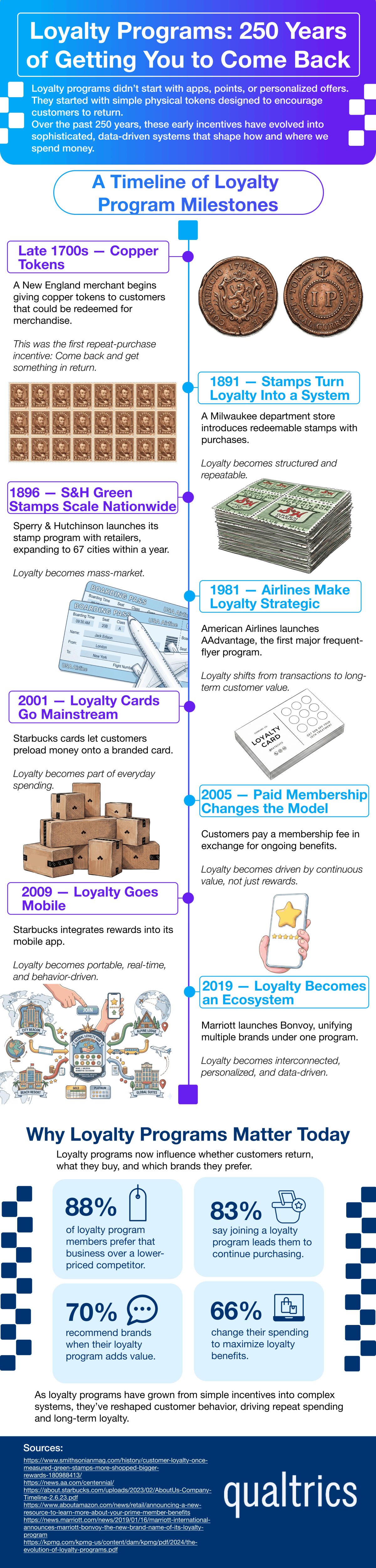
Explore the timeline in the graphic below, and continue reading for a closer look at how these strategies have evolved over the past 250 years.
Use the embed code below to add it to your own website or blog:
<center>
<textarea readonly>
<a href="https://www.qualtrics.com/articles/customer-experience/history-of-customer-loyalty-programs/">
<img src="https://www.qualtrics.com/sites/default/files/styles/standard_3xl/public/2026-05/infographic-loyalty-programs-%281%29.png.webp?itok=9D02VQdD" alt="The History of Customer Loyalty Programs — Infographic" title="The History of Customer Loyalty Programs — Qualtrics — Infographic"></a><br><a href="https://www.qualtrics.com/" alt="Qualtrics Experience Management Software" title="Qualtrics.com">By Qualtrics</a>
</textarea>
</center>
A timeline of loyalty program milestones
Over the past two and a half centuries, businesses have continually adapted how they reward repeat customers. What started as simple, in-person incentives for transactions have grown into a sprawling CX strategy focused on long-term customer value and satisfaction.
Late 1700s: Copper tokens
While other instances of these transactions have reached us through history, the earliest recorded repeat-purchase incentive appeared when a New England merchant began giving customers copper tokens. Shoppers could redeem these coin-like markers for merchandise on future visits. This established a simple premise: come back and get something in return.
1891: Stamps create a system
A Milwaukee department store formalized the concept of rewarding loyalty by introducing redeemable stamps tied to purchases. This shift made encouraging loyal shoppers structured and repeatable, laying the groundwork for more modern point systems.
1896: S&H Green Stamps reach the mass market
Sperry & Hutchinson launched its Green Stamps program, partnering with a variety of retailers. The concept scaled rapidly, reaching 67 cities within a single year and proving that loyalty could operate effectively on a mass-market scale. The company opened showrooms across the country where people could redeem their filled stamp books for a variety of goods, and at their peak, in the 1960s, they were printing more stamps than the postal service. This hugely popular program lasted into the 1980s.
1981: Airlines target long-term value
American Airlines introduced AAdvantage, the first major frequent-flyer initiative. This transition marked a crucial shift in loyalty programs: Instead of merely rewarding individual transactions, companies began focusing on cultivating long-term customer value and retention.
2001: The everyday loyalty card
Starbucks allowed customers to preload money onto branded physical cards. This model integrated rewards directly into everyday spending habits, making the transaction process faster and more rewarding for the daily consumer.
2005: The paid membership model
The introduction of paid memberships, with the biggest of these being the Amazon Prime program, changed the operational model for many retailers. By charging customers an upfront fee in exchange for ongoing benefits, like free shipping or exclusive discounts, companies could drive loyalty through continuous value rather than strictly retroactive rewards.
2009: Loyalty goes mobile
Starbucks integrated its rewards system into a mobile app. This digitization made tracking purchases portable, real-time, and behavior-driven, setting a new standard for accessibility.
2019: Loyalty expands through interconnected brand ecosystems
Marriott launched Bonvoy, unifying multiple distinct hotel brands under a single, central member account.
This represents the current era of customer retention: interconnected, personalized, and highly data-driven.
Summary of loyalty program evolution
| Year | Milestone | Impact on customer experience |
|---|---|---|
| Late 1700s | Copper tokens | Created the first physical repeat-purchase incentive |
| 1891 | Retail stamps | Made rewarding shoppers a structured, repeatable process |
| 1896 | S&H Green Stamps | Scaled the concept to a mass-market audience across multiple retailers |
| 1981 | Airline miles | Shifted focus from single transactions to long-term customer value |
| 2001 | Preloaded cards | Integrated brand loyalty seamlessly into daily spending |
| 2005 | Paid memberships | Transitioned to a model driven by continuous value |
| 2009 | Mobile integration | Made tracking and redeeming rewards portable and behavior-driven |
| 2019 | Loyalty ecosystems | Unified multiple brands into centralized, data-driven platforms |
Why rewards programs matter today
As these systems grew from simple tokens into complex digital ecosystems, they fundamentally reshaped consumer behavior. Today, effective customer loyalty programs dictate where consumers shop, how much they spend, and which brands they recommend to others.
Recent data highlights the direct impact these systems have on business outcomes:
- 88% of loyalty program members prefer that business over a lower-priced competitor.
- 83% say joining a loyalty program leads them to continue purchasing.
- 70% recommend brands when their loyalty program adds value.
- 66% change their spending to maximize loyalty benefits.
This impact clarifies one central theme: Structured incentives drive repeat spending and secure long-term preference.
Understand what drives your customers
Building a system that keeps buyers coming back requires a clear understanding of what they value. Listening to consumer feedback and tracking purchasing behavior are foundational steps in designing a loyalty program that works.
Explore how Qualtrics can help you capture customer feedback, analyze behavioral trends, and build a customer experience that turns casual buyers into lifelong advocates.
Sources:
- https://www.smithsonianmag.com/history/customer-loyalty-once-measured-green-stamps-more-shopped-bigger-rewards-180988413/
- https://news.aa.com/centennial/
- https://about.starbucks.com/uploads/2023/02/AboutUs-Company-Timeline-2.6.23.pdf
- https://www.aboutamazon.com/news/retail/announcing-a-new-resource-to-learn-more-about-your-prime-member-benefits
- https://news.marriott.com/news/2019/01/16/marriott-international-announces-marriott-bonvoy-the-new-brand-name-of-its-loyalty-program
- https://kpmg.com/kpmg-us/content/dam/kpmg/pdf/2024/the-evolution-of-loyalty-programs.pdf