
Commerce is a foundation of almost every society, even looking back to the earliest records of humanity. Whether we’re bartering for goods or processing transactions via our phones, these activities have provided a structured way to exchange goods, services, and currencies. They serve as safeguards and hubs for business operations, while also providing records of services rendered. In commerce, point of sale (POS) systems are the tools that support economic transactions, and throughout history, they’ve developed from simple bartering to the digital and cloud-based systems we use today. The story of how these systems evolved tells us all about the history of economies, how early people managed risks, and how buyers and sellers adapted to their changing world.
In this timeline from Qualtrics, we explore the history of trade and the evolution of point-of-sale technology.

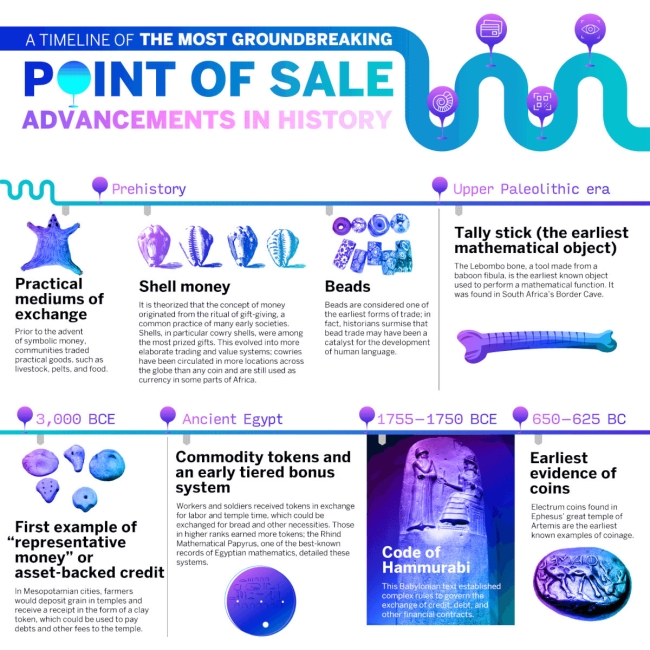
Long before paper cash (let alone barcodes and payment terminals), communities exchanged goods based on immediate need. Trade began with practical items: livestock, food, and furs for clothing and shelter. Value wasn’t set by a central authority but negotiated, item by item. Beads, shells, and tally sticks were among the first point-of-sale advancements, marking the beginnings of symbolic exchange. Cowry shells, in particular, have been found by archaeologists across multiple continents and were used as currency in societies that had never met. Tally sticks, a notched bone or wooden rod, represented early accounting and, in some ways, the original receipt.
Around 3,000 BCE, we start to see the first organized systems appear. In Mesopotamia, temples issued clay tokens as receipts for stored grain. These tokens, accepted as payment, acted as a form of asset-backed credit. In addition to being practical, they showed how economic systems could scale when tied to a trusted institution. Ancient Egypt followed with labor tokens and a tiered pay system, which served as a prototype for both payroll and loyalty programs. These ancient systems demonstrate that early trade was developed for organization and trust, as well as the exchange itself.
Ancient and medieval inovations
As societies expanded and trade became more complex, the tools supporting commerce evolved to meet new demands, and trade as we know it today began to develop. The introduction of metal coins in the seventh century BC, in Lydia, now part of modern-day Turkey, laid the groundwork for early international commerce. These coins, made of electrum, facilitated faster and more reliable transactions, especially across regions with different languages and customs.
One of the most impactful trade routes to emerge was the Silk Road. In 138 BC, Chinese envoy Zhang Qian’s journey helped establish a connection between China and the West, enabling goods, currency, and ideas to travel across thousands of miles. With the growth of such expansive trade networks came the need for alternative methods of exchange. Silent trade, used across parts of Africa and Asia, allowed merchants to trade without direct interaction. Goods were left at a designated spot, and parties took turns adding or removing items until both were satisfied.
Meanwhile, financial tools became more sophisticated. In the Islamic world, merchants developed the sakk, a document instructing a bank to make payment to a third party. This early form of the check allowed traders to avoid carrying large amounts of coin, which was safer and more efficient for long-distance travel. A few centuries later, during the Song Dynasty in China, merchants began using paper money called jiaozi to reduce the burden of transporting heavy metal coins. By the early 11th century, the government took control of the system, issuing the world’s first official paper currency.
These innovations addressed common trade challenges, such as security, portability, and standardization, and each new tool made transactions more manageable, setting the stage for the structured financial systems that would follow in the early modern period.
When was the cash register invented?
The Industrial Revolution completely changed how we paid for goods and services. In the late 19th century, James Ritty invented the first mechanical cash register after noticing money disappearing from his bar. Fraud prevention was a pressing issue, and the “Incorruptible Cashier” delivered a paper trail, a turning point in the history of POS. Soon after, John H. Patterson founded the National Cash Register Company, adding paper rolls and receipt printing to the equation.
The 20th century brought even more secure tech with the era’s growing need for speed, accuracy, and accountability within commerce. Loyalty programs gained traction when American Airlines introduced a form of “buy now, pay later” with their Air Travel Card. Plastic credit cards soon followed, starting with Diners Club and American Express, allowing purchases without tabs or the need to carry cash. Though they’re everywhere today, the first barcode wasn’t introduced until 1974, when a pack of gum changed inventory forever by becoming the first product ever scanned.
When did contactless payments start?
Over the last 50 years, POS technology has moved from manual to machine-based, and from handwritten ledgers to computer-based systems. The cash register became electric, then digital. IBM launched the first PC-based POS system in the 1980s, quickly followed by touchscreen software, self-checkout machines, and graphical interfaces. In this modern era of commerce, sales have become data.
By the 1990s, point-of-sale technology became more connected and customizable. With the introduction of the Internet, e-commerce exploded, beginning with simple online food orders and blossoming into full-scale marketplaces. Companies like Amazon showed the potential convenience and speed that could be offered with online retail.
Debit cards, contactless payments, and QR codes emerged in quick succession. Restaurants and retail shops began embracing digital POS systems with mobile compatibility. In 2009, Square introduced a system that turned any smartphone into a register, dramatically lowering the barrier to entry for small businesses.
While not yet widely adopted, biometric systems like Pay by Touch and PayEye showed that payment via fingerprints and eye scans were possibilities.
Every advancement in the history of point of sale, from cowry shells to eye scans, tells a story of how societies grow, solve problems, and connect. Of course, as communication solutions continue to improve, the link between sales, service, and human connection will only deepen.
For businesses looking to stay ahead, your POS system is more than a tool. It’s a reflection of your promise to your customers. At Qualtrics, we help build the infrastructure that supports this relationship. Together, we can help your business keep ahead of the future of communication and commerce.
Timeline of POS technology
| Event | Description |
|
Practical mediums of exchange
Prehistory |
Prior to the advent of symbolic money, communities traded practical goods, such as livestock, pelts, and food. |
|
Shell money
Prehistory |
It is theorized that the concept of money originated from the ritual of gift-giving, a common practice of many early societies. Shells, in particular cowry shells, were among the most prized gifts. This evolved into more elaborate trading and value systems; cowries have been circulated in more locations across the globe than any coin and are still used as currency in some parts of Africa. |
|
Beads
Prehistory |
Beads are considered one of the earliest forms of trade; in fact, historians surmise that bead trade may have been a catalyst for the development of human language. |
|
Tally stick (the earliest mathematical object)
Upper Paleolithic era |
The Lebombo bone, a tool made from a baboon fibula, is the earliest known object used to perform a mathematical function. It was found in South Africa’s Border Cave. |
|
First example of “representative money” or asset-backed credit
3,000 BCE |
In Mesopotamian cities, farmers would deposit grain in temples and receive a receipt in the form of a clay token, which could be used to pay debts and other fees to the temple. |
|
Commodity tokens and an early tiered bonus system
Ancient Egypt |
Workers and soldiers received tokens in exchange for labor and temple time, which could be exchanged for bread and other necessities. Those in higher ranks earned more tokens; the Rhind Mathematical Papyrus, one of the best-known records of Egyptian mathematics, detailed these systems. |
|
Code of Hammurabi
1755–1750 BCE |
This Babylonian text established complex rules to govern the exchange of credit, debt, and other financial contracts. |
|
Earliest evidence of coins
650–625 BC |
Electrum coins found in Ephesus’ great temple of Artemis are the earliest known examples of coinage. |
|
Foundation of the Silk Road
138 BC |
The expedition of Zhang Qian demonstrated that safe travel was possible from China to the west, commencing the exchange of goods among civilizations across Asia. |
|
First vending machine
1st century AD |
The prolific Greek mathematician Hero of Alexandria designed a coin-operated device that dispensed holy water. |
|
Silent trade
500–1500 |
A method used among traders who did not speak the same language. Group A would leave trade goods in a specific location and signal using a gong, fire, drum, or similar methods. Group B would arrive to examine the goods and deposit wares or money for trade. This would continue until a deal was made. |
|
“Sakk,” the predecessor of checks
7th century AD |
As international commerce grew and required more travel, Muslim merchants began exchanging pieces of paper with instructions for bank payments instead of carrying coin. This practice spread as Europeans ventured into the Middle East. The word “cheque” may be derived from “sakk.” |
|
“Jiaozi,” the first paper money
997 |
During China’s Song Dynasty, merchants began trading paper receipts, or “Jiaozi,” to avoid carrying hefty strings of coin. By the 1020s, the government took over the system, producing the world’s first government-issued paper money. |
|
1762
First printed check |
British banker Lawrence Childs issues the first printed checks to his customers. They featured serial numbers, allowing them to be tracked. |
|
1792
Coinage Act of 1792 |
The United States Congress passes the Coinage Act of 1792, creating the U.S. dollar as the nation’s standard unit of money. |
|
1793
Origin of loyalty programs |
A Sadbury, New Hampshire merchant began rewarding customers with copper tokens that could be redeemed towards future purchases at the store. This approach was quickly adopted by other retailers. |
|
1862
First U.S. one-dollar bill |
The first $1 bill is issued as a Legal Tender Note. |
|
1879 Mechanical cash register |
James Ritty and John Birch patent the Ritty Model I, or “Ritty’s Incorruptible Cashier,” after being inspired by a tool that counted steamship propeller rotations. |
|
1884
The National Cash Register Company (NCR) is founded |
John H. Patterson founds NCR and improves upon Ritty’s design, adding a paper roll to record sales and provide receipts. The original purpose was to prevent embezzlement and fraud. |
|
1906
Cash register with an electric motor |
While working for NCR, inventor Charles F. Kettering designs a cash register with an electric motor. |
|
1928
Charga-Plate |
Farrington Manufacturing Company trademarks the Charga-Plate, a metal dog-tag style plate that served as the predecessor to modern credit cards. |
|
1934
First air travel card (buy now, pay later) |
American Airlines offers the Air Travel Card, introducing the modern concept of “buy now, pay later.” Passengers could secure a ticket through credit and receive 15% off at any accepting airline. By 1941, this practice accounted for about half of the airlines’ revenues. |
|
1945
First computer |
ENIAC (Electronic Numerical Integrator and Computer) becomes the first programmable, electronic, general-purpose computer. |
|
1946
Charg-It |
Banker John C. Biggins of Flatbush National Bank in Brooklyn, New York, introduces Charg-it, the earliest bank-issued “credit card.” It was solely valid at local stores within a two-block radius. |
|
1950
Diners Club (first modern-day credit card) |
Diners Club introduces charge accounts using paper identification cards. Stores could sign up and pay a fee to participate, reaching 42,000 members by the end of 1951. |
|
1958
First plastic credit card |
American Express launches a durable plastic charge card in both the United States and Canada. |
|
1959
Silicon integrated circuit chip |
Robert Noyce invents the silicon integrated circuit chip, a technology that would later be used to make smart cards. |
|
1960
|
While working for IBM, Forrest Parry invents the magnetic stripe for use on plastic cards and ID badges. |
|
1966
First debit card |
The Bank of Delaware launches a pilot debit card program to provide an alternative to carrying cash or checks. |
|
1967
Public debut of the ATM |
A Barclays branch in the Enfield neighborhood of London becomes the world’s first automated teller machine (ATM), known at the time as a Docuteller. |
|
1969
First thermal printer system |
Texas Instruments invents the Silent 700, the first computer equipped with a thermal printer. Thermal paper would become the standard for printing receipts. |
|
1973
First commercial use of client-server technology |
IBM releases the IBM 3650 and 3660 store systems, mainframe computers capable of controlling up to 128 point-of-sale registers. |
|
April 1973
Universal Product Code (UPC) is established |
After decades of refinement, the Universal Product Code was officially established. Soon after, the Uniform Product Code Council was established to organize and assign UPC numbers to companies. |
|
June 1974
|
Marsh Supermarkets’ Head of Research and Development, Clyde Dawson, scans a pack of Wrigley’s Juicy Fruit chewing gum, the first item marked with a UPC in Troy, Ohio. |
|
August 1974
First microprocessor-controlled cash register system |
Using the Intel 8008, William Brobeck develops a local point-of-sale (POS) system for McDonald’s Restaurants. Its accuracy and convenience set the precedent for the fast-food industry. |
|
1977
First interactive kiosk |
University of Illinois pre-med student Murray Lappe designs the first interactive, self-service kiosk. |
|
March 1979
First smart card |
Michel Ugon from Honeywell Bull invents a card containing two chips: one microprocessor chip and one memory chip. The following year, he patented the SPOM (Self-Programmable One-Chip Microcomputer), making it possible to program the card’s chips. |
|
1982
First smart vending machine/first IoT device |
A Coca-Cola vending machine installed at Carnegie Mellon University becomes the first smart vending machine and the first Internet of Things (IoT) device. The available inventory and bottle temperatures could be checked via any computer connected to the ARPANET (Advanced Research Projects Agency Network). |
|
1985
First PC-based POS system |
IBM launches the IBM 4683, the first PC-based point-of-sale system. |
|
1986
First graphical POS software |
Gene Mosher introduces ViewTouch, a color touchscreen interface with configurable widgets to represent menu items. It ran on 16-bit Atari computers. |
|
1986
IBM introduces its 468x series of POS equipment |
This real-time, multi-tasking, and multi-user operating system featured keyboards, customer and operator displays, and a receipt printer port. |
|
July 1986
Self-checkout |
The first self-checkout machine, invented by David R. Humble of CheckRobot Inc., is installed at a Kroger near Atlanta, Georgia. |
|
1991
First online POS debit network |
Mastercard and Cirrus launch Maestro, the world’s first online POS debit network. |
|
1993
World Wide Web |
The World Wide Web is released to the public domain. |
|
1994
QR code |
Japan’s Denso Wave automotive parts company invents the QR code system to streamline product tracking and management. It was influenced by the black and white pieces of a Go board game. |
|
1994
First online food order |
Pizza Hut becomes the first company to offer online food ordering with PizzaNet. PizzaNet.com is still accessible. |
|
Late 1994
First gift cards (sort of) |
Neiman Marcus invents the gift card, yet they only advertised it once and did not display it. |
|
1995
First gift cards on display |
Blockbuster introduces electronic gift cards to replace paper gift certificates, aiming to reduce counterfeiting. |
|
July 1995
Amazon |
Jeff Bezos launches “Cadabra,” an online bookseller that would evolve into the world’s biggest ecommerce website. |
|
December 1995
First online food ordering service |
World Wide Waiter is founded (now Waiter.com). Service was originally only available in northern California. |
|
1996
OPOS |
Microsoft, NCR, Epson, and Fujitsu-ICL create OPS, or OLE for Retail POS, a point-of-sale device standard for Microsoft operating systems. |
|
1997
First contactless payment system |
Mobil introduces “Speedpass,” a keychain radio frequency identification device that could be scanned for electronic payment. |
|
2001
JavaPOS |
Sun Microsystems, IBM, and NCR release JavaPOS, a point-of-sale device standard written in JavaScript. |
|
2002
NFC (Near-Field Communications) standard |
Sony and Philips team up to standardize near-field communication, a key technology used for contactless payment. |
|
2002
McDonald’s begins accepting credit and debit cards |
(purposely no description) |
|
2002
|
Pay by Touch becomes the first service to enable payment via fingerprint. |
|
2003
UnifiedPOS |
The National Retail Federation releases UnifiedPOS, a vendor-neutral point-of-sale software standard. JavaPOS and OPOS have since been merged into the standard. |
|
2008
First restaurant adopts contactless payment |
EAT., a chain of sandwich shops, becomes the first dining establishment to accept contactless payment. |
|
2009
Cryptocurrency |
Developed by Satoshi Nakamoto, Bitcoin becomes the first cryptocurrency, a digital currency that is designed to be free from any central authority. |
|
2009
Square |
Block introduces Square, a cloud-based point-of-sale system. Square became the U.S. market leader in POS systems by 2024. |
|
2010
iPad |
Apple releases the iPad, the first commercially successful iPad. |
|
2011
First app-based card reader |
iZettle (now Zettle by PayPal) develops the first smartphone-based chip card reader that met international security requirements. |
|
October 20, 2014
Apple Pay |
Apple announces Apple Pay, a mobile payment service. |
|
October 29, 2014
First smart payment terminal |
Poynt releases a smart payment terminal that could process traditional cards, EMV, NFC (Apple Pay and Google Wallet), Bluetooth, and QR codes. |
|
2019
PayEye |
PayEye builds eyePOS 1.0, the world’s first commercial eye payment system. |
|
2023
First U.S. state to offer pay by eye |
Several Michigan businesses become the first to offer the ability to pay using eye recognition, thanks to PayEye technology. |
Sources
National Inventors Hall of Fame