
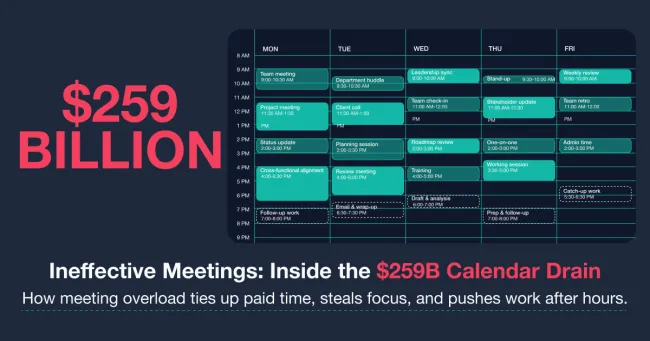
You finally get into a task, find your rhythm, and start making progress. Then, the calendar notification pops up.
An hour later, you are back at your desk trying to remember where you left off. Maybe there’s another meeting starting in 15 minutes. Maybe there are three more before the end of the day. And somewhere between those calls, you are still expected to finish the work.
This is where the true cost of ineffective meetings begins to add up. It's not only the time spent on the call. Meetings also interrupt focused work and leave employees trying to recapture momentum on unfinished tasks.
Key takeaways
- Ineffective meetings can cost more than the time blocked on the calendar by interrupting focused work and pushing unfinished tasks later into the day.
- Research from the London School of Economics estimated that unproductive meetings account for $259 billion in U.S. professional work time each year, although that figure represents the value of paid time rather than direct cash losses.
- Meeting pressure is not only about volume. Employees also report problems when meetings lack a clear purpose or end without clear next steps.
- The impact can continue after a meeting ends, which is why organizations may get more insight from looking at meeting outcomes, focus time, and after-hours work than counting calendar events.
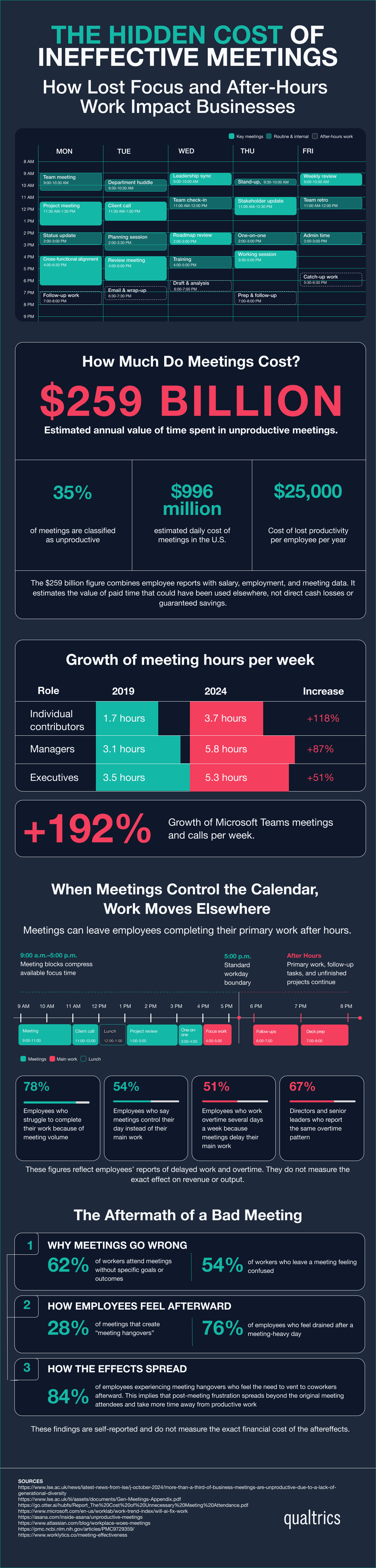
The infographic below illustrates the hidden costs of meeting overload and what happens when those costs extend beyond the meeting itself.
The scale is significant. A 2024 London School of Economics study, involving more than 3,400 professional employees globally, found that 35% of surveyed meetings were classified as unproductive. The same study estimated the annual cost of this wasted time at $259 billion.
While that figure represents the loss of paid time rather than direct cash losses, it highlights a familiar problem. When calendars fill up with meetings, the actual work doesn't disappear. Instead, it’s pushed aside.
<center>
<textarea readonly>
<a href="https://www.qualtrics.com/articles/employee-experience/hidden-costs-ineffective-meetings/">
<img src="https://www.qualtrics.com/sites/default/files/styles/standard_xl_retina/public/2026-11/qualtrics-ineffective-meetings-infographic.webp?itok=vcCXRt40" alt="Ineffective Meetings: The Hidden Costs — Infographic" title="Ineffective Meetings: The Hidden Costs — Qualtrics — Infographic"></a><br><a href="https://www.qualtrics.com/" title="Qualtrics.com">By Qualtrics</a>
</textarea>
</center>
What does this $259 billion price tag actually mean?
This $259 billion figure is a modeled estimate, not money directly lost from company accounts or guaranteed savings. Researchers combined employee reports on meeting productivity with salary, employment, meeting frequency, and meeting duration data to estimate the value of unproductive meetings.
A separate 2022 report from Otter.ai estimated that organizations invest more than $80,000 per employee per year in meetings. Of that total, more than $25,000 represents meeting time employees say they could skip if they were kept in the loop.
A crowded calendar can push focused work later
Meeting activity has become a larger part of many employees’ schedules. Compared with February 2020, Microsoft reported that time spent in Teams meetings and calls per week rose 192%. Meanwhile, according to Asana, wasted meeting time has increased across all organizational levels since 2019, with individual contributors experiencing the largest percentage increase.
Not only do meetings occupy working hours, but a calendar full of short appointments can also leave less time for uninterrupted work and sustained attention. Atlassian's research concludes that employees struggle to get work done around heavy meeting schedules. This pattern is especially common among directors and senior leaders, who more often report working overtime. While these findings do not prove that meetings directly cause overtime, they suggest that the way meetings are scheduled can impact the work those meetings are supposed to support.
The frustration can outlast meetings
The cost of a poorly run meeting can continue after the meeting ends. Researchers studying the transition from meetings to work have examined how meeting experiences can affect employees’ ability to refocus. Asana uses the term “meeting hangover” for the lingering brain fog and frustration that follow a bad or draining meeting.
The effects also spill into coworkers’ time when employees carry frustrations from their meetings to conversations with their colleagues. As reflected in the infographic, post-meeting venting is common.
Frustration alone does not make a meeting ineffective. A difficult conversation can still be productive if it leads to a clear outcome.
Unclear meetings create more work
Meeting overload is only part of the problem. What happens during the meeting matters as well. Atlassian's research found two common problems: meetings without a clear goal, and employees leaving without clear next steps.
When a meeting ends without clear takeaways, decisions, or ownership, the conversations continue elsewhere. Teams may require more meetings just to establish what was supposed to happen next.
Making meetings shorter does not necessarily solve the problem, either. A short meeting that creates more confusion still consumes more time than its calendar block suggests.
To avoid post-meeting meetings, make sure everyone understands the meeting’s purpose and leaves with clear next steps.
How should organizations track meeting efficiency?
Counting the number of meetings alone doesn’t measure the quality of team collaboration.
Worklytics highlights several calendar metrics that can provide a clearer picture of how meetings shape the workday:
|
Metric |
What it can show |
|---|---|
|
Total meeting hours by team and role |
How much of an employee’s or team’s week is spent in meetings. |
|
Back-to-back meeting frequency |
How often meetings leave little or no time between calls, which can reduce available focus time. |
|
Uninterrupted time for focused work |
How much uninterrupted time remains for work outside meetings. |
|
Growth in recurring meetings |
Whether regularly scheduled meetings are growing over time. |
|
Meetings scheduled outside normal working hours |
How often meetings extend beyond normal working hours. |
These measures become more useful when considered together. A packed calendar is more concerning when employees also have little uninterrupted focus time or regularly need to work later in the day. Recurring meetings are also worth reviewing over time to make sure they still serve a clear purpose instead of continuing by default.
Meetings can be valuable when they help people coordinate work or reach a clear outcome. The cost to the business begins when the time and attention they consume repeatedly outweigh the value they produce.
A meaningful meeting audit shouldn’t just ask, “How much time did we spend?” It should also ask, “What did that time accomplish?”
About the data
This infographic combines findings from separate workplace studies and reports. Because each source uses its own sample and methodology, the figures should be read as complementary signals rather than as one unified dataset.
The LSE estimate combines survey responses with U.S. employment and earnings data, while the Otter estimate uses self-reported meeting time and salary data. Microsoft, Asana, and Atlassian provide additional workplace and meeting-behavior findings. Peer-reviewed research is used for context on the transition from virtual meetings back to individual work, while Worklytics informs the examples of calendar metrics organizations can monitor.
Several findings are self-reported, and the financial figures are modeled estimates rather than direct measurements of revenue loss or guaranteed savings.
Sources
- https://www.lse.ac.uk/news/latest-news-from-lse/j-october-2024/more-than-a-third-of-business-meetings-are-unproductive-due-to-a-lack-of-generational-diversity
- https://www.lse.ac.uk/tii/assets/documents/Gen-Meetings-Appendix.pdf
- https://go.otter.ai/hubfs/Report_The%20Cost%20of%20Unnecessary%20Meeting%20Attendance.pdf
- https://www.microsoft.com/en-us/worklab/work-trend-index/will-ai-fix-work
- https://asana.com/inside-asana/unproductive-meetings
- https://www.atlassian.com/blog/workplace-woes-meetings
- https://pmc.ncbi.nlm.nih.gov/articles/PMC9729359/
- https://www.worklytics.co/meeting-effectiveness