
One of the most important metrics for a business to track is employee turnover, or the rate workers leave a company. Because a high turnover rate can indicate internal problems within an organization, monitoring employee retention can benefit both individual companies and the industry, providing crucial data on workforce stability.
Turnover rates tend to vary wildly across industries due to factors such as the nature of the work, economic conditions, and employment structures. In the U.S., certain industries, such as service and retail, consistently exhibit some of the highest turnover rates, whereas federal employees and finance tend to demonstrate high retention. In this report from Qualtrics, we’ll look at which industries experience the highest and lowest turnover and examine some underlying factors contributing to these patterns.
Why does turnover matter?
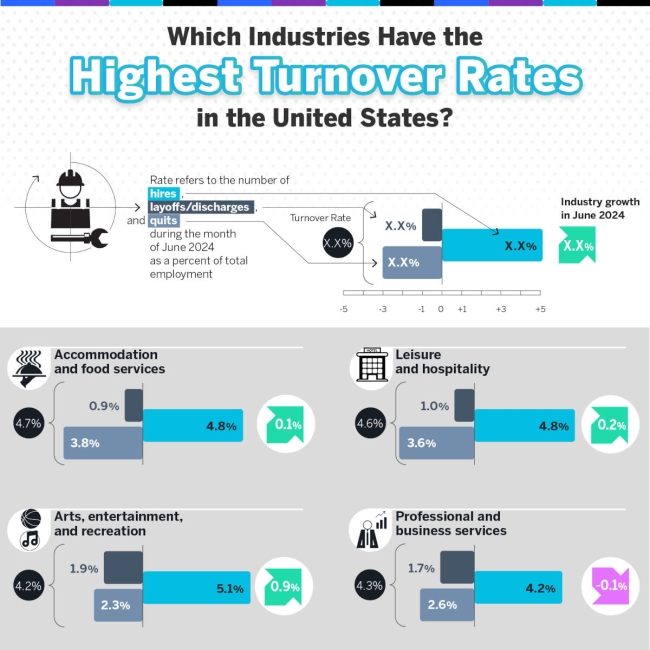
High turnover can be incredibly expensive. When a large percentage of employees leave over a short amount of time, companies are forced to pay more for recruiting, hiring, and training new staff. According to research from Cornell University, recruiting through training costs, on average, $5,864 to replace one employee. In our findings, food service ranks as one of the highest of all industries regarding employee turnover, at a rate of 4.7% for June of 2024. That means a restaurant with an average of 50 employees would be replacing roughly two employees a month. Over one year, that could amount to nearly $150,000. None of this even accounts for the lost revenue from workflow disruptions and lessened efficiency from losing experienced employees.
The costs aren’t only economic, as the disruptions to workflow and loss of help while on the job can stress workers, lowering team morale. A poorly performing workforce can result in lowered service or product delivery quality and, ultimately, dissatisfied customers. Of course, this could further hurt a business’s bottom line until it can stabilize its workforce, but it can have longer-reaching effects on a brand's overall reputation, which is much harder to correct. For example, the entertainment industry, which had a turnover rate of 4.2%, has long been criticized for its gig structure, which forces workers to rely on shorter contracts rather than long-lasting employment. As a result, tensions arose among actors and writers in the industry, and in 2023, both groups went on strike. Though many suspected the industry would rebound, it turns out many Hollywood studios are struggling, as viewers have lost faith in large-budget scripted content and have found alternative means of entertainment.
Causes of high turnover
According to a report from the Society for Human Resource Management (SHRM), the top three causes of employee turnover were compensation, lack of career development, and workplace flexibility, all of which are commonly seen in sectors like food services, retail, and hospitality, which all rank high for employee turnover. When wages are barely enough to live on, employees tend to leave for jobs that offer better compensation. These industries also often present few opportunities for advancement, and when employees feel trapped in a stagnant career, they’re less likely to find satisfaction in their jobs. Finally, irregular schedules, where employees are often required to work nights, weekends, or holidays, make it hard for workers to maintain a proper work-life balance. All these issues can eventually lead to burnout in workers and ultimately quitting or lessening performance, which may lead to termination.
One additional reason for high turnover could be the safety of the job. Of the five industries with the highest turnover, three show up on the Bureau of Labor Statistics’ list of occupations with the highest fatal work injury rates. Logging, truck drivers, iron and steel workers, miners, and construction trades make up half of the organization’s list and are among the jobs with the lowest retention rates.
Conclusion
Employee retention is not only a metric of organizational health but also a reflection of how well a company adapts to the changing needs of its workforce. Especially in the years following the high turnover rates during the COVID-19 pandemic, many companies have been forced to evolve and adapt their traditional workplace culture to retain employees successfully. Due to the high employee turnover costs, businesses in affected industries must understand the issues to help better manage their employees.
If you’re a business owner looking to optimize your employees’ experience, Qualtrics can help increase management performance and create motivated and productive teams with our top-of-the-line Employee Experience software.
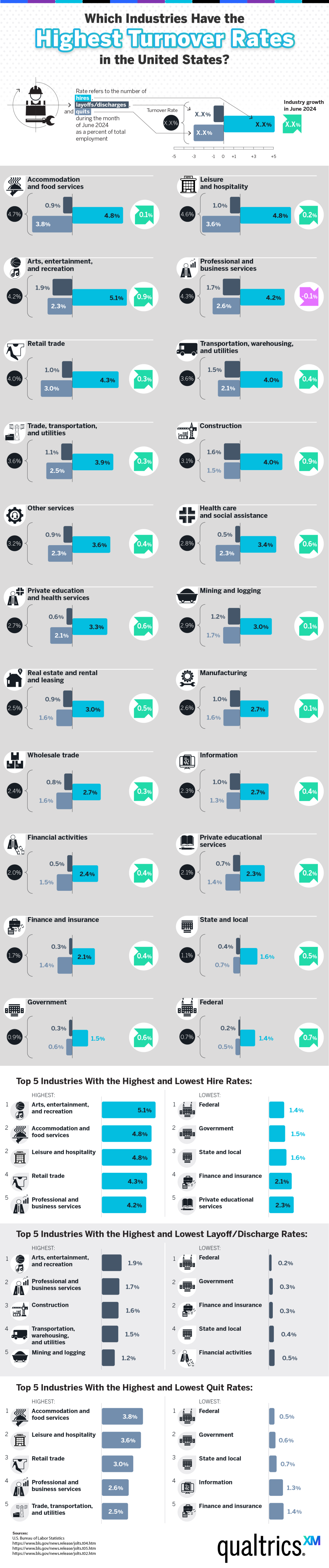
Industries with the highest and lowest turnover Rates
Top 5 industries with the highest and lowest hire rates:
Highest:
- Arts, entertainment, and recreation 5.1
- Accommodation and food services 4.8
- Leisure and hospitality 4.8
- Retail trade 4.3
- Professional and business services 4.2
Lowest:
- Federal 1.4
- Government 1.5
- State and local 1.6
- Finance and insurance 2.1
- Private educational services 2.3
Top 5 industries with the highest and lowest layoff/discharge rates:
Highest:
- Arts, entertainment, and recreation 1.9
- Professional and business services 1.7
- Construction 1.6
- Transportation, warehousing, and utilities 1.5
- Mining and Logging 1.2
Lowest:
- Federal 0.2
- Government 0.3
- Finance and insurance 0.3
- State and local 0.4
- Financial Activities 0.5
Top 5 Industries with the highest and lowest quit rates:
Highest:
- Accommodation and food services 3.8
- Leisure and hospitality 3.6
- Retail trade 3
- Professional and business services 2.6
- Trade, transportation, and utilities 2.5
Lowest:
- Federal 0.5
- Government 0.6
- State and local 0.7
- Information 1.3
- Finance and insurance 1.4
Sources:
U.S. Bureau of Labor Statistics
https://www.bls.gov/news.release/jolts.t04.htm