



PROVO, Utah & SEATTLE, Feb. 5, 2026 – Employees who experienced significant organizational change over the past year report higher engagement and productivity than those with little to no change, a finding that challenges conventional wisdom about change fatigue, according to the Qualtrics 2026 Employee Experience Trends Report.
With the vast majority of employees reporting change in 2025 and more change expected this year, leaders must support employees through it to ensure employees stay productive and engaged. This support is the top driver of employee expectations, and organizations that lead successfully through change will be rewarded with greater motivation and loyalty. Employees need to feel heard the most during times of change, making employee listening – already important – increase in value in these moments. Organizations that increased listening frequency saw employee experience metrics up to four times higher than those that listened less.
"Contrary to popular belief, the constant change and uncertainty workers have experienced has hardened them and those experiencing more change today are generally more engaged,” said Dr. Benjamin Granger, Chief Workplace Psychologist at Qualtrics. “There’s a Goldilocks zone for the right amount of change to keep employees engaged. Too much can leave them burned out, and too little, bored and stagnant. In the face of more change to come, the organizations that come out ahead are the ones that build strong connections between employees and the mission, and support them throughout with the right tools and processes."
Employee resilience to change is one of the headline findings from the annual Qualtrics study, based on 33,831 responses across 24 countries and 30 industries. Additional findings include:
- Introducing new technology like AI correlates with a 10 point increase to employee engagement, while layoffs are associated with a 7 point decrease
- Half of employees are using AI frequently at work, but just 20% are only using company-provided tools
- Customer-facing employees and part-time workers report a worsening employee experience
- The honeymoon phase for new joiners is now downright bitter, with this group reporting the lowest level of engagement since 2021
- Frontline workers have a better sense of customer experience problems than leaders, identifying the same causes flagged by consumers
- 25% of workers say their employer is listening more, and 42% want their company to listen more frequently
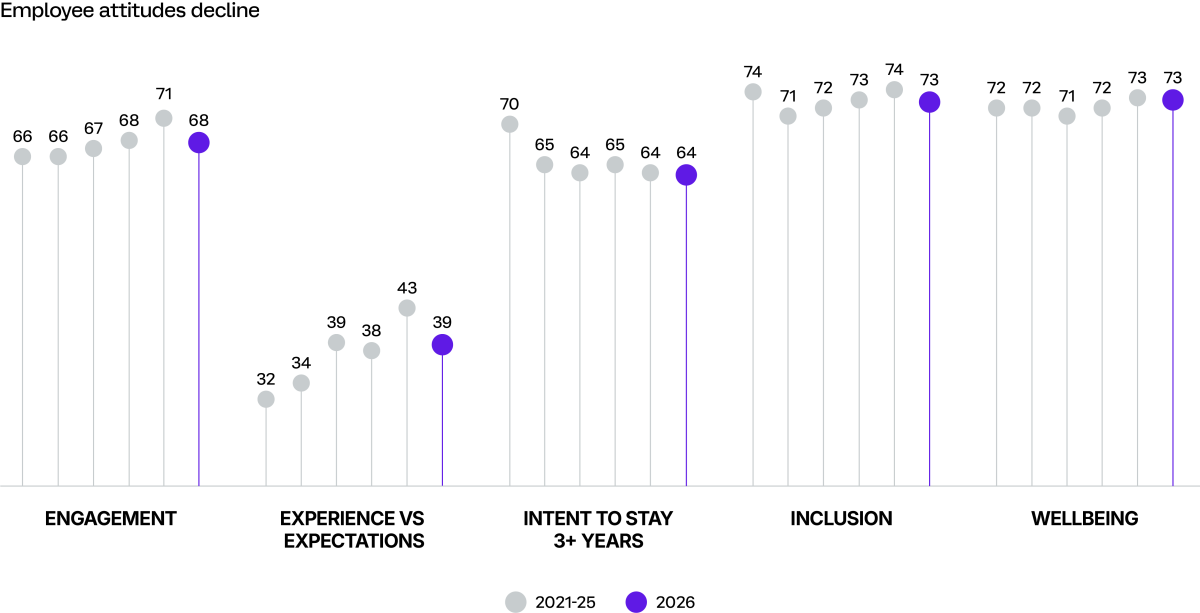
- Employee engagement and how well the organization exceeded expectations fell slightly from last year, while intent to stay, inclusion and well-being held steady.
Change drives engagement, when it’s the right kind
The majority (72%) of employees experienced significant organizational change over the past 12 months. But the type of change matters considerably in how employees respond.
Changes tied to investment, new ways of working and building for success correlated with high engagement, such as new technologies like AI, new and updated work policies, and strategic shifts. Disruptive changes such as layoffs, reorganizations, and leadership turnover had the opposite effect.
"Employees can tell the difference between changes that build toward something and equip them for the future and changes that feel like cuts that don’t benefit them," said Granger. "The former signals investment in the future. The latter signals they might not have one."
|
Type of Change |
Engagement level |
|
New technology, tools, etc. |
78% |
|
New or updated policies |
77% |
|
Physical workspace, e.g., office relocation or RTO |
76% |
|
Strategy changes |
76% |
|
Leadership changes |
67% |
|
Manager changes |
67% |
|
Organizational restructure |
66% |
|
Downsizing/layoffs |
61% |
Most employees are using AI tools their employers don't know about
Employees are using AI more, with frequent use up seven points over the past year, but just 20% of employees are only using the tools their company provides, down from 22% a year ago. This is especially true for employees experiencing high productivity pressure, suggesting that workers are bypassing corporate policy to meet those demands.
"AI is helping employees work faster and do things they couldn't before,” said Granger. “But when they go outside approved tools and policies, the risk extends to customers and the broader organization. It’s essential that HR leaders partner with IT leaders to regularly measure AI usage and sentiment among employees to ensure that the tools they’re providing meet both employees’ and leaders’ expectations."
The top benefits employees report from using AI:
- Completing tasks faster (selected by 65% of workers)
- Improving work quality (58%)
- Increasing overall productivity (51%)
Additionally, 37% of employees say AI enables them to accomplish things they previously could not do, signaling that AI is going beyond automation or acceleration of existing skills and expanding peoples’ capabilities.
Frontline and new hire experiences are declining, and customers notice
The foundation of customer experience rests on two critical groups: employees forming their own first impressions of the organization, and employees creating customers' first impressions of the brand. These groups substantially overlap with many new hires starting in customer-facing roles.
Both report worse experiences than a year ago.
|
Engagement |
Experience Exceeds Expectations |
|||
|
2026 |
Year-over-year change |
2026 |
Year-over-year change |
|
|
Global |
68% |
-3 pts |
39% |
-4 pts |
|
Frontline workers |
65% |
-3 pts |
32% |
-4 pts |
|
Part-time workers |
63% |
-7 pts |
31% |
-10 pts |
|
New hires |
65% |
-7 pts |
36% |
-9 pts |
Frontline workers also understand customers’ problems better than leadership does. When asked to identify causes of poor customer experiences, frontline employees cited communication problems and service delivery issues most often, the same top factors consumers identified. Senior leaders are more likely to blame product quality issues or post-purchase support.
Meanwhile, the new hire experience continues to deteriorate. Employees with less than a year of tenure reported sharp declines in feeling they can challenge the status quo (down from 64% to 50%) and experiencing open, honest communication (down from 71% to 63%). Engagement and exceeding expectations for new hires are at their lowest points since 2021.
“Organizations that neglect or fail to invest in the experience of their part-time, frontline, and new hires will likely experience a reciprocal drop in engagement and loyalty, which will inevitably manifest in productivity problems and churn,” said Granger. “Down the road, this will impact customers too. By failing to invest in the experiences of these critical employees, organizations risk losing their most valuable first line of defense against poor customer experience.”
Employee Listening has Widespread Benefits
High-performing organizations listen to their employees frequently, and are rewarded with strong employee experience scores.
|
Less frequent listening |
Same level of listening |
More frequent listening |
|
|
Engagement |
44% |
66% |
87% |
|
Experience v Expectations |
17% |
32% |
66% |
|
Intent to Stay |
47% |
64% |
73% |
|
Inclusion |
50% |
72% |
87% |
|
Well-being |
51% |
72% |
88% |
Employees want the opportunity to share their opinions, and the majority (68%) of employees enjoy giving feedback. Two in five (42%) of employees say they want their leaders to listen more, yet just 25% said their companies increased how often they listen in the past year.
“Times of change are precisely when employees need to feel heard the most,” said Granger. “Beyond signaling to employees that leaders care about them, it leads to action that moves the signal to reality. High-performing organizations have come to embrace this and have increased the frequency of employee listening. Others, however, have done precisely the opposite and will feel the pain eventually.”
Methodology
The 2026 Employee Experience Trends Report is based on a survey of 33,831 full-time and part-time employees conducted in September and October 2025. Participants represented 24 countries across five continents and 30 industries, with organizations ranging from 100 to 50,000+ employees. The sample was 51% male and 49% female.
About Qualtrics
Qualtrics is trusted by thousands of the world’s best organizations to power exceptional customer and employee experiences that build deep human connections, increase customer loyalty, boost employee engagement, and drive business success. Our advanced AI and specialized Experience Agents™ allow businesses and governments to proactively interact with customers and employees in personalized ways across every channel and touchpoint, respond in-the-moment to fix or improve experiences, and stay across the latest market trends and opportunities.