


The employee engagement virtuous cycle explains the critical link between employee experience (EX) and customer experience (CX) that these high-performing organizations enjoy. Organizations need great EX to sustain great CX.
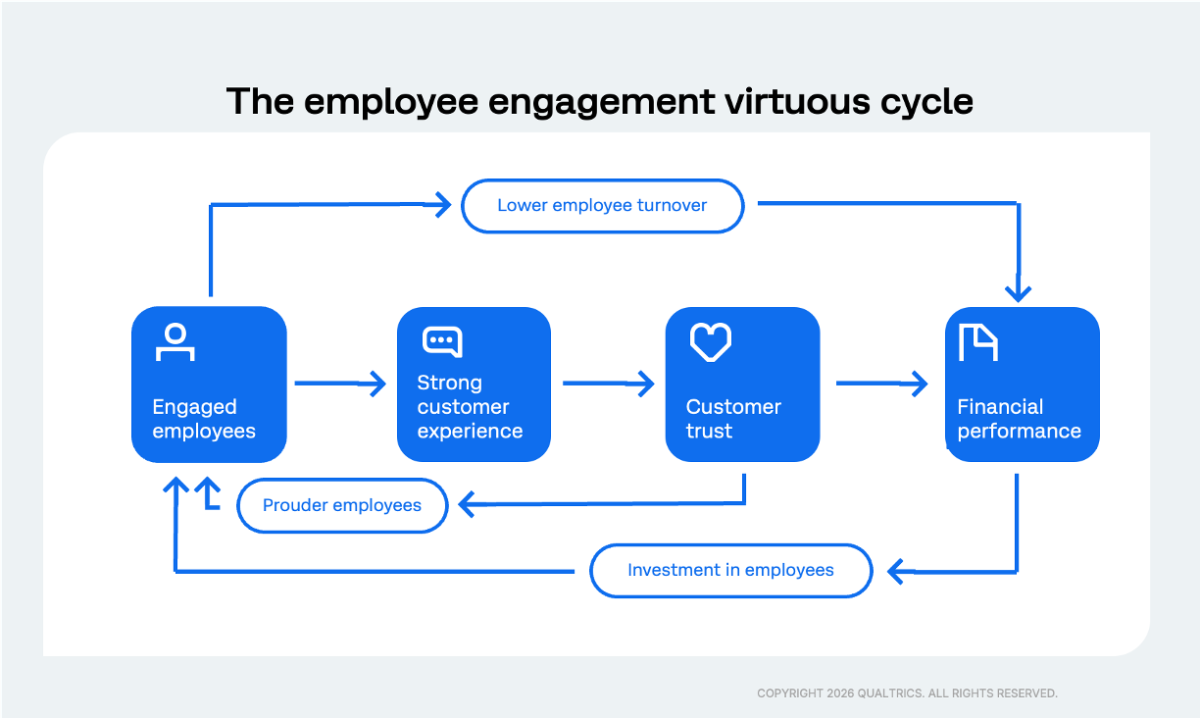
As experience management (XM) leaders increasingly understand this connection, more XM programs are capitalizing on the linkage. The reciprocal linkage among EX, CX, and business outcomes is well established, but in strategically aligning their efforts and insights, organizations aim to activate employees across the organization to drive CX improvements and better business outcomes, at scale and over time.
We’ve identified four ways to strategically align EX and CX. We share activities within each of the four categories that can help organizations better understand how and why their employees drive CX and the changes they can make to create tangible business value.
Four categories of CX and EX alignment
We’ve defined four categories of EX and CX alignment: Visualize, Analyze, Involve, and Converge.
| Alignment category | Key activities |
|---|---|
|
Visualize Present EX and CX insights together |
|
|
Analyze Examine statistical links between EX and CX |
|
|
Involve Widely include employees within CX efforts |
|
|
Converge Align EX and CX technologies and competencies |
|
Visualize: present EX and CX insights in a single view
The goal of Visualize is to present senior leaders with actionable EX and CX insights alongside each other, inherently communicating that both are important to the business and should be used in decision making.
- Anchor to key EX and CX metrics. To start, identify and present metrics that describe employees’ and customers’ overall relationships with the organizations, like customer NPS or CSAT alongside employee engagement metrics.
- Present within existing systems. Share insights with leaders in dashboards or systems they already use to view data and make decisions.
- Establish joint review protocols. Discuss insights on a regular basis to diagnose and define actionable next steps. Alternatively, leverage existing regular business reviews to discuss both EX and CX insights along with other key metrics and KPIs.
Analyze: examine statistical links between EX and CX
The goal of Analyze is to understand how EX affects CX or vice versa using actionable, statistical drivers of core EX metrics such as employee engagement to predict current or future CX metrics, such as CSAT, or customer behaviors such as repurchase and renewal. Instead of assuming the connection exists, quantify it. Analyzing the data together provides leaders with specific EX levers that are most likely to drive downstream customer attitudes and behaviors.
- Identify a meaningful unit of analysis. In order to explore the connections between EX and CX data, you must identify a meaningful unit of aggregation across your EX and CX data, such as retail sales locations, contact centers, or functional groups.
- Anchor to a reasonable CX outcome. Pick a CX metric or customer behavior attributable to a specific group of employees. It’s important to avoid metrics that employees do not have at least some direct control over or company-wide metrics that no single team owns. For example, transactional metrics about agent friendliness or knowledge in a contact center are great places to start. Relational metrics like NPS are much further removed from direct employee interactions and don’t model well in these analyses.
- Capture EX drivers. EX drivers should be theoretically related to CX outcomes, directly actionable, and measured in advance of CX metrics so there’s time for employee attitudes to impact customers. Measure whether contact center agents feel equipped with the training and autonomy to handle customer issues.
Organizations often skip this category because it requires connected EX and CX data and traditionally solid teams to actually work with each other. And yet, this is one of the most impactful steps XM professionals can take to drive actionable change at scale and earn the all-important executive buy-in. One XM leader put it simply: every point of improvement in employee engagement showed a 2% lift in customer engagement and 0.5% lift in profit. That's evidence that turns "we should probably invest in EX" into a funded initiative.
Involve: widely include employees within CX efforts
Unlike Visualize and Analyze, which deal with data and insights, Involve introduces action—ways for employees to more directly impact customer experiences.
- Identify employee-customer moments of truth. Find the touchpoints across the customer journey, like a point of sale or service call, where it’s most important that employees understand customers’ needs, deliver on brand promises, and improve experiences.
- Collect feedback from employees. Establish listening posts to gather feedback from employees at those critical moments to bring context to customer interactions, surface CX barriers, and capture ideas for innovation.
- Reinforce desired behaviors. Use feedback from customers and employees to find and propagate best practices, celebrate people making a positive impact, and address performance gaps through training and coaching.
Converge: align EX and CX technologies and competencies
Converge is not typically the starting point for organizations, but it’s necessary to progress beyond the basics in the other categories.
- Create a unified vision. EX and CX professionals need to align their objectives and the business outcomes they are trying to impact, then identify how EX efforts can support CX and vice versa. For example, a team might develop employee training to coach contact center agents on building emotional rapport with customers or rolling out new systems to improve the customer onboarding journey.
- Establish a shared Center of Excellence (CoE). Bring together EX and CX professionals to exchange approaches, best practices, and capabilities within a CoE. Even informal working sessions can be useful, and may build to formal functions over time.
- Align platforms and processes. In order to support the work of the CoE and make the other categories of EX and CX alignment more natural, synchronize and consolidate the related platforms and processes that underpin this work. For example, standardize on an enterprise platform that collects and analyzes both EX and CX insights.
The bottom line: EX and CX are individually valuable, but are far more powerful together. They are intimately connected to each other and are ultimately what determine the long term financial success of an organization.