
While it was once the subject of speculative fiction, AI has become a feature of our everyday lives. Whether helping us navigate rush hour traffic, summarizing search engine results, or assisting doctors with critical diagnoses, artificial intelligence seems to have gone from futuristic fantasy to being fully integrated into society in the blink of an eye.
The pace of AI’s adoption by corporations, startups, and individuals alike has been rapid, but public opinion doesn’t always move at the same speed as technological advances. AI is currently a hot topic in the media, ranging from listicles offering tips on using a new tool effectively to fearmongering articles about its implications for the future. With such a wide spread of opinions, the Qualtrics team wanted to know the broader public sentiment surrounding AI.
With that in mind, today we’re looking at Stanford University’s 2025 AI Index Report to get a feel for where AI optimism is blooming, where people feel more wary, and which regions are seeing the biggest shifts.
The growth of AI in recent years
Artificial intelligence technology has gone from modest growth to rapid acceleration in the last few years. In the 2020s in particular, countries across the world have seen a marked increase in AI adoption across industries. Governments are investing heavily in AI infrastructure, businesses are leveraging machine learning to improve customer experiences and cut costs, and individuals are integrating tools like generative AI into their workflows and even personal lives.
This acceleration comes hand in hand with widespread conversations about its implications. As people adapt to AI-enabled environments, their feelings about the technology are evolving in tandem, shaped by things like access to education, cultural values, and media representation of AI platforms.
What are the benefits of AI?
AI is getting increasingly popular globally, not just because it can generate emails and funny videos. There are real, tangible ways that AI is starting to benefit individuals and society at large. At work, it can automate certain repetitive tasks, which helps speed up and optimize workflow. It’s also skilled at data analysis and offers real-time decision support, which allows workers to spend more time on strategic and creative tasks, rather than mundane grunt work. Additionally, we’re seeing things like virtual assistants and AI-powered chatbots that can help reduce wait times and deliver on-the-spot customer service.
Healthcare is one of the most exciting examples of the benefits of AI. AI has shown itself to be extremely skilled at identifying diseases, even at earlier stages. By working alongside AI, doctors will be able to diagnose and treat more patients sooner and may even be able to offer more personalized treatment plans. Thanks to its data analysis abilities, AI can also benefit researchers and scientists, helping to speed up discoveries in healthcare and other industries.
Even at home, AI is showing up in both subtle and significant ways, from improvements to voice-activated mobile phone assistants to things like smart thermostats that can cut energy costs and new cars that have self-driving capabilities. In short, AI has widespread beneficial applications to high-tech, billion-dollar companies and individuals alike.
Why are some people wary of AI?
As expected with any new technology, public opinion on AI remains mixed. There are major concerns about AI, including security and personal data exposure, infringement of intellectual property rights, deep fakes, inaccuracy or unreliability, and environmental impact. These reasons are being openly discussed in countries around North America and Europe, which may explain the relatively low popularity of the tech. However, concerns about AI are especially apparent in developing economies where AI seems to signify a higher risk of job loss.
In India, for example, trust in AI dropped from 71% in 2022 to 62% in 2024. While this was the largest decline recorded, other developing countries, including Peru, Chile, and Malaysia, also reported falling trust levels. Though each of these countries still shows more than 50% approval of AI, favor has been dropping in response to the increasing discussion around the threat to white-collar, higher-paying work in lower-income countries.
AI sentiments around the world
So, which country trusts AI the most? China is at the top of the list, with 83% of respondents saying they believe AI will bring more benefits than drawbacks, and Indonesia (80%) and Thailand (77%) aren’t far behind. These high levels of trust may be tied to the integration of AI in public services, education, and commerce in these regions.
On the other end of the spectrum, Western European countries appear to be much less enthusiastic about AI, with countries like France (41%), Germany (47%), and the Netherlands (36%) all showing less than 50% approval. That said, many of these countries have also seen increases in trust, suggesting a slower, yet steady rise in acceptance as time goes on. The EU has demonstrated a stricter and more cautious approach to AI regulation, which has likely been a factor in the increased skepticism seen in these countries.
The United States, with 39% approval, ranks in the lower third of the list. But even here, trust in AI rose by 4% in two years, pointing to a gradual but consistent shift in public perception. The U.S., despite being one of the leading developers of AI, has a greater history of distrust in corporations and the government, which may explain why the public is more wary of how political leaders and big business will use these tools. In summary, most countries are seeing AI grow in popularity, even in places where trust is relatively low.
Trust in AI is growing, not just among tech leaders but among everyday people across the globe. As confidence builds, AI becomes more accepted and deeply integrated into how we work, communicate, and solve problems. For businesses that want to stay ahead, AI is becoming a core part of how they operate, communicate, and make decisions. For companies focused on delivering better employee and customer experiences, Qualtrics AI-powered tools turn complex data into clear direction. Contact us today if you’re ready to put AI to work where it counts.
How popular is AI around the world?
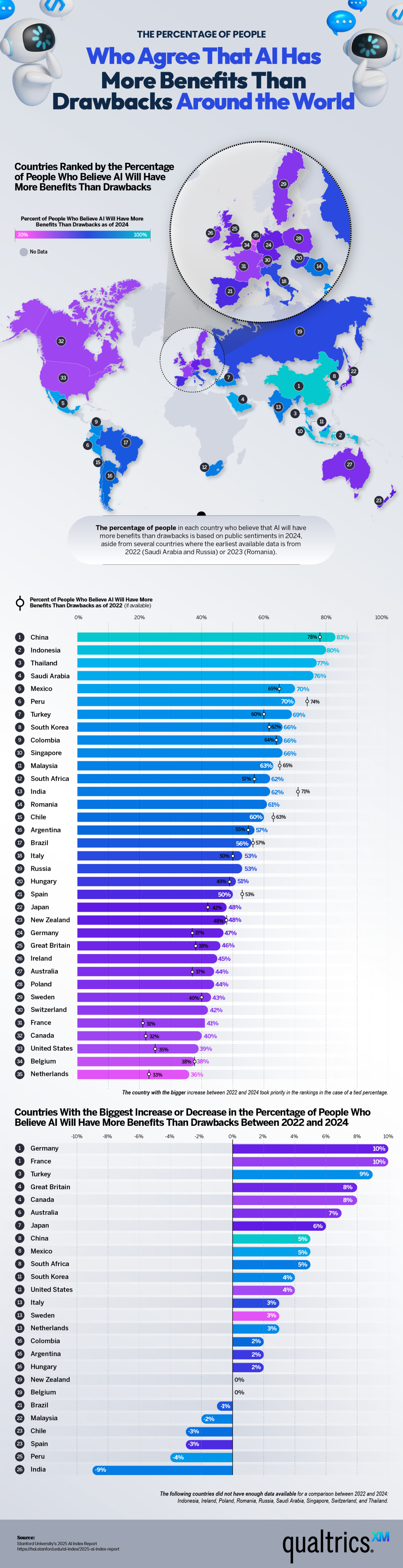
Countries ranked by the percentage of people who believe AI will have more benefits than drawbacks
The percentage of people in each country who believe that AI will have more benefits than drawbacks is based on public sentiments in 2024, aside from several countries where the earliest available data is from 2022 (Saudi Arabia and Russia) or 2023 (Romania).
| # | Country | Percent of People Who Believe AI Will Have More Benefits Than Drawbacks as of 2022 (if available) | Percent of People Who Believe AI Will Have More Benefits Than Drawbacks as of 2024 |
| 1 | China | 78% | 83% |
| 2 | Indonesia | x | 80% |
| 3 | Thailand | x | 77% |
| 4 | Saudi Arabia | x | 76% |
| 5 | Mexico | 65% | 70% |
| 6 | Peru | 74% | 70% |
| 7 | Turkey | 60% | 69% |
| 8 | South Korea | 62% | 66% |
| 9 | Colombia | 64% | 66% |
| 10 | Singapore | x | 66% |
| 11 | Malaysia | 65% | 63% |
| 12 | India | 71% | 62% |
| 13 | South Africa | 57% | 62% |
| 14 | Romania | x | 61% |
| 15 | Chile | 63% | 60% |
| 16 | Argentina | 55% | 57% |
| 17 | Brazil | 57% | 56% |
| 18 | Italy | 50% | 53% |
| 19 | Russia | x | 53% |
| 20 | Hungary | 49% | 51% |
| 21 | Spain | 53% | 50% |
| 22 | Japan | 42% | 48% |
| 23 | New Zealand | 48% | 48% |
| 24 | Germany | 37% | 47% |
| 25 | Great Britain | 38% | 46% |
| 26 | Ireland | x | 45% |
| 27 | Australia | 37% | 44% |
| 28 | Poland | x | 44% |
| 29 | Sweden | 40% | 43% |
| 30 | Switzerland | x | 42% |
| 31 | France | 31% | 41% |
| 32 | Canada | 32% | 40% |
| 33 | United States | 35% | 39% |
| 34 | Belgium | 38% | 38% |
| 35 | Netherlands | 33% | 36% |
The country with the biggest increase between 2022 and 2024 took priority in the rankings in the case of a tied percentage.
<h3>Countries With the Biggest Increase or Decrease in the Percentage of People Who Believe AI Will Have More Benefits Than Drawbacks Between 2022 and 2024</h3>
| # | Country | Change in Percentage |
| 1 | Germany | 10% |
| 1 | France | 10% |
| 3 | Turkey | 9% |
| 4 | Great Britain | 8% |
| 4 | Canada | 8% |
| 6 | Australia | 7% |
| 7 | Japan | 6% |
| 8 | China | 5% |
| 8 | Mexico | 5% |
| 8 | South Africa | 5% |
| 11 | South Korea | 4% |
| 11 | United States | 4% |
| 13 | Italy | 3% |
| 13 | Sweden | 3% |
| 13 | Netherlands | 3% |
| 16 | Colombia | 2% |
| 16 | Argentina | 2% |
| 16 | Hungary | 2% |
| 19 | New Zealand | 0% |
| 19 | Belgium | 0% |
| 21 | Brazil | -1% |
| 22 | Malaysia | -2% |
| 23 | Chile | -3% |
| 23 | Spain | -3% |
| 25 | Peru | -4% |
| 26 | India | -9% |
The following countries did not have enough data available for a comparison between 2022 and 2024: Indonesia, Ireland, Poland, Romania, Russia, Saudi Arabia, Singapore, Switzerland, and Thailand.
Source
Stanford University’s 2025 AI Index Report. https://hai.stanford.edu/ai-index/2025-ai-index-report