
Executives who rate their organizations ahead of competitors expect a more turbulent path to 2030 than their peers. They are much more likely to anticipate major restructuring, faster operations, and rising demands from customers and employees. Yet 74% say their organizations are very or completely prepared to compete in 2030, compared with just 36% of executives who rate their performance on par with or below competitors.
However, while their outlooks might differ, high and low performers’ investment priorities look surprisingly similar. Technology and AI lead both groups’ current priorities and the areas where they believe investment should increase over the next five years. Both also identify talent shortages or skills gaps as their leading competitive risk, even though talent and skills development ranks near the bottom of current investment areas across the sample.
Executives are making investment decisions today that will help shape how their organizations operate in the years ahead. As AI takes on more routine work and changes how organizations make decisions and manage relationships, the question for experience leaders is whether those decisions will prepare employees for changing roles and help organizations meet the rising expectations of customers and employees.
How high and low performers’ outlooks for 2030 compare
XM Institute’s survey of 1,000 executives at large organizations asked about the changes they anticipate, how prepared they feel, the capabilities they report today, and their future priorities. We compared responses between high performers, who rated their organization’s business performance better than competitors, and low performers, who rated it the same as or worse.¹
High performers expect more change by 2030
To understand the future executives are preparing for, we asked about the changes they anticipate in their organizations and in the expectations of customers and employees.
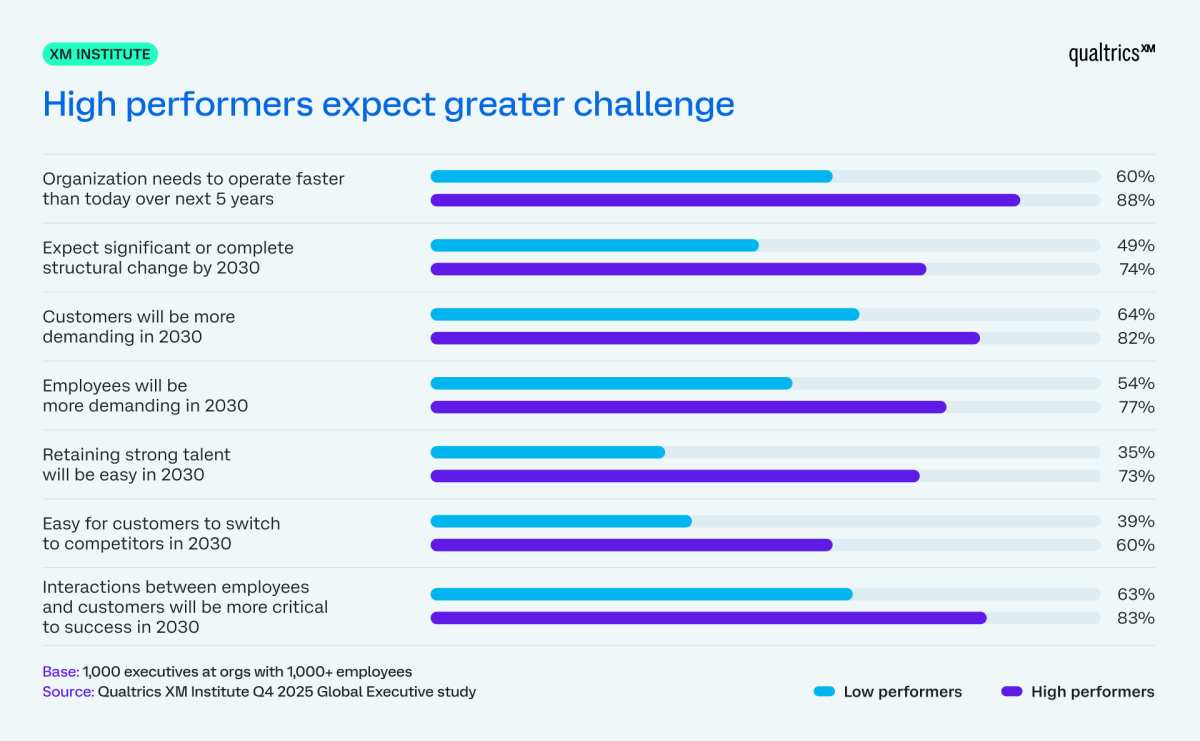
- High performers are more likely to anticipate major organizational change. Nearly three-quarters of high performers expect significant or complete structural change by 2030, compared with about half of low performers (74% versus 49%). An even larger share, 88%, say their organization will need to operate faster over the next five years, compared with 60% of the low-performing group.
- High performers anticipate a more demanding customer environment. Eighty-two percent of high performers expect customers to become more demanding by 2030, compared with 64% of low performers. Alongside those rising demands, they are also more likely to expect customers to find switching to a competitor easy (60% versus 39%).
- Rising employee expectations coexist with optimism about talent. Seventy-seven percent of high performers expect employees to become more demanding by 2030, compared with 54% of low performers. Yet nearly three-quarters of the high-performing group expect attracting and retaining strong talent to be easy, compared with just over a third of the low-performing group (73% versus 35%).
- High performers expect human interaction to matter more. Eighty-three percent of high performers agree that direct interactions between employees and customers will become more critical to their organization’s success by 2030, compared with 63% of low performers.
High performers feel better prepared for 2030
Alongside their expectations for change, we asked executives about their organizations’ preparedness for 2030 and the technology adoption, employee skills, and leadership support they have in place today.
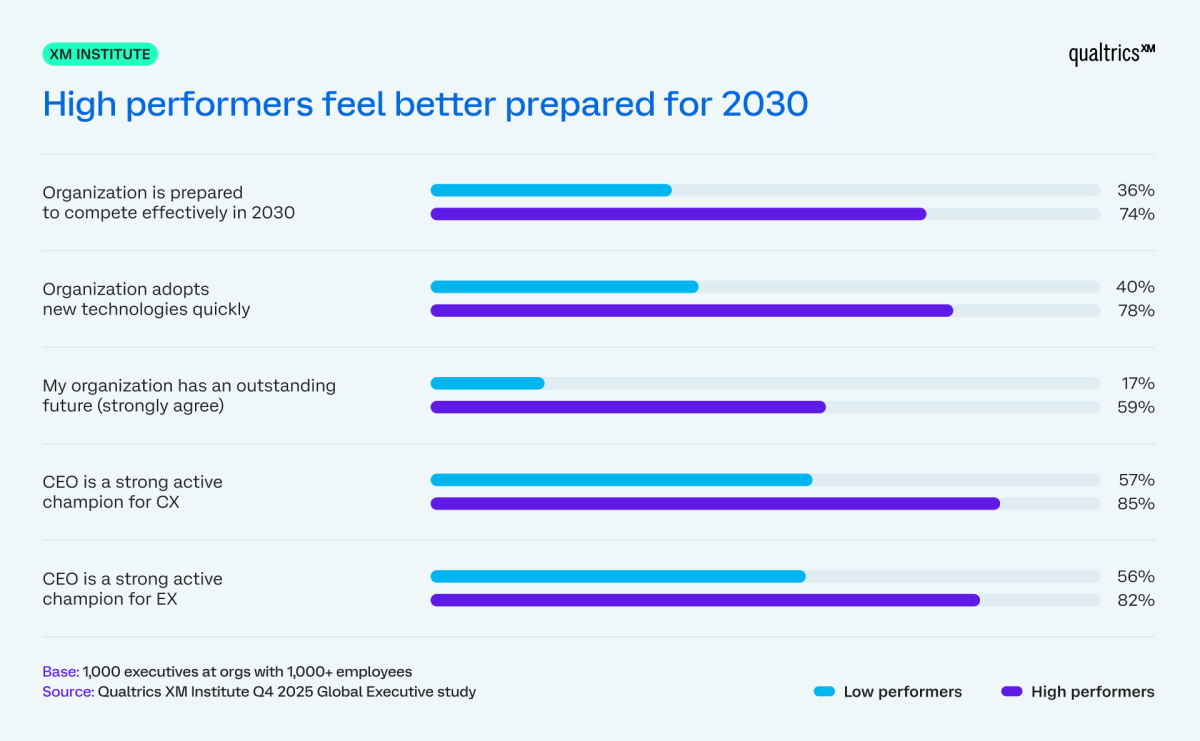
- High performers feel better prepared and more optimistic about their future. High performers are about twice as likely as low performers to say their organization is very or completely prepared to compete in 2030 (74% versus 36%). A majority, 59%, also strongly agree that their organization has an outstanding future, compared with fewer than one in five in the low-performing group (17%).
- Active technological experimentation is more common among high performers. High performers are about five times as likely as low performers to say they adopt new technologies very quickly, actively experimenting with emerging technologies (31% versus 6%).
- High performers report stronger workforce skills. More than three-quarters of high performers say their employees have most or all of the skills needed to succeed over the next five years, compared with half of low performers (78% versus 50%). Among the six specific skills assessed, business-driven prioritization has the largest gap in strong or very strong ratings, 28 percentage points (78% versus 50%).
- High performers report stronger executive support for customer and employee experience. Eighty-five percent of high performers say their CEO or the executive in charge strongly champions customer experience, compared with 57% of low performers. The pattern is similar for employee experience, at 82% versus 56%.
High and low performers share similar priorities and concerns
While high and low performers differ in how much change they expect and how prepared they feel, their answers are more closely aligned on investment priorities, sources of competitive advantage, and the risks ahead.
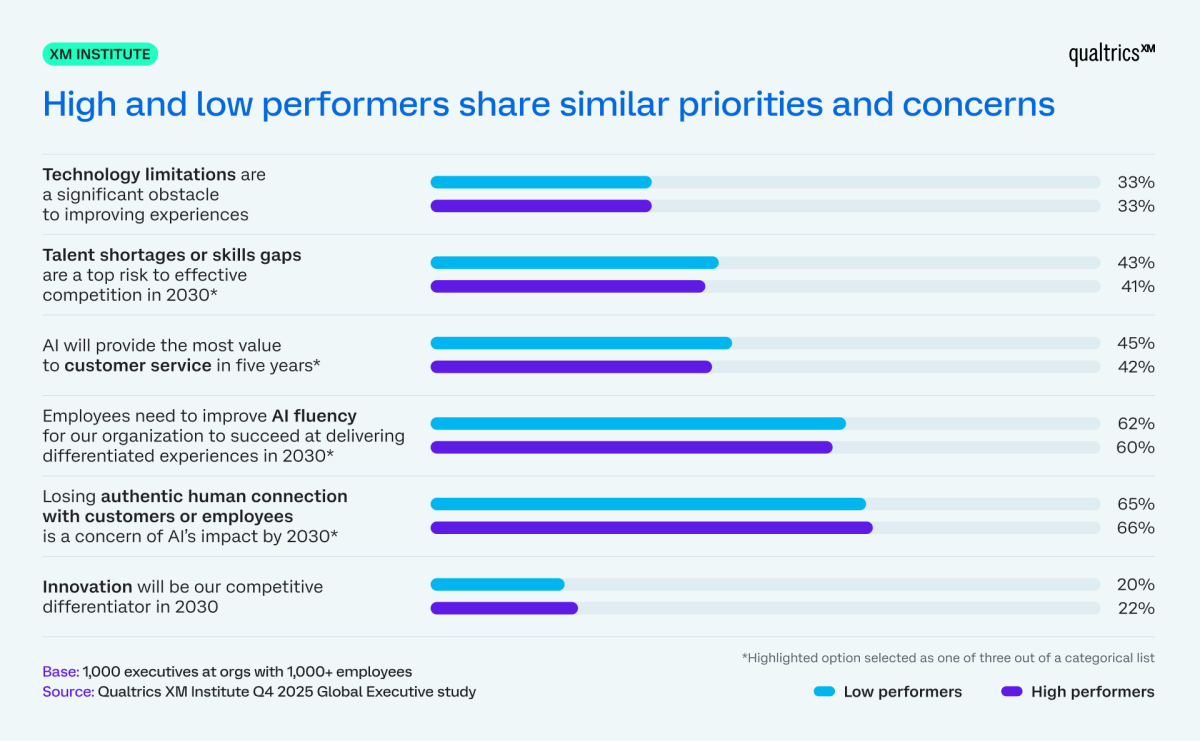
- Technology is both a leading obstacle and an investment priority. Technology limitations top both groups’ lists of obstacles to improving experiences, cited by a third of each group (33%). Across all executives, unclear returns on investment (28%) and insufficient funding (27%) are the next most commonly cited obstacles. Technology and AI lead both groups’ current investment priorities and their choices of where investment should increase over the next five years.
- Talent is a top concern but low investment priority. Talent shortages or skills gaps are the most commonly cited risk to competing effectively in 2030 among both high and low performers (41% and 43%, respectively). Yet across the sample, talent and skills development ranks seventh out of eight current investment areas, with 30% of executives naming it among their organization’s top three. It also ranks sixth among the areas where executives believe their organizations should increase investment in five years.
- AI fluency tops both groups’ skills improvement priorities. About 60% of executives in each group identify AI fluency as one of the three employee skills most in need of improvement to deliver differentiated experiences by 2030.
- Customer service leads expectations for AI value. Both groups most often include customer service among the three functions where they expect AI to provide the most value in five years (42% and 45%, respectively). Research and development (36%) and quality assurance (34%) rank second and third overall.
- Losing human connection is a shared concern about AI. Nearly identical shares of high and low performers identify losing authentic human connection with customers or employees among their three leading concerns about AI’s impact by 2030 (66% and 65%, respectively).
- Both groups see innovation as a leading differentiator. Asked to choose one factor that will differentiate their organization for customers in 2030, high performers most often select innovation (22%). It ranks second among low performers (20%), behind product or service quality. High performers are also more likely to select brand reputation and trust (16% versus 10%).
What these findings suggest about organizational readiness for 2030
High performers expect much more change by 2030 than low performers do, but their investment priorities look remarkably alike. Technology and AI lead both groups’ current priorities and the areas where they believe investment should increase over the next five years.
That emphasis is understandable, given that AI is already changing how organizations make decisions and manage relationships with customers and employees. But executives also anticipate more demanding employees and customers. And technology that speeds up operations won’t automatically produce better experiences for either. Their own answers suggest a disconnect between the future they expect and the priorities they have set to prepare for it.
Workforce skills expose this disconnect most clearly. Talent shortages or skills gaps are the leading competitive risk for both groups (41% of high performers and 43% of low performers), even though high performers rate their workforce skills far more highly (78% versus 50%). About six in ten executives in each group also name AI fluency among the employee skills most in need of improvement. And yet, across the sample, talent and skills development ranks seventh out of eight current investment areas and sixth among those where executives believe investment should increase. Which means that much of the value executives expect from technology and AI, their top priority, depends on workforce capabilities whose development they rank near the bottom.
AI will also change the jobs those capabilities are meant to support. As it takes on more routine tasks and shifts how work gets done, employees will likely assume new responsibilities. At the same time, high performers expect employees to become more demanding of their jobs and employers. While training can help prepare people for these redesigned roles, organizations also need to consider how those changes affect employees’ experience of work, including whether they have the support and discretion to do their jobs well and whether they find the work itself worthwhile.
High performers anticipate a tougher environment for customer experience as well. They are more likely to expect customers to become more demanding and to find it easy to switch to a competitor. Customer service illustrates why AI's potential value to the business must be considered alongside its value to customers. It tops both groups’ lists of functions where they expect AI to provide the most value. Yet in our 2026 Consumer Experience Trends research, nearly one in five consumers who used AI for customer service reported no benefit, the highest share of any AI application we studied and nearly four times the average. If AI makes service faster without making it more helpful, organizations risk undermining customer loyalty just as high performers expect switching to become easier.
The quality of AI-enabled service will depend partly on which requests organizations automate and when employees step in. As AI handles more straightforward requests, employees will deal with a greater share of complex or emotionally charged problems. Most high performers expect direct interactions between employees and customers to become more critical to business success (83% versus 63% of low performers), and about two-thirds of both groups worry about losing authentic human connection with customers or employees. If customers cannot reach someone who can help or employees lack the information and authority to resolve the problems AI passes to them, automation could make service worse for customers and work more frustrating for employees.
To address the disconnect between forecasts and priorities, executives should test their investment plans against the future they anticipate. That means asking whether those plans build the skills employees will need as jobs change, and whether the changes they make across the business will improve what customers and employees experience. Otherwise, they could deploy AI exactly as planned and still widen the Experience Gap between what people expect and what their organizations deliver.
How experience leaders can help executives prepare for 2030
Experience leaders can help executives prepare for the changes they anticipate by bringing customer and employee evidence into technology planning and the operating decisions that follow.
- Stress-test investment plans against the changes executives expect. Start by identifying the three or four changes your leadership team believes will have the greatest impact on the organization by 2030. For each one, list the initiatives intended to prepare for it, including their owners, required workforce capabilities, and expected business and experience outcomes. Compare these requirements with current plans and resources. Where technology projects have detailed roadmaps but the corresponding workforce or experience requirements remain undefined, bring those gaps into the next strategy or investment discussion.
- Redesign work and build workforce skills together. Before scaling an AI initiative, work with HR, managers, and affected employees to understand how it will reshape their jobs. Ask employees which parts of their work they would gladly hand off and which give them satisfaction or help build their expertise. Use XM Institute’s HR task-suitability worksheet to weigh their preferences against task complexity, risks, and customer impact before deciding what AI should automate, support, or leave to employees. Then identify the skills employees will need, clarify which decisions require human review or override and who remains accountable for the outcomes, and build training and practice time into implementation plans. During pilots, ask whether redesigned roles give employees the support and discretion to do their jobs well and whether they find the work worthwhile, then adjust responsibilities, workloads, and performance expectations accordingly.
- Make customer outcomes a condition for expanding AI-enabled service. Start with an important customer journey, such as getting help with a problem, and define what successful completion means from the customer's perspective. Establish baseline measures for issue resolution, customer effort, and repeat contacts, then compare AI pilots with existing service for comparable types of requests. Decide which requests AI can handle effectively, when customers should be able to reach an employee, and what information and authority that employee needs to resolve the issue. Evaluate these outcomes alongside efficiency measures such as containment and handling time, and use the findings to expand, revise, or pause deployments.
- Keep customer and employee outcomes visible in operating decisions. Bring relevant customer and employee experience measurements into the business reviews where technology and operating decisions are already made. For an AI-enabled staffing and scheduling initiative, that could mean reviewing labor efficiency alongside employees' workloads and schedule predictability, as well as customers' wait times. Agree in advance who will investigate when operational gains coincide with deteriorating experiences and what decisions they can revisit, from staffing levels to automation rules. Continue reviewing these measures as AI use expands so improvements in one area don't mask problems elsewhere.
Qualtrics XM Institute Q4 2025 Global Executive Study surveyed 1,000 executives online at organizations with 1,000 or more employees, headquartered in Australia, Canada, Germany, the United Kingdom, and the United States (200/country). Business performance is a self-reported rating against competitors on a five-point scale. The high-performer group (n=700) rated performance better than competitors. The low-performer group (n=300) rated it the same or worse. Source report: Global executives predict the future of experiences.