By their own account, employees are more invested in customer satisfaction than they believe their employers are.
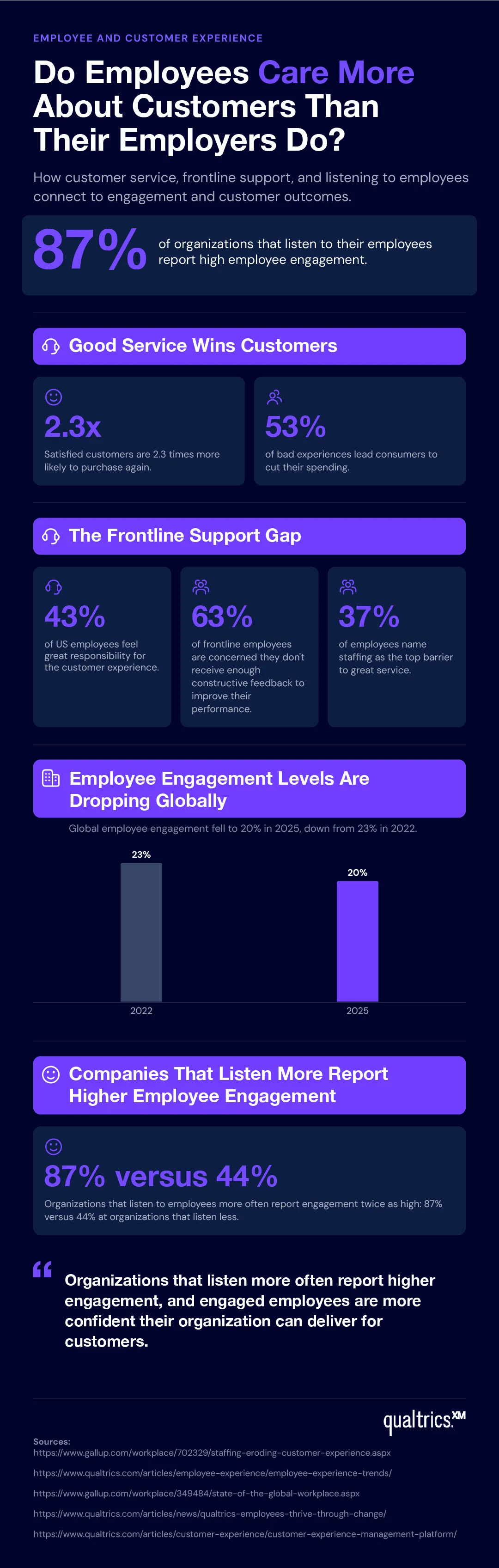
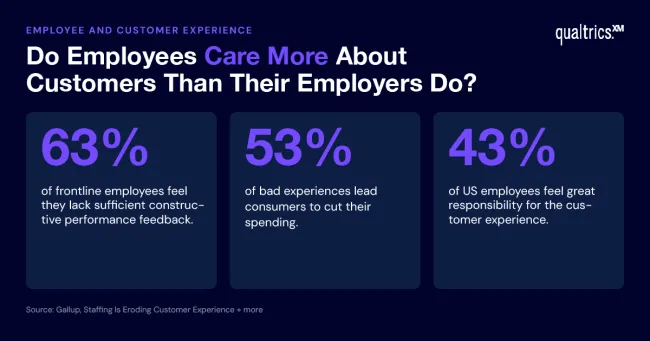
In a 2025 Gallup survey of U.S. employees, 43% strongly agreed that they feel great responsibility for the customer experience. But only 23% strongly agreed that their organization consistently delivers on the promises it makes to customers.
That 20-point difference is the frontline support gap: the distance between how accountable employees feel for customers and how well their employer equips them to deliver. Many employees want to deliver excellent service, but they often feel they lack the support needed to do it well.
The team at Qualtrics analyzed recent workplace and consumer data to better understand this gap. The findings reveal the contrast between worker dedication and organizational support and show why closing it matters for customer loyalty.
Key takeaways
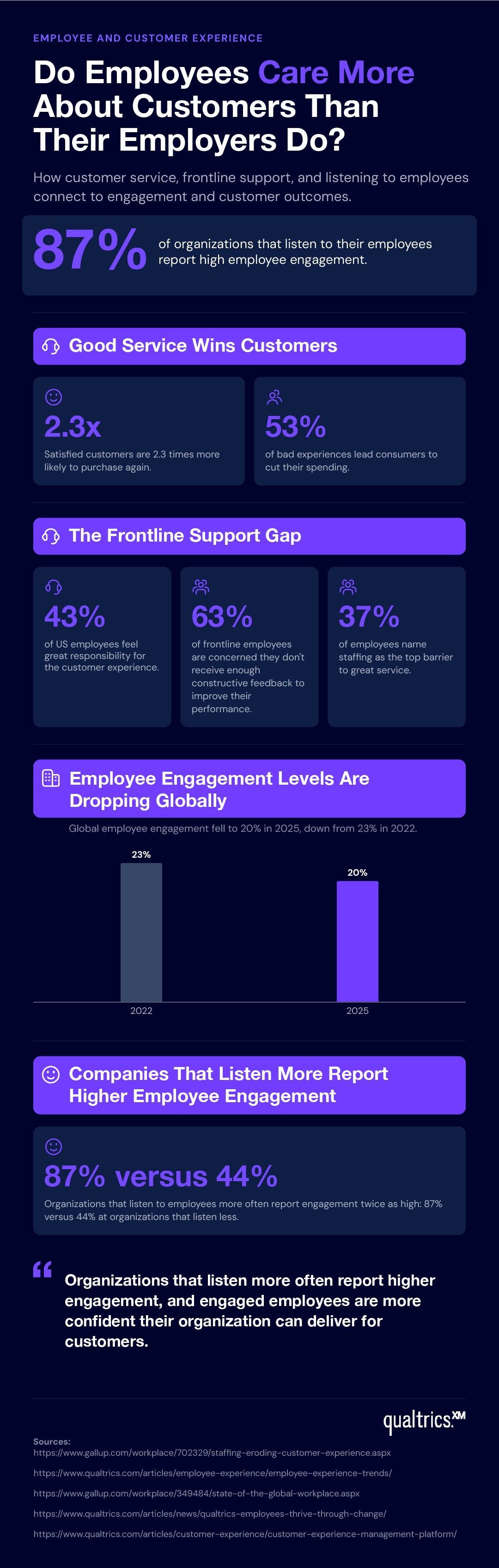
- Employees name staffing as the top barrier to great service (37%), ahead of training (16%), tools or equipment (9%), and unclear standards (8%).
- Qualtrics research found that 63% of frontline employees are concerned they don’t receive enough constructive feedback to improve their performance.
- Global employee engagement fell from 23% in 2022 to 20% in 2025.
- Organizations that listen to employees more report employee engagement of 87%, compared with 44% at organizations that listen less.
Embed code
Embed this infographic on your website or blog by using the code below:
<center>
<textarea readonly>
<a href="https://www.qualtrics.com/articles/experience-management/do-employees-care-more-about-customers/">
<img src="https://www.qualtrics.com/sites/default/files/styles/standard_3xl_retina/public/2026-10/employee-care.webp?itok=03R6AQf2" alt="Do Employees Care More About Customers Than Their Employers Do? — Infographic" title="Do Employees Care More About Customers Than Their Employers Do? — Qualtrics Infographic"></a><br><a href="https://www.qualtrics.com/" alt="Qualtrics Employee Experience Software" title="Qualtrics.com">By Qualtrics</a>
</textarea>
</center>
How service quality affects customer loyalty
Customers respond quickly to the service they receive. According to Qualtrics’ 2026 Consumer Experience Trends report, a survey of 20,000 consumers across 14 countries, satisfied customers are 2.3 times more likely to purchase again. Poor service carries a cost as well: The Qualtrics 2025 Consumer Trends report found that 53% of bad experiences led to consumers cutting their spending.
That puts a lot of pressure on frontline employees, who are expected to deliver consistent, high-quality service in every interaction.
Staffing is the biggest barrier
When Gallup asked U.S. employees in the third quarter of 2025 to name the biggest barrier to giving customers a good experience, staffing came first by a wide margin.
|
Barrier |
Share of Employees |
|---|---|
|
Staffing |
37% |
|
Training |
16% |
|
Tools or Equipment |
9% |
|
Unclear Standards |
8% |
Staffing pressure is also growing. Gallup found that 23% of U.S. employees say their organization is reducing its workforce, up 12 points since early 2023.
The strain shows up in how employees see their employer: Those who frequently experience burnout are far less likely to believe their organization delivers on its customer promises.
Consider a typical shift on a short-staffed team. A customer who calls a store for help has to wait on hold, and the representative who finally answers the phone is also trying to cover a cash register at the same time. The customer asks about a delayed order, and the representative wants to help, but they have little time to check the order status, escalate the issue if needed, or follow up later on. Regardless, the customer still holds that representative accountable for the outcome.
Frontline teams need feedback and coaching
Employees also need to know what good performance looks like. That means they need regular coaching, clear performance data, and feedback on what customers respond to and where interactions break down.
Many frontline employees say they aren’t getting that support, though. Qualtrics research found that 63% are concerned they don’t receive enough constructive feedback to improve their performance.
Managers usually provide that feedback, and manager engagement has fallen. Gallup’s State of the Global Workplace 2026 report found that manager engagement dropped from 31% in 2022 to 22% in 2025, which may make consistent coaching harder to sustain. Without regular feedback, employees are left guessing what customers need and where to adjust.
How employee engagement connects to customer delivery
Employees who are more engaged are more confident that their organization can deliver for customers, according to Gallup’s 2025 survey of U.S. employees.
And the connection works both ways: Consistent delivery reinforces pride and purpose at work, which supports engagement, and employees who are clear on expectations and supported in their work serve customers more effectively.
However, globally, employee engagement is slipping. The 2026 Gallup report showed that worldwide employee engagement fell from 23% in 2022 to 20% in 2025. That decline may seem small, but at scale, it represents millions of employees becoming less connected to their work.
The multiplier effect of active listening
Employees at organizations that listen to them more often reported better experiences on all five measures Qualtrics tracked. In the 2026 Employee Experience Trends Report, a survey of 33,831 employees across 24 countries and 30 industries, engagement was 87% at organizations that increased how often they listened, compared with 44% at organizations that listened less.
The same report found that 42% of employees want their company to listen more frequently, but only 25% say their company increased how often it listens in the past year.
Listening to frontline employees matters for customer experience in particular. When asked to identify the causes of poor customer experiences, frontline employees most often cited communication problems and service delivery issues, the same top factors consumers named. But senior leaders were more likely to point to product quality and post-purchase support, which points to a gap between leaders’ and frontline employees’ views of what goes wrong.
Four ways to close the gap between your team and your customers
The data points to where organizations can start bridging the gap: listening to the people closest to customers, backing them with enough capacity, and giving them regular feedback.
- Ask frontline employees what gets in the way, and ask often. Frontline employees tend to see customer problems clearly. In our 2026 research, they named the same top causes of poor customer experiences that consumers did. Run a short pulse survey on what most often keeps them from keeping a promise to a customer, then share the top answers and who owns each fix.
- Check service targets against capacity. Staffing was the most-cited barrier to great service in Gallup’s survey, so compare goals with current headcount before raising them.
- Set a regular coaching schedule. Give each employee scheduled one-on-one coaching that uses performance data and examples of real customer interactions. Incorporate 360-degree feedback to gain peer and manager perspectives.
- Return customer feedback to the team. Share customer comments and scores with the employees involved within days, and track engagement alongside customer satisfaction to see whether the two move together.
Interested in collecting insights from your employees so you can equip them to satisfy your customers? Explore Qualtrics customer and employee experience solutions today.
Sources:
https://www.gallup.com/workplace/702329/staffing-eroding-customer-experience.aspx
https://www.qualtrics.com/articles/employee-experience/employee-experience-trends/
https://www.gallup.com/workplace/349484/state-of-the-global-workplace.aspx
https://www.qualtrics.com/articles/news/qualtrics-employees-thrive-through-change/
https://www.qualtrics.com/articles/customer-experience/customer-experience-management-platform/