
Every year, we strive to understand the current state of the world’s work by tracking core employee experience metrics. We identify what shapes it, what redefines it, and what hasn’t changed.
The findings in our report give leaders and organizations clear and comprehensive insights into what will matter in the year ahead, and our experts give their advice on what to do about it.
What is the current state of play?
The world of work has been chaotic for several years now, and 2026 seems to show no signs of the chaos letting up. Businesses must change and evolve rapidly to keep pace with relentless global developments and challenges, but they cannot do this if they don’t motivate and engage their valuable people.
While businesses change, the core drivers of employee attitudes and behaviours remain the same. These are:
- Alignment with company values
- Opportunities to grow and develop
- Being treated with respect
- The belief that the future is bright
The key here is connection. 2026’s employees want to feel connected with their organization and what it stands for, not just today, but into the future.
We found that the majority of the world’s workforce is feeling change and pressure that stems from the aforementioned chaos. But change and pressure aren’t necessarily bad. Think of being in a job that stays the same, day in, day out, with little or no urgency. How tedious and unfulfilling is that? The challenge for 2026 is to find the sweet spot of enough pressure to make work engaging and fulfilling, and enough change to keep things fresh and interesting, but not so much that they stress, burn out or alienate your people.
Unsurprisingly, AI is the hot topic this year. More than half of us are using it at work daily or weekly, saying that it’s speeding up work completion, improving work quality, and driving productivity and innovation. But, our research found that employees are still sourcing their own personalized AI tools, often in response to pressure from managers and leaders to get the job done. This poses huge security risks to organizations; when teams use personal, unvetted AI accounts, your data can end up anywhere.
Cost-cutting is nothing new, and the pressure to ‘do more with less’ continues into 2026. However, this is shortsighted, as cutting costs leads to hidden costs. It may seem cheaper to employ part-time and gig workers, especially in the front line, or cut the onboarding budget for the newest recruits, but these workers report decreased employee experience since last year.
And when employee experience is poor, customer experience suffers. Unsatisfied customers tend to do one thing: go elsewhere.
Trend 1: Disruptive tech energizes employees. Disruptive organizational changes exhaust them.
Disruption isn’t always problematic, but the source of the disruption matters. Disruptive tech, such as introducing new tools and processes, can be energizing for employees, if it makes their work easier and more interesting. The disruption that does unsettle and stress employees is organizational change, such as layoffs, cuts, leadership churn and reshuffles.
Specifically, we found that long-tenured employees (5+ years) are more worried about their future with an organization than newer employees. They are valuable people; trained, experienced, and connected, who have their own unique, critical, institutional knowledge.

What can you do about this?
Most of today’s employees have lived through change, and expect more in the future. To stay the same is to stagnate, and employees prefer not to be in a job that doesn’t advance or challenge them. We found that the biggest driver of employee expectations is feeling supported while they adapt to change.
You don’t want to lose your long-tenured employees, and all that skill, so make sure you give them plenty of support and reassurance during change. In short, treasure them.
And when you have to make substantial changes, the challenge is to keep employees focused, engaged and productive while it’s happening. Respect for the individual is key here, along with honest, two-way conversations that keep employees connected with your organization despite the change.
Trend 2: Employees are solving productivity pressure using AI - without you
Of course employees are going to use AI to make their work better and faster, especially when managers put them under pressure.
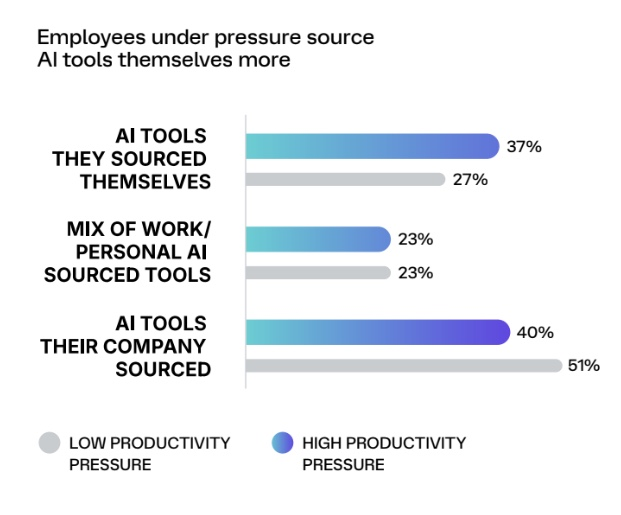
We found that 52% of employees report using AI at work with high frequency (daily or weekly) which is a 7-point increase from 2025.
They also report that AI helps them do things that they couldn’t do before, opening up new capabilities for themselves and their organizations.
The main problem we discovered is that, compared to previous years, more global employees admit to sourcing their own AI tools to boost their productivity, often because organizations aren’t providing more secure alternatives. This is risky; precious organizational data can flow out into all manner of personalized AI accounts, without checks or controls, and end up anywhere.
What can you do about this?
Simply saying reactively, ‘don’t use AI’ is not enough; employees who have relied on their own AI tools to help their work will find some other way of using them. AI is here to stay and it’s more proactive to embrace it, but on your organization’s terms.
Instead, give employees specific, secure AI tools for specific purposes, and train them to use them responsibly and ethically. Your AI tool selection strategy needs to take into account employee needs, IT safety, legal compliance, and business strategy. Be clear about the value these tools bring to the organization and to employees.
Trend 3: The hidden costs to cutting costs: disengaged employees, unsatisfied customers
Is your cost-cutting costing more than it’s saving? Some organizations think it’s a great idea to cut the onboarding budget, or replace frontline employees with part-timers or gig workers, but this approach can be a false economy.
Some years ago, our research noticed that the new hire ‘honeymoon period’ disappeared. In 2026, this honeymoon is not only over; it’s heading for divorce. New employees report that their onboarding – their first impression of an organization - was one of their most underwhelming work experiences.
Only 44% intended to stay for more than 3 years – potentially costing businesses dearly in lost production and re-recruitment.
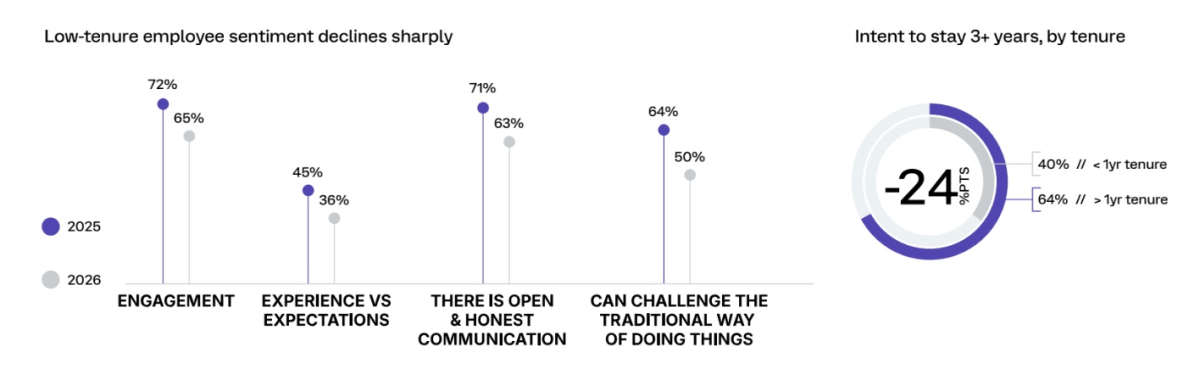
Similarly with your frontline. Frontline employees are critical to business, placed squarely in the middle between the organization and customers or public. Those employees, who are many customers’ first impressions of a business have long been the least appreciated and understood, and are still struggling with poor employee experience:
- 63% of frontline workers are concerned that they have failed to receive feedback that improves their performance, and 50% are concerned that they are unable to challenge traditional ways of doing things
- Part time workers fare even worse: only 46% believe they can challenge traditional ways of doing things, and only 61% received useful performance feedback
These are your people who serve and assist your customers and (we hope) keep them coming back. If they’re not receiving the right support to deliver a great customer service, those customers, and their money, will go elsewhere.
What can you do about this?
First impressions last, whether that’s for your new hire walking through the door on their start day, or a new customer encountering your frontline workers for the first time. You need these impressions to be positive.
The great news is that there are simple, tried-and-tested ways you can improve the experiences of your new hires and frontline workers. These are:
- providing meaningful recognition and feedback
- encouraging honest communication
- seeking feedback from employees to help them deliver what customers expect
In short, making your employees feel connected to the organization.
Why employee listening is crucial
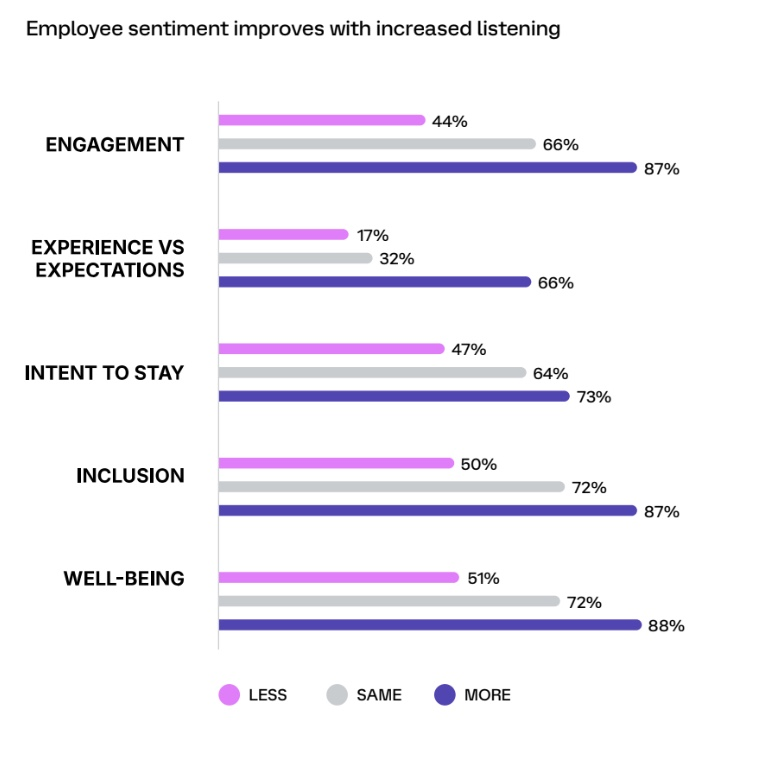
All the issues we discovered in our latest report can be addressed head-on with employee listening. And when organizations listen, employees reciprocate with better job attitudes and motivation.
We found that employees whose companies ramped up listening reported higher engagement, stronger intent to stay, better well-being, and greater inclusion. Their experience was noticeably better than those that didn’t change their listening strategy, and they outshone employees at companies that cut back on listening.
Employee listening helps organizations navigate change by:
- highlighting important discussion topics and potential pitfalls
- keeping employees connected with their leaders
To help navigate change, ask more questions of your employees, particularly the long-tenured. Ask them about their concerns and what you can do to support them. And don’t just listen to them; show them, through your actions, that you’re listening!
In the case of AI use, it’s essential to use employee listening to find out why your employees are using AI, how they are using it, and what they need so you can supply suitable, governed, secure tools. You’ll also need to measure AI usage and sentiment regularly to ensure that the tools you’re providing meet the requirements and expectations of both employees and leaders.
Empowering your frontline and part-time employees doesn’t need a massive budget. By simply encouraging managers to ask for frequent feedback, having authentic, caring career conversations, and letting staff innovate and enjoy some autonomy, they’ll soon hear about what’s working and what isn’t.
And while employee listening has direct benefits, it’s the resulting actions that matter most.
Now it’s time for you to take your first action
In our 2026 Employee Experience Trends report, you can explore these 3 trends and their supporting data in much more detail.
The report features expert analysis, commentary from workplace psychologists and experience management professionals, and plenty of advice for turning employee insights into actions that improve every employee’s experience, customer experiences, and drive business success.