
U.S. Department of State x Qualtrics
U.S. Department of State x Qualtrics
How the U.S. Department of State turned a 40-minute paper process into a 10-minute digital one
What it took to modernize the highest-volume transaction in American consular services — and what the agency learned by listening.
+90%
customer satisfaction rate reported for the online renewal experience
+50%
of all passport renewals are now completed online
4M+
hours of collective customer burden eliminated since 2022
A process built for a different era
Renewing a passport used to be an ordeal. Fill out a printed paper form by hand, track down a vendor that takes passport photos, write a check (assuming you remembered your checkbook existed!), and mail the whole bundle off with your current passport, hoping you got back what you needed before your trip. For many Americans, that meant a multi-day scavenger hunt spread across a busy week, all to complete a form that only took about forty minutes once you had everything ready to fill it out.
The Bureau of Consular Affairs decided that Americans deserved a better, more efficient process. Today, renewing a passport can take about ten minutes, and can be done on a phone from your own couch, thanks to the Bureau's Online Passport Renewal (OPR) application. But getting there took four years and a willingness to keep listening and improving even after the online tool was already in use by millions of Americans.
In the 1990s, just 5% of Americans held a passport. Today it's nearly half, and demand keeps climbing. But the Bureau of Consular Affairs was still relying on a process from a bygone era: paper forms, printed photos, paper checks, and documents and checks mailed in, then a wait. Every point in that process was a place where things could go wrong, from a printer low on toner to a photo that wasn’t quite right.
The reliance on snail mail to communicate where there was a problem was also a failure point. There could be weeks of back-and-forth for a missing signature or a needed photocopy. Getting real-time signals from customers as things started going off track wasn't a nice-to-have, it was the only way to catch problems before they cascaded into delays that could ruin a planned trip abroad.
"We had a passport process developed in the 1970s, now processing 23 million passports a year... we had a fierce desire to make the process more efficient for the customer, and honestly more efficient for us." — Laura Larrimore, Travel.State.Gov Manager
Really fixing the experience meant understanding all the inefficiencies and eliminating them. As the team built OPR, it would be key to know where customers were getting stuck and quickly get them back on track.
A survey that evolved alongside the product
The team built a single feedback survey for OPR and kept adjusting the questions overtime to pinpoint where customers were struggling.
The first version of the survey went out to customers weeks after they'd received their new passport, and customers’ memories were hazy on the details of the process and any pain points. The survey surfaced some useful elements, mostly about processing and mailing timelines – but these elements were largely not something that could be changed. What the team wanted was information about the online renewal experience itself, something the team could actually act on very quickly.
To get better information from customers, the team began sending the survey earlier in the process, triggering it when a customer started an online renewal but hadn't logged back in for two weeks. Using Qualtrics text analytics to group sentiment by topic, this version gave the team its first clear, structured picture of a specific usability problem that was stumping some customers: uploading a digital passport photo. These insights were used to do more investigation into the photo upload process.
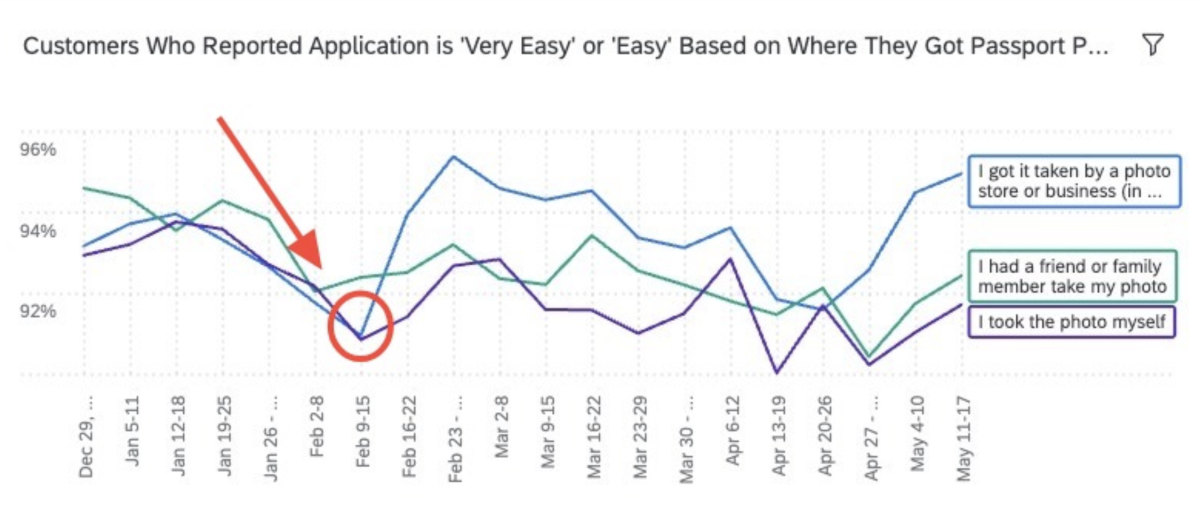
The team continued to move the trigger point for feedback earlier in the process, to identify and head off small problems before they could become bigger ones. Today the survey fires right after a customer completes payment, the final step in the application. It asks specifically how they obtained their photo, whether they took it themselves, had a friend help, or used a photo store or business.
Yet even the latest iteration is only seen by people who finish the process. To hear from the ones getting stuck midway during the photo upload portion, the team added a second trigger to the same survey instrument, a follow-up prompt that fires when a customer fails three or more times to upload a photo. Picture the moment: a customer has cropped and re-uploaded the same photo three times and is about to give up when a short prompt appears asking what happened. Their answer is shared with the product team while the frustration is still fresh, giving product and development teams needed details to understand what’s happening and set immediate priorities on what to adjust in the photo tool.
Turning insight into action
The team found that customers who had their photo taken at a store or business – about 30% of people – reported a smoother experience and fewer errors than customers who took the do-it-yourself approach. But customers of one major photo vendor were more likely to have problems. That split pointed to two distinct problems, each one worth solving.
Internally, the passport team combined the failed-upload error codes with the survey responses and handed that dataset to the product team, giving them clear priorities for what to fix in the do-it-yourself photo tool.
Externally, armed with the same satisfaction data, the team met directly with photo vendor executives and suggested ways to improve their training materials for employees who capture photos in-store that will consistently meet Department requirements. Also, the team suggested some additional guidance be given to passport photo customers to ensure the photos taken would be submitted and accepted correctly.
Together, the two efforts moved the numbers. Error rates tied to background, head position, and image quality, most of them by the do-it-yourself customers, fell by nearly 50% in a matter of months. Photo upload time for customers using a vendor-provided photo dropped from over 10 minutes to roughly 5 minutes on average.
What ten minutes adds up to
Approximately 9 million Americans have now renewed their passports through OPR. More than half of all renewals today are completed digitally. The shift from a 40-minute paper process to a 10-minute online one has eliminated over 4 million hours of collective customer burden since 2022, with customers reporting a satisfaction rate above 90%!
This transformation story got national attention. The Wall Street Journal wrote that the agency had "pulled off the impossible" by making passport renewal simple. CNET compared the new experience to the ease of ordering takeout. The Washington Post walked readers through a process that, for some applicants, took as little as six minutes.
“When you serve millions of Americans, you have little margin for error –– every decision, every step of the process is magnified with this many customers. To achieve this success, we had to listen carefully and learn daily from our customers….we had to focus on what worked well and resolve issues quickly."— Carl Siegmund, Division Chief, Passport Community Relations
Extending the model to a redesigned, digital front door
The same feedback philosophy has now been extending to travel.state.gov, one of the federal government's most-visited websites and the starting point for most Americans researching passport requirements. As a high impact service provider, the Bureau was already required to collect feedback on the site, but that data arrived quarterly, from a limited sample, and comments were often too vague to act on. The redesign changes that.
"With the reimaging of our website," Larrimore said, "we've now built a feedback button into every one of the redesigned pages... and we combine their feedback with automatically captured data like what page they were on and what type of device they were using, which helps us understand and pinpoint problems."
Since the redesigned passport section went live in May of 2026, customers have let the team know about broken links, confusing wording, and bugs specific to certain mobile phones, which when combined with data about the page they were on and their device info, allowed the team to quickly fix these issues.
The team is also exploring passive behavioral signals to better understand the silent majority of customers who don't respond to surveys, but whose experience still matters.
As Siegmund put it: "This is the power of listening to your customers. Qualtrics gave us the tools to analyze the data and help others understand its meaning. But then we had to act on the data to implement change, by making requirements easier to understand, simplifying the tool, and meeting directly with the businesses who take photos. That's what made a real difference."

When you serve millions of Americans, you have little margin for error, every decision, every step of the process is magnified with this many customers. We had to listen carefully and learn daily from our customers, and lean into what worked well and resolve issues quickly. The tools Qualtrics provided were integral to getting us to today.
Carl Siegmund
Division Chief, Community Relations for Passport Services
U.S. Department of State
About U.S. Department of State
The U.S. Department of State leads America’s foreign policy through diplomacy, advocacy, and assistance by advancing the interests of the American people, their safety and economic prosperity.
Industry
Government Organization Size
Enterprise
Region
AMER Products In Use
Related Content
Explore other CX stories

State of Iowa
Iowa x Qualtrics

State of Missouri
Missouri x Qualtrics

The City of Corona