
In today’s evolving business landscape, workplaces that excel in diversity, equity and inclusion thrive, and drive better business outcomes. By celebrating diversity, prioritising equity and practising inclusion, your organisation can become more innovative, and your employees more engaged.
One report by McKinsey found that ‘companies in the top quartile for gender diversity on executive teams were 25% more likely to have above-average profitability than companies in the fourth quartile’.
In this guide, we look at the importance of DEI in the workplace and give you some practical strategies for making your organisation more diverse, more inclusive and more equitable.
What is diversity, equity, and inclusion (DEI)?
DEI is the umbrella term for the programmes, policies, strategies, and practices that support a company’s mission to create and sustain a diverse, equitable, and inclusive environment that respects and accommodates every employee.
- Diversity represents the differences within the organisation, and covers:
- Race
- Ethnicity
- Sexual orientation
- Gender identity
- Physical ability
- Religion
- Age
- Marital status
- Socio-economic status
- National origin
- Veteran status
- Marginalised groups
Diversity is about making sure your organisation represents a wide variety of backgrounds, experiences and perspectives.
Equity makes sure that every employee is treated fairly and has the same opportunities for advancement as everyone else. Some groups experience more barriers to full participation in work than others, and equity identifies and aims to eliminate those barriers.
While equality aims to treat everybody the same, equity provides everyone with what they need to be successful.
Inclusion is when every individual, or group of individuals, feels they belong in their workplace – they, and their contributions, are welcome, respected, valued, recognised and supported
Free eBook: How to apply DEI to your employee experience programme
What is workplace diversity?
Defining diversity is a great place to start with DEI initiatives. An organisation is considered diverse when it represents a wide range of characteristics and perspectives, just as society does, and aims to tear down institutional bias around race and other marginalised identities.
Improving diversity in the workplace requires:
- hiring individuals of different races, ethnicities, genders, ages, religions, disabilities, and sexual orientations, as well as those with varied experiences, education, skill sets, beliefs, and personalities
- creating an environment where employees feel valued, respected and able to contribute freely, regardless of their differences
While not entirely comprehensive, these broad categories of diverse groups can help identify gaps that exist within an organisation. They also provide an opportunity to establish metrics and set goals for increasing diversity in the workplace.
What is workplace equity?
Equality and equity are two distinct concepts, although they’re often used interchangeably. Where equality gives everyone access to the same opportunities, equity in the workplace means that access to opportunities is proportional to each person’s needs and capabilities.
This ensures that opportunity is equally advantageous to everybody, because it’s offered in a way that takes diversity into account. In other words, equity eliminates barriers and levels the playing field by giving each person the right kind of support:
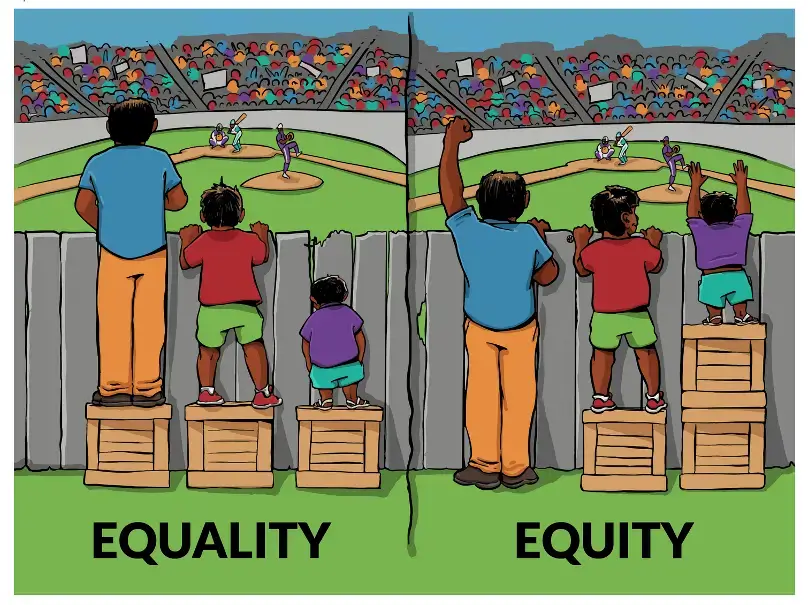
Angus Maguire’s popular cartoon (above) illustrates the difference perfectly. In the ‘equality’ part of the image, each person receives the same number of boxes to stand on, so that only the tallest gets the best view of the action. In the ‘equity’ part of the image, each person gets the number of boxes they need to see over the fence, creating an equal vantage for everyone.
What is workplace inclusion?
Through social norms and behaviours, a culture of workplace inclusion ensures that everyone is given equal opportunity – and feel welcome – to participate and contribute.
“You can’t have true inclusion without diversity,” says Judith Williams, Global Head of People Sustainability & Chief Diversity and Inclusion Officer at SAP. “If everyone has the same background, expectations, and experiences, inclusion is really easy. You don’t have to think about what it will take for people with different backgrounds and experiences to excel.
“It’s when you actually get diversity in your organisation – a mix of gender, a mix of generations, a mix of cultural backgrounds – that you begin to ask the fundamental questions about: ‘Are we inclusive?’, ‘Are we being equitable?’, ‘Do people feel like they belong?’, and ‘Can everyone bring their best selves to work?’”
DEI training at work
Thanks to the increasing necessity for organisational accountability, businesses are placing a higher standard of autonomy and professional integrity on everybody, from entry level roles all the way up to leadership. Where a company’s highest priorities include equity and equality for all races, ages, genders, people with disabilities, and socioeconomic status groups, it makes sense to include diversity initiatives in workplace training.
Tackling equity issues requires different approaches for different companies and sometimes even for different teams within a business. For some, formal DEI training is the best approach for getting everyone on the same page around DEI initiatives and business strategy.
For others, creating ally programmes or diverse employee networks helps focus these strategies.
Accenture, for example, includes diverse employee networks – including groups based on disability, faith, gender, race and ethnicity, LGBTIQ+ and more – to help create a sense of belonging and community for their people.
Inclusive leadership training can be very valuable as leaders set the standard for the rest of the workforce to follow. You may choose to outsource training and awareness to a specialist provider, or offer in-house training as part of a wider DEI programme.
The benefits of DEI in the workplace
An organisation with strong DEI practices ensures all voices are heard. Through representation, organisations foster a socially- and morally-adept workplace. These are wins in and of themselves. Workforce DEI can also benefit an organisation’s bottom line by creating a competitive advantage in many ways.
Here are some of the benefits of diverse, equitable, and inclusive environments:
- Financial performance. A study conducted by McKinsey & Company found that ethnically diverse companies are 35% more likely to have financial returns above their respective national industry medians. Gender diverse companies are 15% more likely to outperform their respective national industry medians.
- Employer of choice. According to Glassdoor, 67% of job seekers view a diverse workforce as an important factor when evaluating companies and considering job offers.
- Innovation and growth. Harvard Business Review found that diverse companies are 70% likelier to capture a new market. They’re also 45% more likely to report increased market share year-over-year.
- Increased employee engagement. 83% of millennials report being actively engaged when they believe their organisation fosters an inclusive workplace culture. That percentage drops to 60% when their organisation does not foster an inclusive culture. (A Gallup study has assessed the cost of disengaged employees at up to $350 billion per year in lost productivity.)
- Better decision-making: According to one white paper, teams make better decisions than individuals 66% of the time, but diverse teams make better decisions 87% of the time. Inclusion means that the spread of gender, age and geographic diversity makes for better business decision making.
Image by Claudio Schwarz on Unsplash
Why is workforce DEI critical – especially now?
As many employees report feeling anger, stress, and fear around the pervasive and repetitive injustices against the Black community that have led to recent protests, there has never been a more clear need for organisations to take sustained action.
“To make this a movement, and not just a moment, organisations must take a close look at what they’re doing internally and ask: ‘Who are we hiring?’, ‘Who are we promoting?’, and ‘Can we make sure we’re distributing opportunities more fairly?’”
Judith Williams, Global Head of People Sustainability & Chief Diversity and Inclusion Officer at SAP.
“The organisations who take this as an opportunity to be more fair, equal, and more just – internally – will be the ones to make a difference.”
Add to that the fears over COVID-19 and the outlook for the economy, it’s clear that many of us are being deeply affected by issues happening outside of the workplace.
“Right now our people are affected by the deep uncertainty of the future more than ever before,” said Arianna Huffington, CEO at Thrive Global. “This is going to affect how they work both in terms of their productivity and in terms of their relationship with their colleagues, which are now becoming even more paramount with all the latest emphasis on racial justice and diversity, inclusion, and belonging.”
In addition to addressing systemic racial bias and pervasive (physical and mental) health crises, nurturing diverse, equitable, and inclusive workplaces is a way of preparing for the future.
DEI is set to take on even greater importance as younger generations – including millennials and Generation Z – become the dominant groups within the workforce. These demographics are set to be more culturally diverse than ever before, and they are motivated by political perspective, values, purpose, and experience.
Successfully building DEI gives your company a competitive advantage, enabling organisations to better attract and retain the best talent – as well as fostering an atmosphere of belonging where all employees feel welcome and safe.
Free eBook: How to apply DEI to your employee experience programme
What steps can you take to foster DEI in the workplace?
Broadly, fostering diversity, equity, and inclusion in the workplace looks the same for each organisation: equal opportunities and fair treatment for everyone. However when you dive deeper, there are nuances unique to each organisation that will determine how you can successfully promote DEI in your workplace.
The most important thing to remember is that DEI today goes much further than a mere initiative; the entire culture of a company must embrace diversity, equity, and inclusion. This is not something that will happen overnight – it requires sustained effort in order to see results.
Over time, your continuous effort will bear fruit as new employees come aboard with an understanding of diversity matters and give full participation in initiatives. The root causes of inequality will diminish as DEI flourishes and a more inclusive environment will develop.
Improving DEI is a marathon, not a sprint, but that doesn’t mean you can’t take action quickly. Here are our 12 steps to get you started.
Step #1: Do your diversity, equity and inclusion work
Be informed; learn the history, background, and context that inform the need for DEI. This includes understanding the systemic issues that exist today and the biased norms that went before. This is especially salient in the case of racial inequality, though it also applies to sexual orientation, gender, ability and other demographic categories.
“We need to educate ourselves first,” says Judith Williams. “There’s a plethora of anti-racism resources out there that can be yielded via a simple Google search.”
Step #2: Dig into your data
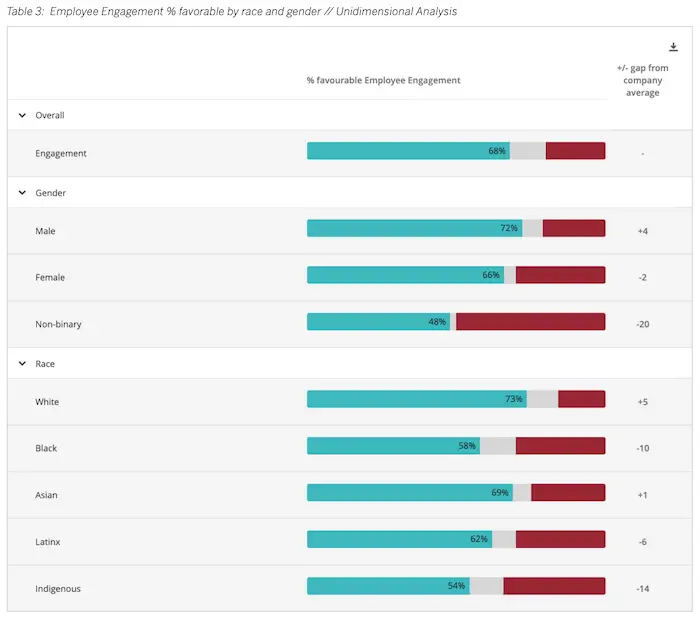
The next step is to understand where you are in terms of metrics. This will require collecting and analysing your people data to assess the demographics of your organisation – including your leadership team. Once you have the data, you can set benchmarks and metrics for the DEI goals you want to achieve.
For example, the following table shows how data highlights disparity of outcomes in an organisation. Only 54% of Indigenous and 48% Non-binary employees have given favourable employee engagement feedback, lagging far behind the company average feedback score. With these outcome disparities, they are clearly groups that need to have the most DEI initiatives.
Step #3: Set measurable targets – and hold yourself accountable
Organisations that set measurable DEI targets (for interviews, pass-through rates, or metrics around hiring demographics) will be more successful in fostering a diverse, equitable, and inclusive workforce. Some organisations hold themselves accountable to measuring DEI progress by tying measurable outcomes to compensation – especially for leaders, but also to the overall bonus pool.
You could follow the example of these leading brands and make a public commitment to hiring from underrepresented groups:
- Hilton: Provide a 50% diverse slate of candidates for all open positions
- Amazon: Increase the number of women and Black employees in senior roles, and also create a more inclusive workforce for retention of employees from under-represented groups.
- Citi: Increasing Black and female representation in leadership by 40%
- Alphabet: Hire enough Black workers and managers to push Google’s numbers to 30% by 2025
- Microsoft: Double the number of Black and African American people managers, senior individual contributors, and senior leaders in the United States by 2025
Step #4: Look at your hiring process
Look at your talent pipeline and the strategies your talent acquisition team uses to attract new employees. Is DEI part of the picture? Are you proactively building a diverse talent pool? Be strategic about where you’re posting open positions. Go beyond homogeneous networks to tap into diverse talent pipelines you might have previously ignored and/or didn’t realise existed.
For some demographics, you have to be proactive with your search strategies by posting on certain websites, advertising in specific publications, or doing outreach through dedicated organisations.
DEI is a powerful competitive advantage when it comes to hiring. Companies that recruit a diversity of candidates – and create inclusive and equitable work environments that encourage diverse employees to stay – will win the war for talent.
– Rusty O’Kelly, Managing Director at Russell Reynolds Associates
Step #5: Hire for culture contribution
Conventional advice says to hire for culture fit, but progressive companies up the hiring ante by recruiting new employees for culture contribution. That means hiring employees who not only align with your company’s values, but also bring a wide spectrum of experiences, perspectives, and backgrounds to the table, too.
After all, if you hire more of the same types of people you already have, you’ll end up with a company that becomes more and more homogeneous and less representative of the society it’s a part of. Hiring for culture contribution with an eye to DEI will create a richer mix that can be sustained over the long term.
“In tech, we often hire for culture fit,” said Judith Williams. “Instead, we should hire for culture contribution. We need to think differently and ask ourselves: ‘What does this new hire bring to my team that I don’t already have; what skills, background, and perspectives?’”
We should hire the best person for our team, not just the best person for the role.
Step #6: Make DEI part of your company’s DNA
Just like your corporate values, put your company’s DEI mission statement in writing. The best workplace diversity statements include:
- Ideally fewer than 100 words
- Your company mission
- Your diversity commitment
- Language that is positive and inclusive
- Particular mention of under-represented groups
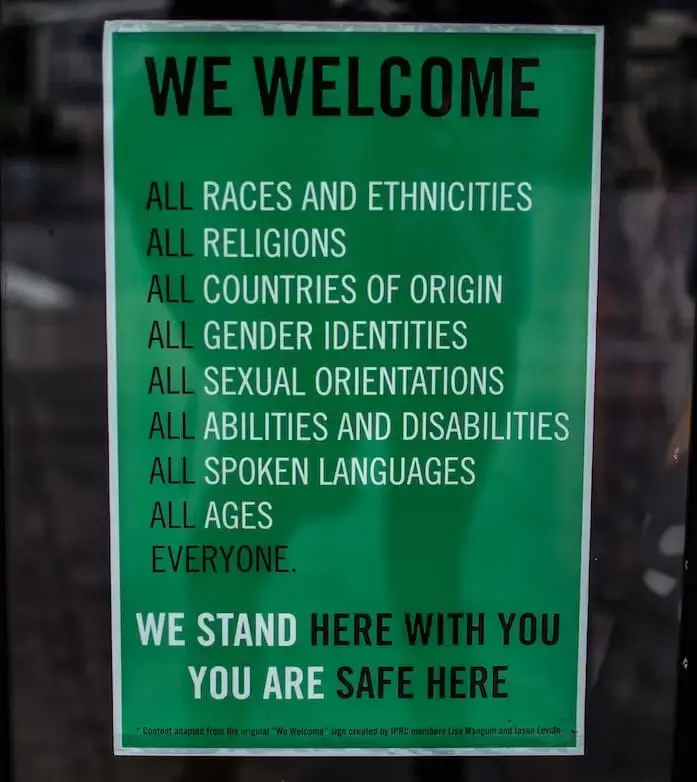
Image by Brittani Burns on Unsplash
Step #7: Institute intentional (and extended) onboarding programmes
Even before a new, diverse employee arrives, make sure you prepare the team. Make them aware of any special needs their new colleague may have, religious or cultural observances or practices, and what words or actions could be deemed rude or inappropriate, especially within the context of physical disability or neurodiversity.
And more than ever, onboarding needs to extend beyond a new employee’s first week. Build onboarding programmes that provide ongoing support for at least six months, or even the first year, to ensure new employees are set up for success.
“As part of onboarding, ensure that new employees – especially those that are from underrepresented groups – have a mentor,” said Rusty O’Kelly. “Then, check back in at regular intervals to reassess and ensure that the mentor-mentee relationship is a good fit.”
Step #8: Avoid the ‘minority tax’
Sometimes organisations already have well-meaning policies in place, but the execution of those policies has the unintended consequence of adding to the workload of, say, people of colour or an underrepresented sexual orientation.
For example, when you want to diversify your hiring panel but you have just three women on your team of 100, you’ve essentially created a whole separate job with more responsibilities for them – one they might not have time for, and that won’t help them get promoted.
Step #9: Align ERGs with leadership sponsors
Align your employee resource groups, or ERGs, with executive leadership sponsors to enable conversations around how to improve DEI in your workplace. This alignment also helps educate leadership about where the diverse talent is in the organisation.
Step #10: Open up lines of communication
Leadership roundtables, always-on feedback mechanisms, and communications platforms such as Slack enable employees to share their experiences and contribute their ideas.
Step #11: Support remote employees who might feel isolated
Not everyone thrives in a virtual workplace environment. Employees who are extroverts, for example, will be missing the opportunity to engage with (and gain energy from) fellow colleagues when working remotely.
On the other hand, introverts face unique challenges in group video calls. Get to know your employees so you can support their communication, learning, and socialisation preferences as early as you can.
Step #12: Foster a culture where it’s OK to speak up
We all miss things. Make employees feel safe enough to voice their thoughts and concerns to have meaningful conversations that help move the organisation forward.