
Understanding customer loyalty in the age of social media
Social media influences how consumers discover and evaluate brands, but it no longer tells the full story of customer loyalty. Likes, shares, and comments signal visibility, not commitment. Today, loyalty is built through consistent experiences, earned trust, and reliable follow-through, even when customers never post about a brand publicly.
Research conducted by the team at Qualtrics highlights a clear shift in behavior: Customers may give brands high ratings, but far fewer actively recommend those brands or share their feedback directly. As social engagement declines, it’s become a weaker indicator of customer loyalty, making trust, repeat behavior, and experience quality far more meaningful measures of long-term customer relationships.
Key stats at a glance
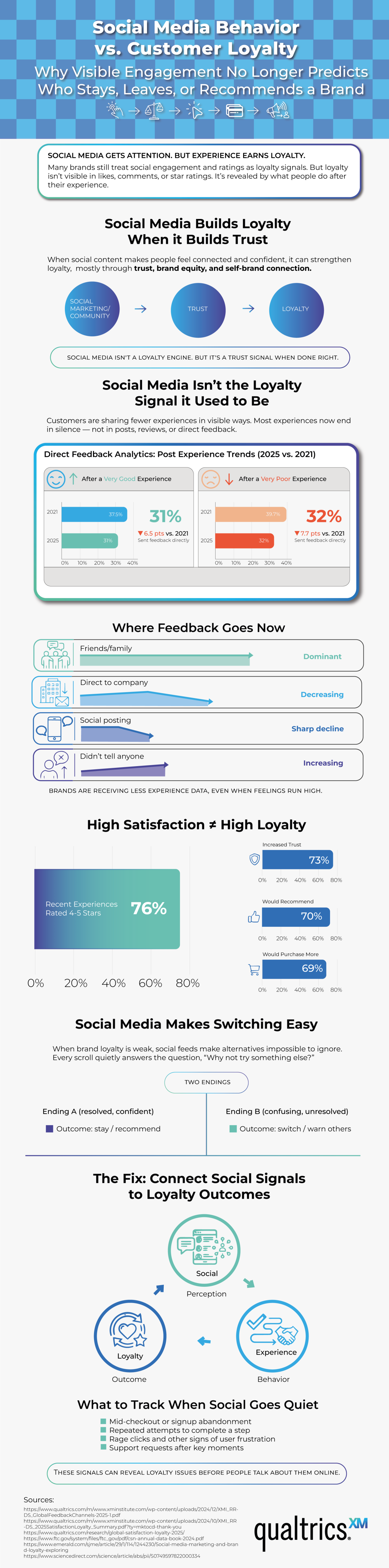
- Only 31% of customers gave feedback after a positive experience (down 6.5 points since 2021).
- An estimated 76% of experiences earned 4–5 stars, yet only 70% of customers said they would recommend the brand, and 69% said they’re likely to purchase more.
- Customers post about their experiences less often than they used to.
Visible engagement is no longer a reliable loyalty signal
Social platforms have evolved, and so have engagement patterns. Brands that treat likes and comments as loyalty signals risk misreading what customers actually do after a purchase.
Consumers still form opinions on social media, but many keep their reactions private. After a very good experience, only 24% of consumers post about it on social media. Instead, they may send a DM to a friend, share in a family group chat, or say nothing at all.
Direct feedback to brands has also declined. Only 31% of satisfied customers share feedback with the brand. More customers choose silence — no review, no comment, no tag — especially after experiences that feel merely “fine.”
Importantly, public engagement can decline even when repeat-purchase intent remains steady. Loyalty behavior and visible activity are no longer tightly linked.
Trust drives loyalty more than public posts
Loyalty today is rooted in trust. In fact, 67% of consumers say they must trust a brand before they’ll continue buying. Trust develops through reliable products, clear policies, and fast issue resolution, not through social engagement.
After positive experiences, 73% of customers report higher trust. That trust has measurable consequences: Customers are more tolerant of small mistakes, more likely to stay longer, and more willing to recommend the brand, even if they never engage publicly.
Customers may form “self-brand connections” through identity and shared values, but trust ultimately determines whether they repurchase. Brands that strengthen trust protect retention, even when competitors increase their visibility or promotional activity.
Social feeds make switching easier
Social platforms reduce the distance between satisfaction and switching. Customers encounter competing brands constantly through feeds, reels, ads, testimonials, and influencer endorsements.
This exposure doesn’t automatically break loyalty. But when an experience feels replaceable, switching becomes frictionless. A moment of uncertainty paired with a compelling alternative can quickly shift behavior.
Brands retain loyalty not by posting more often but by differentiating themselves through:
- Clear value propositions
- Consistent delivery
- Transparent service recovery
- Proof that they stand behind their products
Reliability and clarity create friction against switching. Visibility alone does not.
Feedback channels are shifting
Customers still share feedback, but they often don’t share it directly with brands.
- Only 32% of customers give feedback after negative experiences (down 7.7 points since 2021).
- Even after a bad experience, only 21% of consumers post about it on social media.
Many customers limit feedback to conversations with friends and family or reviews on third-party platforms rather than contacting the brand. As a result, brands can’t rely on social comments as a proxy for sentiment.
Organizations need multiple listening points and a clear, simple path for customers to report issues. Brands that make feedback easy to submit gain stronger signals and resolve problems faster.
What this means for consumers
- Look for brands that earn trust through transparency, clear policies, and strong service, not just social presence.
- Share feedback when something goes wrong; companies can only fix what they can see and measure.
- Reward brands that respond well to problems, not just brands that market themselves well.
What this means for marketers
- Stop treating engagement as a loyalty KPI; treat it as a reach and resonance metric.
- Build loyalty by improving the end-to-end experience: onboarding, support, returns, and service recovery.
- Track loyalty with behavioral data: repeat purchases, churn, referrals, complaint rate, and resolution time. Combine this with advocacy metrics such as Net Promoter Score to better understand how willing customers are to recommend the brand.
Engagement metrics no longer reflect loyalty the way they once did, but with deeper listening and behavioral insight, organizations can better understand what drives retention. Solutions from Qualtrics can help you capture meaningful feedback, connect it to real customer behavior, and turn this customer experience data into stronger, more trusted relationships. Sign up for a demo today.
FAQs
How Does Social Media Affect Customer Loyalty?
Social media influences customer loyalty by shaping brand awareness, perceptions, and initial trust. However, it does not reliably predict long-term loyalty, since many customers stay loyal without posting, commenting, or engaging publicly.
What Signals Matter Most for Loyalty Today?
Trust, repeat purchase behavior, renewal rates, referrals, complaint frequency, and service recovery outcomes matter more than likes or comments.
How Can Brands Improve Customer Loyalty?
Deliver consistent experiences, resolve issues quickly, simplify feedback submission, and communicate policies clearly, especially around returns and support.
How Can Marketers Track Loyalty Effectively?
Combine direct feedback, behavioral analytics, support data, and social listening. Prioritize examining repeat purchases, churn, referral activity, and resolution time.
Methodology:
This analysis compiled findings from published research on loyalty, feedback behavior, and social media engagement. Primary statistics were drawn from Qualtrics reports and cross-referenced with additional industry sources. Data reflects consumer behavior trends as of 2025. Qualitative interview data was not included.
Sources:
- https://www.qualtrics.com/m/www.xminstitute.com/wp-content/uploads/2024/03/XMI_RR-DS_ConsumerFeedbackChannels24-1.pdf
- https://www.ftc.gov/system/files/ftc_gov/pdf/csn-annual-data-book-2024.pdf
- https://www.emerald.com/sjme/article/29/1/114/1244230/Social-media-marketing-and-brand-loyalty-exploring
- https://www.sciencedirect.com/science/article/abs/pii/S0749597822000334
- https://som.yale.edu/story/2023/navigating-brand-trust-modern-marketing