These days, it’s hard to make a purchase without being prompted for your phone number or email address. What started as punch cards for coffee has evolved into an entire ecosystem of loyalty programs, offering customers everything from discounts to cash back.
Nearly one in ten companies now have a loyalty or customer rewards program in place, and it’s a popular idea for good reason. In fact, when done well, loyalty programs can help companies grow revenues up to 2.5 times faster than their competitors and deliver significantly higher shareholder returns. They can be a boon for shoppers, too, who are remarkably enthusiastic about saving money with reward programs. About three-quarters of consumers say they’re more likely to choose a brand that rewards them for sticking around.
But when every other company has its own version of a rewards app, how do you tell which ones actually pay off? Today, Qualtrics is breaking down which big brands’ loyalty programs give shoppers the most value for their dollar.
What are loyalty programs?
At their core, rewards programs are deals between companies and consumers that occur alongside regular purchases. Customers spend money, and brands give back a little something in return, such as points, cashback, discounts, or free products. But rewards alone don’t guarantee success, and the programs that work are the ones that feel transparent and worthwhile. When customers clearly see how their spending leads to real rewards, they’re more likely to keep coming back. Programs that are confusing, stingy, or invasive, on the other hand, risk turning customers away entirely.
For our purposes, we’re focusing on base-level, free-to-join programs that anyone can access (meaning no credit card tie-ins or hidden membership fees). This ensures the results reflect the actual return on everyday spending, not one-time promotions or exclusive tiers.
Which retailers offer the highest cashback loyalty programs?
Food and Beverage
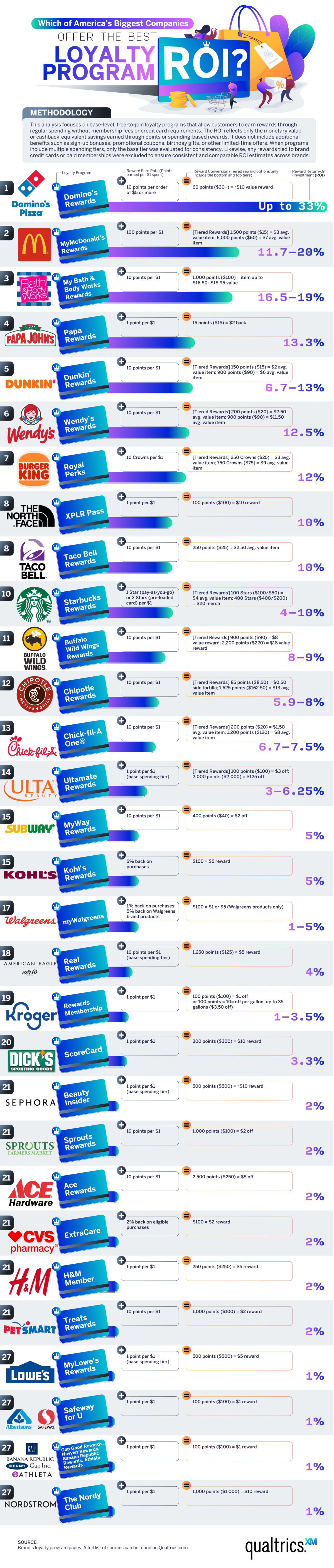
Food dominates the top of the list, with Domino’s Pizza leading the way. The “Domino’s Rewards” program offers up to a 33% ROI, giving customers about $10 in free food for every $30 spent. It ends up being remarkably high loyalty program savings for a program that requires no fee and no special conditions.
McDonald’s doesn’t fall too far behind, with an 11%–20% ROI through its MyMcDonald’s Rewards program. This system lets users earn 100 points for every dollar spent, which can be redeemed for small, popular menu items once you accumulate enough points. Papa John’s, Dunkin’, Wendy’s, and Burger King also offer a great value, ranging from 10% to 13%. It’s clear that the fast-food industry has cracked the code for loyalty rewards, as eight of the top ten reward programs are from casual dining restaurants.
Retail and Beauty
In the retail and beauty sector, Bath & Body Works far outpaces the rest with a 16.5%–19% ROI through its My Bath & Body Works Rewards program. Through this program, shoppers earn points for every purchase and can redeem them for free items, along with perks like early access to new launches and sales, as well as an annual birthday gift.
Ulta Beauty’s “Ultamate Rewards” program delivers a 3%–6% ROI, with higher returns for long-term customers who accumulate points over time, making it a relatively generous offering in the retail sector. One of the most recognizable customer reward programs in the beauty sector is Sephora’s Beauty Insider, which offers about 2% ROI at the base level but supplements this with exclusive samples and early access to products.
Brand rewards for apparel retailers like H&M, Gap Inc., and American Eagle/Aerie fall in the lower range, typically offering 1%–4% ROI. These programs, while lower in reward, can still appeal to consumers who intend to shop with these brands again in the future anyway.
Pharmacy, grocery, and home goods
For everyday spending, loyalty programs in the pharmacy and grocery categories tend to deliver smaller direct returns but offer good rewards nonetheless. Walgreens’ myWalgreens program offers 1% back on most purchases and 5% on Walgreens brand products, incentivizing shoppers to come in to buy generic alternatives to staple items for the extra rewards. CVS ExtraCare competes with a 2% ROI, supported by personalized coupons that customers may find even more valuable than the base rewards.
In grocery, Kroger and Safeway/Albertsons both sit in the 1%–3.5% ROI range, offering fuel rewards that strongly appeal to shoppers. These programs focus on retention and repeat visits to great effect in an industry where margins are slim.
Home improvement and hardware brands like Lowe’s and Ace Hardware also land around 1%–2%, offering small but steady returns for their high-frequency customers, many of whom may be shopping there as part of their jobs in the trades.
Outdoor and sporting goods
For adventure seekers, The North Face’s XPLR Pass earns a strong 10% ROI, rewarding members for purchases that can add up quickly given the brand’s price point. Dick’s Sporting Goods follows with its ScoreCard program, offering a 3.3% ROI, striking a good balance between tangible rewards and sustainable margins for the popular sporting goods chain.
Why loyalty still matters
For customers, loyalty programs are a small but satisfying way to get more from their spending. Whether it’s a few dollars off here and there or a free coffee, it adds up, and people are typically ravenous for freebies.
The programs that are easy to understand and quick to reward tend to be the most successful. When customers can see their rewards building, they’re more likely to stay loyal.
At their best, brand reward programs give customers something real, tangible, and valuable for their loyalty. With their widespread popularity, they’re likely not going anywhere, and loyalty programs will continue to shape how we shop and save in 2025 and beyond.
If your organization wants to understand what drives customer loyalty and how to turn everyday data into actionable insights, Qualtrics can help. Our AI-powered systems help businesses collect, analyze, and act on real-time customer data to enhance the customer experience. Contact us today to learn how you can make loyalty measurable.
Methodology
This analysis focuses on base-level, free-to-join loyalty programs that allow customers to earn rewards through regular spending without membership fees or credit card requirements. The ROI reflects only the monetary value or cashback-equivalent savings earned through points or spending-based rewards. It does not include additional benefits such as sign-up bonuses, promotional coupons, birthday gifts, or other limited-time offers. When programs include multiple spending tiers, only the base tier was evaluated for consistency. Likewise, any rewards tied to brand credit cards or paid memberships were excluded to ensure consistent and comparable ROI estimates across brands.
| # | Brand | Loyalty Program | Reward Earn Rate (Points earned per $1 spent) | Reward Conversion (Tiered reward options only include the bottom and top tiers) |
Reward ROI |
| 1 | Domino’s Pizza | Domino’s Rewards | 10 points per order of $5 or more | 60 points ($30+) = ~$10 value reward | Up to 33% |
| 2 | McDonald’s | MyMcDonald’s Rewards | 100 points per $1 | (Tiered Rewards) 1,500 points ($15) = $3 in food; 6,000 points ($60) = $7 in food | 11.7–20% |
| 3 | Bath & Body Works | My Bath & Body Works Rewards | 10 points per $1 | 1,000 points ($100) = item up to $16.50–$18.95 value | 16.5–19% |
| 4 | Papa John’s | Papa Rewards | 1 point per $1 | 15 points ($15) = $2 back | 13.3% |
| 5 | Dunkin’ | Dunkin’ Rewards | 10 points per $1 | (Tiered Rewards) 150 points ($15) = $2 avg. value item; 900 points ($90) = $6 avg. value item | 6.7–13% |
| 6 | Wendy’s | Wendy’s Rewards | 10 points per $1 | (Tiered Rewards) 200 points ($20) = $2.50 avg. value item; 900 points ($90) = $11.50 avg. value item | 12.5% |
| 7 | Burger King | Royal Perks | 10 Crowns per $1 | (Tiered Rewards) 250 Crowns ($25) = $3 avg. value item; 750 Crowns ($75) = $9 avg. value item | 12% |
| 8 | The North Face | XPLR Pass | 1 point per $1 | 100 points ($100) = $10 reward | 10% |
| 8 | Taco Bell | Taco Bell Rewards | 10 points per $1 | 250 points ($25) = $2.50 avg. value item | 10% |
| 10 | Starbucks | Starbucks Rewards | 1 Star (pay-as-you-go) or 2 Stars (pre-loaded card) per $1 | (Tiered Rewards) 100 Stars ($100/$50) = $4 item; 400 Stars ($400/$200) = $20 merch | 4–10% |
| 11 | Buffalo Wild Wings | Buffalo Wild Wings Rewards | 10 points per $1 | (Tiered Rewards) 900 points ($90) = $8 value reward; 2,200 points ($220) = $18 value reward | 8–9% |
| 12 | Chipotle | Chipotle Rewards | 10 points per $1 | (Tiered Rewards) 85 points ($8.50) = $0.50 side tortilla; 1,625 points ($162.50) = $13 avg. value item | 5.9–8% |
| 13 | Chick-fil-A | Chick-fil-A One® | 10 points per $1 | (Tiered Rewards) 200 points ($20) = $1.50 avg. value item; 1,200 points ($120) = $8 avg. value item | 6.7–7.5% |
| 14 | Ulta | Ultamate Rewards | 1 point per $1 (base tier) | (Tiered Rewards) 100 points ($100) = $3 off; 2,000 points ($2,000) = $125 off | 3–6.25% |
| 15 | Subway | MyWay Rewards | 10 points per $1 | 400 points ($40) = $2 off | 5% |
| 15 | Kohl’s | Kohl’s Rewards | 5% back on purchases | $100 = $5 reward | 5% |
| 17 | Walgreens | myWalgreens | 1% back on purchases; 5% back on Walgreens brand products | $100 = $1 or $5 (Walgreens products only) | 1–5% |
| 18 | American Eagle, Aerie | Real Rewards | 10 points per $1 (base tier) | 1,250 points ($125) = $5 reward | 4% |
| 19 | Kroger | Rewards Membership | 1 point per $1 | 100 points ($100) = $1 off or 100 points = 10¢ off per gallon, up to 35 gallons ($3.50 off) |
1–3.5% |
| 20 | Dick’s Sporting Goods | ScoreCard | 1 point per $1 | 300 points ($300) = $10 reward | 3.3% |
| 21 | Sephora | Beauty Insider | 1 point per $1 (base tier) | 500 points ($500) = ~$10 reward | 2% |
| 21 | Sprouts Farmers Market | Sprouts Rewards | 10 points per $1 | 1,000 points ($100) = $2 off | 2% |
| 21 | Ace Hardware | Ace Rewards | 10 points per $1 | 2,500 points ($250) = $5 off | 2% |
| 21 | CVS | ExtraCare | 2% back on eligible purchases | $100 = $2 reward | 2% |
| 21 | H&M | H&M Member | 1 point per $1 | 250 points ($250) = $5 reward | 2% |
| 21 | PetSmart | Treats Rewards | 10 points per $1 | 1,000 points ($100) = $2 reward | 2% |
| 27 | Lowe’s | MyLowe’s Rewards | 1 point per $1 (base tier) | 500 points ($500) = $5 reward | 1% |
| 27 | Safeway, Albertsons | Safeway for U | 1 point per $1 | 100 points ($100) = $1 reward | 1% |
| 27 | Gap Inc. (Gap, Old Navy, Banana Republic, Athleta) | Gap Good Rewards, Navyist Rewards, Banana Republic Rewards, Athleta Rewards | 1 point per $1 | 100 points ($100) = $1 reward | 1% |
| 27 | Nordstrom | The Nordy Club | 1 point per $1 | 1,000 points ($1,000) = $10 reward | 1% |
Sources
| # | Brand | Loyalty Program Source |
| 1 | Domino’s Pizza | https://www.dominos.com/en/pages/rewards/#!/rewards/ |
| 2 | McDonald’s | https://www.mcdonalds.com/us/en-us/mymcdonalds.html |
| 3 | Bath & Body Works | https://investors.bbwinc.com/news-releases/news-release-details/bath-body-works-launches-nationwide-loyalty-program/ |
| 4 | Papa John’s | https://www.papajohns.com/order/papa-rewards |
| 5 | Dunkin’ | https://www.dunkindonuts.com/en/dunkinrewards |
| 6 | Wendy’s | https://www.wendys.com/rewards |
| 7 | Burger King | https://www.bk.com/royalperks |
| 8 | The North Face | https://www.thenorthface.com/en-us/xplr-pass |
| 8 | Taco Bell | https://www.tacobell.com/rewards |
| 10 | Starbucks | https://www.starbucks.com/rewards |
| 11 | Buffalo Wild Wings | https://www.buffalowildwings.com/rewards/ |
| 12 | Chipotle | https://www.chipotle.com/reward |
| 13 | Chick-fil-A | https://www.chick-fil-a.com/one |
| 14 | Ulta | https://www.ulta.com/rewards/all |
| 15 | Subway | https://www.subway.com/en-us/rewards |
| 15 | Kohl’s | https://www.kohls.com/feature/rewards.jsp |
| 17 | Walgreens | https://www.walgreens.com/topic/promotion/mywalgreens.jsp |
| 18 | American Eagle/Aerie | https://www.ae.com/us/en/content/help/real-rewards-faq |
| 19 | Kroger | https://www.kroger.com/pr/loyalty-points-program |
| 20 | Dick’s Sporting Goods | https://www.dickssportinggoods.com/s/scorecard-benefits |
| 21 | Sephora | https://www.sephora.com/BeautyInsider |
| 21 | Sprouts Farmers Market | https://www.sprouts.com/rewards/ |
| 21 | Ace Hardware | https://www.acehardware.com/ace-rewards |
| 21 | CVS | https://www.cvs.com/extracare/home |
| 21 | H&M | https://www2.hm.com/en_us/member/info.html |
| 21 | PetSmart | https://www.petsmart.com/treats-rewards |
| 27 | Lowe’s | https://www.lowes.com/l/about/mylowes-rewards |
| 27 | Safeway/Albertsons | https://www.safeway.com/faq/foru.html |
| 27 | Gap Inc. (Gap/Old Navy/Banana Republic/Athleta) | https://oldnavy.gap.com/browse/info.do?cid=1178224 |
| 27 | Nordstrom | https://www.nordstrom.com/browse/nordy-club |