Picture a new analyst on her first Tuesday on the job. She has a dozen browser tabs open, a shared drive full of documents nobody has updated in years, and a sticky note reminding her to find out who approves travel expenses. The work itself looks manageable, but figuring out how things get done here takes most of her energy.
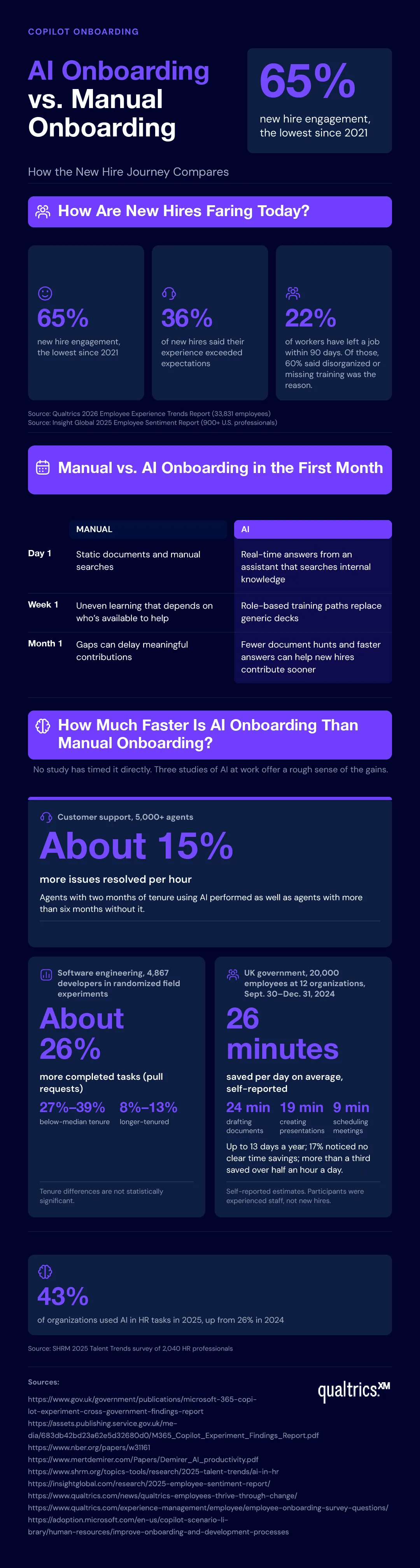
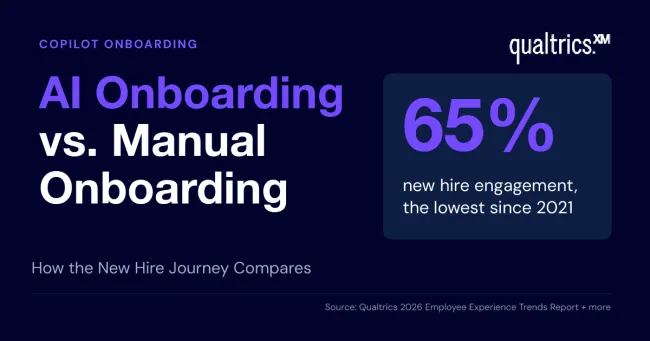
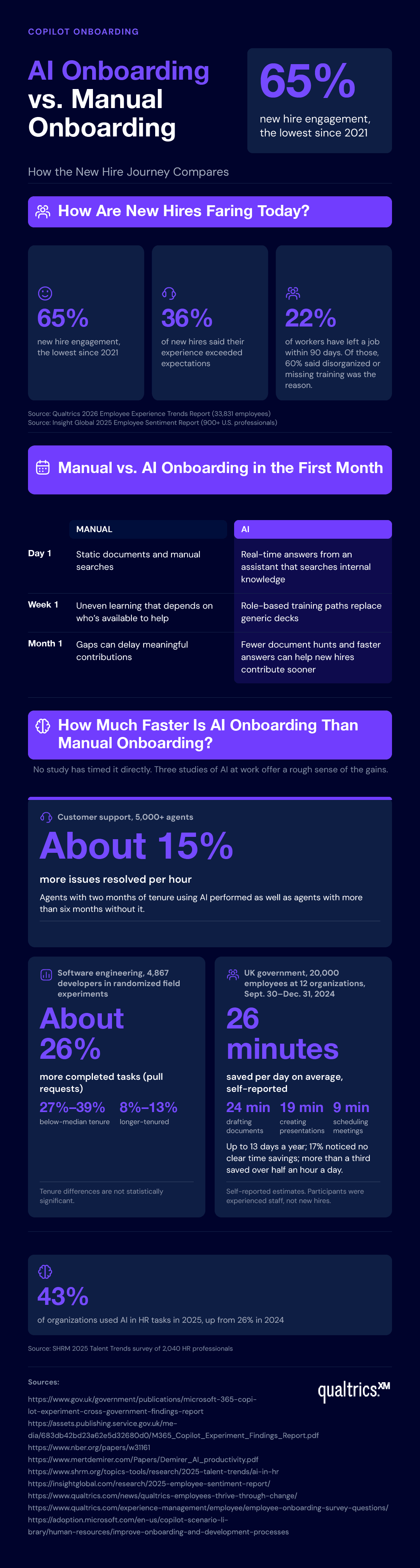
That is manual onboarding at its most familiar, drawing on static documents, scattered knowledge bases, and whoever happens to be free to help. And her rough start is a common one: In a 2026 study of 33,831 employees, the Qualtrics team found that engagement among new hires had fallen to 65%, its lowest level since 2021, and only 36% said their experience as a new employee exceeded expectations.
AI onboarding takes a different approach. It uses AI assistants, such as Microsoft Copilot, Google Gemini, or custom-built tools, to answer new hires’ questions based on company knowledge, draft plans and checklists, and customize training to each role.
Early evidence suggests that AI-powered onboarding can help new hires get up to speed faster. In studies of customer support, software engineering, and government work, AI tools have shortened learning curves and saved time. And when these studies compared experience levels, the gains tended to be larger for less experienced workers.
Key takeaways
- AI speeds up onboarding setup by drafting plans and checklists, summarizing scattered information, and building role-based learning paths.
- The Society for Human Resource Management (SHRM) found that 43% of organizations used AI in HR tasks in 2025, up from 26% in 2024.
- In a customer support study, agents with two months of tenure using AI performed as well as agents with more than six months of tenure without it.
- A UK government trial found that civil servants given access to Microsoft Copilot reported saving an average of 26 minutes per day by using it.
Embed Code
Copy and paste the embed code below to use this infographic on your website or blog.
<center>
<textarea readonly>
<a href="https://www.qualtrics.com/articles/employee-experience/ai-vs-manual-onboarding/">
<img src="https://www.qualtrics.com/sites/default/files/styles/standard_3xl_retina/public/2026-11/ai-vs-manual-onboarding-infographic.webp?itok=n8miTgx5" alt="AI Onboarding vs. Manual Onboarding: How the New Hire Journey Compares — Infographic" title="AI Onboarding vs. Manual Onboarding: How the New Hire Journey Compares — Qualtrics — Infographic"></a><br><a href="https://www.qualtrics.com/" alt="Qualtrics Experience Management Software" title="Qualtrics.com">By Qualtrics</a>
</textarea>
</center>
How are new hires faring today?
Many workers have walked away from a job within the first three months, and they often point to training and onboarding as the reason why. Insight Global’s 2025 survey of more than 900 U.S. professionals found that 22% had left a job within the first 90 days. Of those workers, 60% said disorganized or missing training was the reason. Four in five workers said they would stay longer in a role with better onboarding.
Our 2026 data shows the new employee experience eroding in other ways. Employees with less than a year of tenure reported sharp declines in feeling they can challenge the status quo (from 64% to 50%) and in experiencing open, honest communication (from 71% to 63%).
How does AI speed up onboarding?
AI accelerates new hire onboarding programs by drafting plans and checklists, summarizing scattered information, and answering questions from internal documents.
With AI, HR teams spend less time assembling materials, and new hires get guidance matched to their role. Major platforms support this in similar ways:
- Microsoft Copilot can draft onboarding plans and checklists, pull notes from chats and emails into a summary, and generate learning paths based on role, learning style, and career goals.
- Google Gemini supports onboarding, too. New hires can use Gemini Notebook to find information buried in lengthy documents and ask questions about specific processes.
- Custom assistants built on a company’s own knowledge base can offer the same real-time answers inside the tools new hires already use.
HR teams are already moving in this direction. SHRM’s 2025 Talent Trends survey of 2,040 HR professionals found that 43% of organizations used AI in HR tasks, up from 26% in 2024.
Manual vs. AI onboarding in the first month
|
Phase |
Manual Onboarding |
AI Onboarding |
|---|---|---|
|
Day 1 |
New hires work from static documents and manual searches, spending time finding information that they could have spent learning it. |
New hires get real-time answers from an assistant that searches internal knowledge. |
|
Week 1 |
Learning is uneven and depends on who is available to help. |
Role-based training paths replace generic decks. |
|
Month 1 |
Gaps from the first weeks can delay when a new hire starts contributing meaningfully. |
Fewer document hunts and faster answers can help new hires contribute sooner. |
How much faster is AI onboarding than manual onboarding?
No one can give a single figure yet, because no study has timed AI-assisted onboarding against manual onboarding directly. However, three studies of AI use in different fields illustrate where AI can make a big difference and how large that difference is.
AI helps inexperienced customer support workers the most
Economists at Stanford and MIT studied a generative AI assistant rolled out to more than 5,000 customer support agents at a Fortune 500 software company. The published study found that productivity, measured as issues resolved per hour, rose about 15% on average. Less experienced and lower-skilled workers improved in both speed and quality. The working paper also included something with clear onboarding implications: Agents with two months of tenure using the tool performed as well as agents with more than six months of tenure without it. In other words, AI compressed months of learning.
Newer software engineers see biggest productivity boosts
The strongest evidence comes from randomized trials. Researchers pooled three field experiments at Microsoft, Accenture, and a Fortune 100 manufacturer, in which 4,867 developers were given access to GitHub Copilot. The trials showed that use of the tool increased the weekly number of completed tasks by 26.08%, measured as pull requests, a common unit of work in software teams. At Microsoft, where the researchers could see hire dates, output rose 27% to 39% for developers with below-median tenure, versus 8% to 13% for longer-tenured colleagues.
UK government saves time with Copilot
The UK Government Digital Service ran a workplace trial of Microsoft Copilot. From Sept. 30 to Dec. 31, 2024, 20,000 government employees at 12 organizations were given access to the tool. In an end-of-trial survey with 7,115 responses, participants estimated how much time Copilot saved them each day. The average came out to 26 minutes, which could add up to 13 days over a full working year. Only 17% noticed no clear time savings, and more than a third saved more than half an hour a day.
By task, drafting documents saved the most time at 24 minutes, followed by creating presentations at 19. Smaller, more frequent tasks such as scheduling meetings saved about 9 minutes. The participants were experienced staff doing everyday work, not new hires, but the findings still show where AI onboarding could pay off: less time searching, drafting, and summarizing.
How to roll out AI onboarding
- Fix access and information hygiene first. An AI tool can surface files a user shouldn’t have access to. Clean up permissions and outdated documents before launch.
- Invest in training and change management. The UK trial found a correlation between users’ confidence and familiarity with AI and their time savings. The report also concluded that resources and training were essential to reach about 80% active use. New hires need guidance on using the tools, not just access to them.
- Keep humans in the loop. The report also found that Copilot showed limitations with complex, nuanced, or data-heavy work and required human oversight at all times. Use AI for retrieval and planning, and leave judgment and connection to managers and mentors.
- Measure before and after. Capture a baseline for time to productivity and sentiment so you can tell whether the tools helped.
Frequently asked questions
Will new hires use AI tools even if the company doesn’t provide them?
It’s quite possible that new hires will use AI on their own; many employees already do.
In our 2026 Employee Experience Trends Report, half of the employees surveyed said they use AI frequently at work, but only 20% said they use nothing but company-provided tools, down from 22% a year earlier. The survey covered all employees, not just new hires.
Providing approved tools, along with guidance on how to use them, gives new hires a sanctioned option from the start.
What are the key metrics for measuring a successful employee onboarding experience?
The key metrics for measuring a successful employee onboarding experience are time to productivity, new hire sentiment, early retention, and manager assessment of readiness.
Time to productivity is how long a new hire takes to reach full performance, measured in a way that fits the role, like issues resolved per hour or tasks completed per week. New hire sentiment is how confident, supported, and informed new hires say they feel, which can be tracked through short surveys at set milestones. Early retention is the share of new hires who stay through their first 90 days and first year. And manager assessment is how prepared managers feel their new hires are to contribute. Together, these metrics cover both speed and experience.
How can AI-driven feedback analysis reduce new hire attrition?
AI-driven feedback analysis can help reduce new hire attrition by flagging recurring friction points, such as unclear expectations or access problems, early enough for managers to fix them. It scans open-ended survey comments for patterns that manual review might catch later or miss.
Why should you integrate onboarding feedback into the broader employee journey?
Onboarding feedback belongs in the broader employee journey because a new hire’s first weeks shape how they experience everything after.
Connecting early feedback with later signals shows which gaps persist and which close. And linking onboarding feedback to other lifecycle feedback can reveal connections to development, engagement, and attrition.
How do you transition from onboarding feedback to actionable improvement?
To move from onboarding feedback to actionable improvement, route results to managers quickly, assign an owner and a deadline to every issue, update the process or materials that caused the problem, and re-measure with the next cohort to confirm that the change worked.
Sources:
- https://www.gov.uk/government/publications/microsoft-365-copilot-experiment-cross-government-findings-report
- https://assets.publishing.service.gov.uk/media/683db42bd23a62e5d32680d0/M365_Copilot_Experiment_Findings_Report.pdf
- https://www.nber.org/papers/w31161
- https://www.mertdemirer.com/Papers/Demirer_AI_productivity.pdf
- https://www.shrm.org/topics-tools/research/2025-talent-trends/ai-in-hr
- https://insightglobal.com/research/2025-employee-sentiment-report/
- https://www.qualtrics.com/news/qualtrics-employees-thrive-through-change/
- https://www.qualtrics.com/experience-management/employee/employee-onboarding-survey-questions/
- https://adoption.microsoft.com/en-us/copilot-scenario-library/human-resources/improve-onboarding-and-development-processes