

The biggest element shaping and influencing customer experience (CX) does not live inside the CX program. It lives in your people. The employee who greets the customer and handles the complaint is producing the experience you measure. So are the people behind that moment: the product builders, the policy makers, the strategists and the process managers. How these employees show up depends on how supported, developed, and valued they feel about their employee experience. These are all things a CX dashboard can’t record. The input that shapes customer experience — an engaged workforce — is managed elsewhere.
The cycle that connects EX to CX
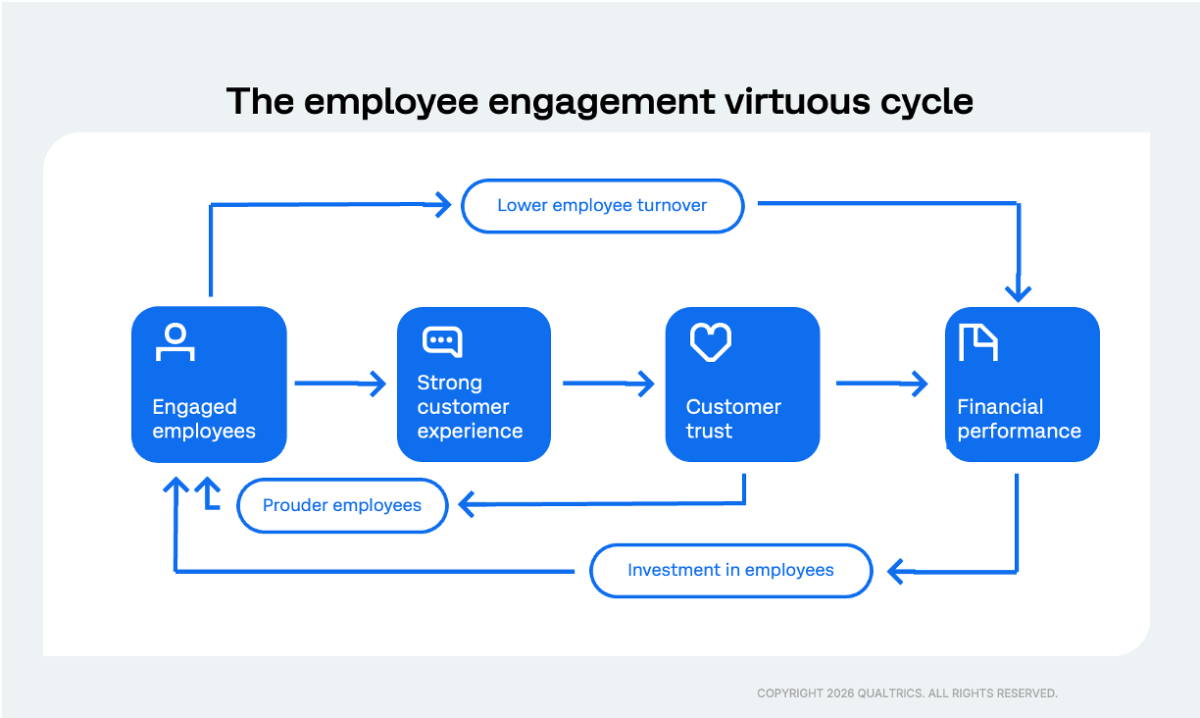
Qualtrics XM® researchers have quantified how employee experience (EX) drives customer outcomes. The Employee Engagement Virtuous Cycle represents a research-backed model that connects how employees feel to how a business performs. It’s a reciprocal cycle that illustrates the inherent connections among employee experience, customer experience, and financial results.
The Connections
Engaged employees → Strong Customer Experience (CX)
The chain starts with engaged employees. Engaged people work harder, help their colleagues, and proactively look for ways to improve things. That effort ultimately produces a strong customer experience.
Strong CX → Customer trust
A strong experience, delivered consistently, earns customer trust. Trust is what transforms interactions into a relationship. Customers that trust you stay longer and spend more, and bring others with them.
Customer trust → Financial performance
Because trusting customers stay, so does their Customer Lifetime Value. Their recommendations and ratings bring in new customers at a lower acquisition cost. And retaining a customer costs less than winning a new one. Loyalty reaches the bottom line in three ways at once: what customers spend, who they bring with them, and what you save by not replacing them.
The Feedback Loops / Influencing Elements
Prouder employers
Employees feel more connected with companies when customers are happier with the company. And the more connected they feel to their work and the value it creates, the more engaged they become.
Lower employee turnover
Engagement and the stability a healthy business brings keeps people in their roles longer. Lower turnover avoids the immense cost of searching, hiring, and retraining, and it keeps institutional knowledge in place.
Investment in employees
When leaders can see the cycle working, they reinvest in employees, which lifts engagement and starts the next turn from a higher point.
Engaged employees create better customer experiences. Better experiences build loyalty, loyalty drives repeat business and referrals: making engagement a financial lever, not just a cultural one. Engaged employees are the pivot point that transform a customer experience strategy into an actual customer experience.
The cycle step that's easy to skip
This is where the cycle earns the word “virtuous”, and where it is easiest to break. A portion of the loyalty and revenue that engaged employees generate has to be reinvested in the people who generated it: this can look like recognition, honest feedback, professional development, and the opportunity to raise concerns and be heard, though the actual employee drivers that most influence your organization’s CX and financial outcomes may differ. When organizations pull the right levers, employee engagement sustains, the experience stays strong, and the next turn of the cycle begins from a higher starting point.
Skip it, and the cycle stops or reverses. Cutting back on the people who deliver the experience might save money in the short term, but it will eventually cost you customer loyalty in the long run.
What skipping employee engagement costs, right now
This is not abstract. The 2026 Qualtrics® Employee Experience Trends Report found the precipitous engagement decline where customer experience is most exposed—the frontline. In 2026, frontline, customer-facing workers report far lower job attitudes compared to prior years.
Neglecting your frontline impacts both the overall service quality your organization delivers to customers and denies your CX program the wealth of customer insights and feedback your frontline has to offer. When asked to name the root causes of poor customer experiences, frontline employees pointed to communication problems and service delivery failures, the same issues customers raised in Qualtrics 2026 global consumer trends research.
Yet their insights are going unheard. Just half of frontline employees say they can challenge the traditional way of doing things, and their perceptions have rapidly declined (-7 pts YoY). The signals are there, and the solution is remarkably simple: listen to them!
Tapping into the cycle
So where to begin? Start with your people and your data.
Invest in frontline listening
Make sure the people closest to the customer feel heard. They are a key source to understanding where the gaps are in both employee and customer experiences—and listening demonstrates interest and care.
The 2026 EX Trends report found employees whose companies increased listening reported higher engagement, stronger intent to stay, better well-being, and greater inclusion. Their experience was significantly better than employees’ whose companies listened at the same frequency as before—and far outshined employees at companies that cut back on listening.
Find which employee experiences drive customer experience outcomes
Tap into your EX and CX datasets and conduct analyses to identify the specific employee experiences that are most critical to drive and improve customer experiences and organizational performance. Understanding those key drivers allows you to act proactively rather than fixing issues after they appear. Start with a single unit of analysis like a team, location, or product to make sure you can successfully link your EX and CX data.
Equip your managers
Your CX or EX program on its own can’t change how employees feel or behave. You need to leverage middle managers. They’re the ones who deliver training, set goals and expectations, and model the culture that shapes day-to-day employee and customer experiences. They also need to coach their employees to adapt to change and adopt new behaviors, yet many aren’t trained to do so effectively; 63% of frontline workers say they have not received feedback that improves their performance.
Recognition programs, honest feedback, and development rarely need a big budget, and they enable the improved customer experience you are working to build. To move your customer numbers, invest in the people behind them and watch the virtuous effect show up in your bottom line.