

What is market research?
Market research is the process of gathering, analyzing, and interpreting information—typically about your target audience, market, or competitors. This information helps organizations understand what people need, want, think, and do—and why.
To do this, market research draws on a wide range of methods, each suited to different questions and stages of decision-making. From in-depth interviews that uncover motivations, to large-scale surveys that highlight trends across audiences, the breadth of market research methods allows teams to choose the right approach for the task at hand.
At its core, market research is about reducing uncertainty: instead of relying on assumptions or gut feel, it provides the evidence to make better decisions—whether you’re a startup finding your target market, an enterprise optimizing a global brand, or someone with a business idea looking to launch your own venture.
Why is market research important?
Market research has been an important tool in the arsenal of most organizations for decades. Today, it matters more than ever.
That’s not because of one single shift, but because multiple forces are changing at the same time. Markets are more competitive, customer expectations are higher, and change is happening faster than most organizations can comfortably predict. Add economic uncertainty, rapid technological advancements, and shifting behaviors into the mix, and we’re left with a tricky landscape to navigate—one where the cost of getting decisions wrong can be devastating.
Market research helps organizations navigate this complexity by turning uncertainty into insight, and insight into action.
There are many reasons why market research is important. Here are three of the biggest ones.
Market research helps organizations make decisions with confidence
When the stakes are high—like they are right now—market research provides a structured way to reduce uncertainty. From driving your marketing strategy to determining your true market size, by grounding decisions in evidence rather than assumptions, teams can move forward with greater confidence.
For example, your organization has developed new messaging concepts. Using market research to test them with real customers before launch can reveal what resonates and what falls flat—guiding you in the right direction and away from any costly missteps.
Market research creates a deeper understanding of customers and their needs
Effective market research goes beyond describing what customers do to explaining why they do it—especially when using qualitative research. This kind of insight helps teams uncover motivations, emotions, and unmet needs behind consumer behavior that aren’t always visible in data alone.
For example, customer interviews reveal that your churn issues aren’t driven by your pricing or a lack of features, but by confusion over how to use your product. This insight leads you to develop more comprehensive, easier to understand guidance for both your onboarding and marketing efforts.
Market research enables smarter prioritization and more efficient use of resources
With limited time and budgets, organizations can’t do everything. But market research, by identifying which audiences, moments, or features drive the greatest impact, can help you focus on what matters most.
Concept testing, for example, can show which product or campaign ideas customers actually value before significant investment is made. This allows teams to prioritize concepts with the highest potential return, reducing wasted time and spending on ideas that aren’t working for customers.
Learn about Qualtrics Market Research software
The evolution of market research: Traditional, digital, and AI
Few industries reflect the pace of technological change over the past 30 years as clearly as market research. What began as a slow, specialist discipline has become an increasingly agile, technology-enabled capability.
Understanding how market research activities have evolved, from traditional methods to digital tools and now AI-enabled approaches, can help researchers choose the right techniques for today’s decisions—and best prepare for what’s next.
1. Traditional market research
Traditional market research was built for a slower, more predictable world. It relied heavily on surveys, focus groups, and interviews conducted through panels or in-person sessions. Analysis was manual, timelines were long, and insights were often retrospective.
This era laid the foundations of rigorous research design and statistical validity. But it struggled with speed, scalability, and accessibility. By the time insights reached decision-makers, market conditions had often already moved on.
2. Digital market research
Digital tools have transformed how research is run: online surveys, agile panels, and self-serve platforms made it faster and easier to collect data at scale. With digitization, research became more democratized, enabling more teams to ask questions and get answers without specialist support, and more businesses to access and benefit from research insights.
This shift dramatically improved speed and reach. However, many organizations faced challenges turning the large volumes of collected data into clear, actionable insights. Analysis often remained time-consuming, and advanced methods were still limited to specialist teams.
3. AI market research
AI represents the next generation of market research—not just speeding up what already exists, but fundamentally changing what’s possible.
Right now, AI is helping many organizations move from insight as a support function to insight as a growth engine. By dramatically increasing speed-to-insight, teams can spot high-potential opportunities earlier, validate product-market fit faster, and make confident investments that capture market share.
AI is at the center of the Qualtrics® Market Research solution, expanding what’s possible across the research cycle—including through the use of synthetic responses. These are AI-generated research inputs that are trained on millions of validated responses to mimic real-world data. Through the Qualtrics Platform®, organizations are combining traditional human panels with synthetic responses to unlock comprehensive insights at scale and speed—and reducing research costs by up to 50%.
Agentic AI points to an even more proactive future. This refers to AI agents that are capable of automating entire research workflows, continuously monitor incoming data, identify opportunities, and even design and execute studies automatically. Instead of reacting to questions, Agentic AI empowers market research to become continuous, adaptive, and always on.
AI best practices in market research
AI is rapidly reshaping how market research is designed, conducted, and analyzed. It enables teams to move faster, work at greater scale, and uncover deeper insight than was previously practical.
But simply using this technology in your market research won’t see you unlock these benefits. In fact, without the right guardrails, AI can just as easily amplify weak assumptions, low-quality data, or unclear objectives.
Following proven best practices helps ensure AI strengthens research rigor rather than undermining it. Here are four of the most important to follow.
Start with clear research objectives
As any user of large language models (LLM) will know, AI works best when it’s given a good brief.
Before launching any study, you should already be clear on the decisions the research needs to inform and the level of confidence required—and this should certainly be the case when leveraging AI. Doing this will help teams choose the right methods, prompts, and analytics, and avoid using AI simply because it’s available.
Choose AI built specifically for market research
While general-purpose AI tools can be useful for exploration, specialized AI-enabled research platforms like Qualtrics typically deliver more reliable and relevant results because they’re specifically designed for market research. They’re trained on validated research data, embed methodological rigor, and are built to support techniques like survey design, advanced analytics, and insight generation.
For organizations deploying market research, using specialized AI tools will ultimately lead to higher-quality outputs, better governance, and greater confidence in decisions—especially important when research findings carry real business risk.
Apply AI across the entire research lifecycle
AI delivers the most value when it’s embedded across every phase of a research study, not bolted on at the end as an analysis shortcut. Applying AI thoughtfully and thoroughly helps teams design better studies, collect higher-quality data, and move from insight to action faster.
Across the research lifecycle, AI can support:
- Problem definition and discovery—by helping teams clarify objectives, refine hypotheses, and identify knowledge gaps early
- Data sources and sampling—including leveraging both real and synthetic respondents to balance scale, speed, and cost
- Survey design and scripting—improving question clarity, flow, and consistency, while reducing bias
- Data collection—through AI-generated follow-up questions, conversational feedback, and even full AI-led interviewing that deepens understanding in real time
- Data quality and scrubbing—automatically identifying unmotivated respondents, fraud, and bots to protect data integrity
- Data analysis—with automated notes, theme detection, summaries, and Machine Learning-driven topic modeling
- Reporting and summarization—accelerating insight sharing through AI-drafted reports tailored to different stakeholders
Use AI to augment, not replace, human judgment
AI is exceptionally good at pattern recognition, automation, and scale, but it doesn’t and therefore shouldn’t replace critical thinking.
The strongest outcomes come when AI handles data collection, analysis, and synthesis, while researchers bring human value through context, domain expertise, and interpretation.
If you treat AI as a research partner that accelerates insight, not a black box that replaces expertise, you’re off to a good start.
The core types of market research
Market research can feel complex at first glance, with a wide range of methods, study types, and terminology. But underneath that variety are a couple of core distinctions that shape how research is designed, what it can tell you, and how it should be used.
Understanding these fundamentals makes it much easier to select the right approach for your goals, and to combine methods in a way that balances speed, depth, and confidence.
Primary vs. secondary market research
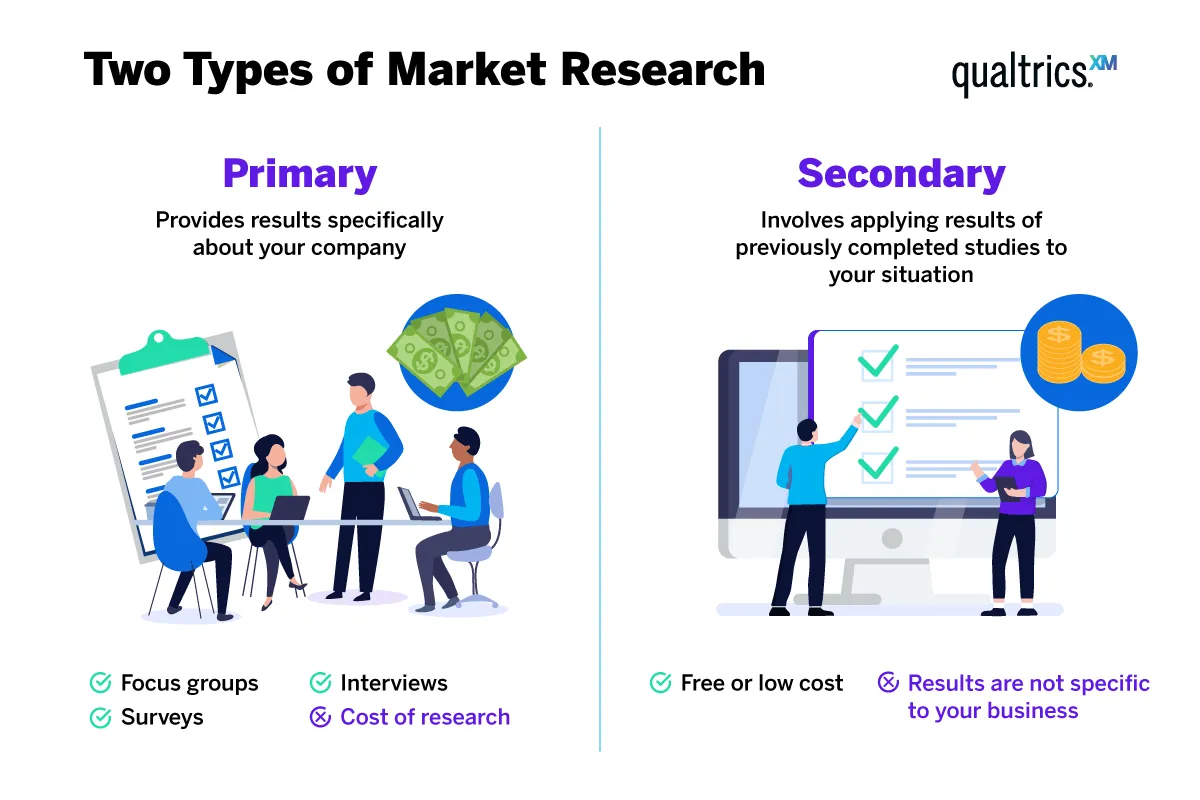
There are many market research methods. They all, however, fall into one of two broad categories: primary research and secondary research.
Primary market research
Primary market research is research you collect firsthand to answer a specific question. It’s designed around your objectives, your audience, and the decisions you need to make. Common primary research methods include surveys, interviews, focus groups, and user testing.
The main advantage of primary research is relevance. Because you control what’s asked and who’s involved, the insights are current, targeted, and directly tied to your use case. This makes primary research especially valuable for testing new ideas, validating product or messaging decisions, and exploring unmet needs. The tradeoff is that it typically requires more time and budget to design, field, and analyze.
Secondary market research
Secondary market research uses existing data. This can include industry reports, government census data or statistics, academic studies, syndicated research, customer reviews, and internal data from past research or sales trends.
Traditionally, secondary research has been used to build background understanding, size markets, and identify broad trends. But today, newer forms of secondary research are making this insight far more accessible. For example, instant insights solutions like those available through Qualtrics Edge™ provide on-demand visibility into real-time market trends, consumer preferences, and competitive positioning without the need to run a new study. This allows teams to answer common market questions in minutes rather than weeks, and to ground decisions in continuously updated benchmarks.
The key advantages of secondary research are efficiency—in terms of both speed and cost. Secondary data can be a lot faster and more cost-effective than collecting data from scratch, making it ideal for early-stage exploration, ongoing monitoring, and informing hypotheses. The limitation is that the data wasn’t collected specifically for your question, so it may not offer the precision or depth you need.
Ideally, it shouldn’t be a choice between primary and secondary research; they are most powerful when used together. Secondary research provides instant context and direction, while primary research fills in the gaps with tailored, decision-ready insight. Paired effectively, they help teams move quickly without sacrificing confidence or rigor.
Qualitative vs. quantitative market research
Another way to categorize market research is by the type of data it produces: qualitative or quantitative.
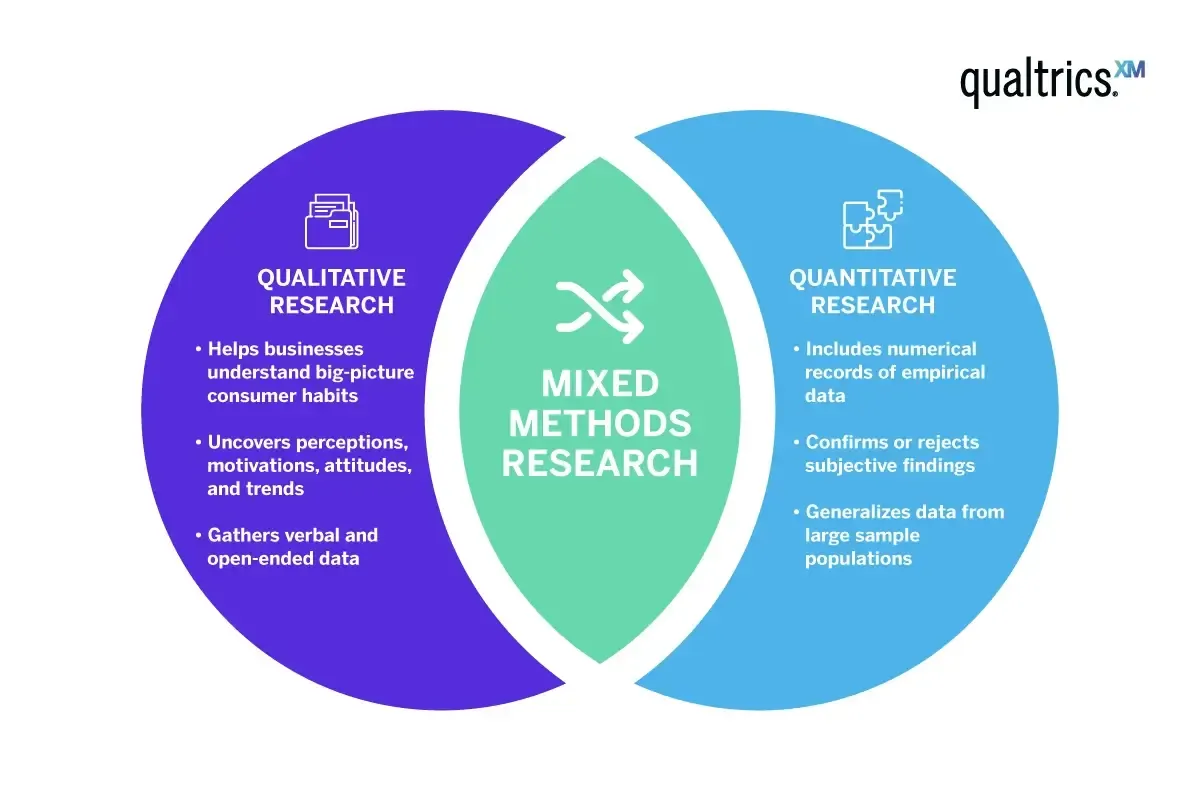
Both play distinct roles and answer different kinds of questions: qualitative research helps you understand the why behind customer behavior; quantitative research helps you measure what, how many, and how much.
Qualitative market research
Qualitative market research focuses on depth over scale. It’s typically exploratory and open-ended, designed to uncover motivations, perceptions, language, and unmet needs. Rather than producing statistically representative results, qualitative research surfaces rich insight and context.
Common qualitative research methods include:
- In-depth interviews (IDIs): One-on-one conversations that allow researchers to explore attitudes, behaviors, and decision-making in detail
- Focus groups: Moderated group discussions that reveal shared perceptions, differences in opinion, and group dynamics
- Video questions: Short, open-ended video responses that capture emotion, tone, and nuance
- Video diaries: Participant-led recordings that show how experiences, habits, or opinions evolve over time
Qualitative research is especially valuable in early discovery phases, when developing hypotheses, shaping messaging, or attempting to understand how customers experience a product or service in real life.
Quantitative market research
Quantitative market research, on the other hand, focuses on measurement and scale. It uses structured questions and larger sample sizes to produce statistically reliable results that can be compared, tracked, and modeled. Quantitative studies are designed to support confident decision-making by showing patterns, relationships, and tradeoffs.
Common quantitative research studies include:
- Attitudes and Usage (A&U): Understand who your customers are, how they behave, and how they perceive your brand or category
- Concept testing: Evaluate new product, feature, or service ideas before launch
- Creative and ad testing: Measure how well marketing assets perform and which messages resonate
- Feature prioritization (MaxDiff): Identify which features matter most by forcing tradeoffs
- Feature optimization (Conjoint): Understand how customers value different combinations of features and attributes
- Pricing studies: Techniques such as Van Westendorp Price Sensitivity Meter, Gabor-Granger, and willingness-to-pay analysis help identify optimal price ranges
- Key driver analysis: Reveal which factors have the greatest impact on outcomes like satisfaction, loyalty, or intent
- Brand tracking: Monitor brand health, awareness, and perception over time
- Bespoke or custom research: Tailored studies designed to address unique or complex business questions
Like primary and secondary research, in practice qualitative and quantitative research are most effective when used together: qualitative insight helps shape the right questions and interpret results; quantitative data validates findings at scale. Combined—what’s known as mixed methods research—they provide a complete view, helping teams understand not just what’s happening, but why, and what to do next.
How to write a market research plan
A market research plan is a practical roadmap for your research project—outlining how you will gather the research insights you need. It defines what you want to learn, who you need to hear from, and how the research will be carried out.
A well-written market research plan is important because it creates clarity before any data is collected, reducing risk and ensuring the research delivers insight that truly supports better decisions.
Here are the key actions to get you there, which can be applied to any market research project.
Define the business decision or problem
Start by clearly defining the decision the research needs to support or the problem you want to address. This might be whether to launch a new product, refine positioning, enter a new market, or prioritize features. Anchoring the plan to a real decision or problem, helps avoid unfocused research and keeps stakeholders aligned.
Set clear research objectives
Translate the business decision or problem into specific learning goals. Research objectives describe what you need to understand to proceed with confidence—such as customer needs, preferences, perceptions, or willingness to pay. The best objectives are kept both concise and front of mind.
Define the target audience
Your market research plan should identify who should participate in the research. In consumer research, for example, this could be current or potential customers, lapsed users, or specific segments within your audience. Make sure you are clear about any criteria that’s important to your research, such as demographics, behaviors, or usage patterns, to ensure that insights are both relevant and reliable.
Choose the right research methods to gather data
It’s crucial that your plan outlines the research methods you will use to gather data—and that beforehand you have spent time identifying the methods that best fit your objectives, timeline, and budget.
This might involve qualitative methods to explore motivations, quantitative methods to measure demand, or a combination of both. At this stage, also decide whether the research will be primary, secondary, or a mix of the two.
Design the study
Your market research plan should summarize how the research will be executed. This might include defining the structure of surveys or discussion guides, deciding on key metrics, and outlining how data will be collected. Done well, study design will ensure your questions are clear, unbiased, and aligned with the research objectives.
Set timelines, budget, and responsibilities
Finally, establish the all-important—and often overlooked—practical details, such as timelines, budget, and ownership. Aligning on these details upfront will help your research project run smoothly and stay on track.

How to analyze and present your market research findings
You’ve conducted your research and collected your data—but this is only half the job.
The real value of market research comes from how effectively insights are analyzed, interpreted, and shared. These best practices help ensure findings are clear, credible, and easy to act on.
Start with your question
Analysis should always return to the original decision or problem the research was designed to support. Rather than exploring data in every possible direction, focus on what you initially set out to determine—and therefore what stakeholders actually need to know to move forward.
Look for patterns in your market research data
Individual results rarely tell the full story. That’s why the best analysis looks for patterns across questions, segments, or time periods—transforming raw data into insight that explains what’s happening and why.
This might mean comparing how different customer segments respond to the same concept, or linking attitudes to outcomes like intent or satisfaction.
Combine results with evidence
Numbers alone often fail to tell the full story. Context—whether it’s qualitative feedback, benchmarks, or historical trends—bring meaning to quantitative data, helping stakeholders interpret results with confidence.
For instance, a drop in satisfaction may look concerning in isolation. But comparing it to industry benchmarks or previous waves can clarify whether it reflects a real issue or a broader market shift.
Use AI to surface what matters most
As research has grown in scale and volume, it’s become both easier to miss crucial insights and harder to keep track of what’s already been found. This is where AI-enabled research is revolutionary—helping teams avoid duplicating work and uncover relevant findings far faster.
With tools like Qualtrics Market Research, teams can centralize research in an AI-driven insights archive, making it easier to find and explore relevant findings, recommendations, and past work— and helping teams build on existing knowledge before launching new studies.
Tell a clear, focused story
The most effective research presentations prioritize clarity over completeness. Instead of walking through every chart, they lead with the key, valuable insights, explain what they mean, and connect them to implications or next steps—all focused around a single clear narrative.
Make insights easy to find and reuse
Research shouldn’t be a one-off deliverable that disappears after it’s presented. Instead, it should exist as a long-term asset that’s returned to and built on.
Ensuring this requires making your insights organized and accessible. Which, in practical terms, means storing your findings in a searchable, shared library. Done over time, this practice should strengthen your institutional knowledge and improve the quality of future decisions.
What to avoid when you conduct market research
Market research can be as much about avoiding mistakes as it is about choosing the right methods. So, what should you be looking out for?
Here we look at some of the most common ways research can lose rigor, relevance, or impact. While avoiding these pitfalls doesn’t mean eliminating risk entirely, being aware of them upfront helps teams design stronger studies and make better use of the insights they generate.
Starting with assumptions instead of questions
Research is most valuable when it challenges thinking, not when it reinforces it.
If you’re starting a research project with strong, existing assumptions, you will find yourself led to narrow objectives, biased study design, and results that are steered toward predetermined answers. Instead, effective research begins with open, well-framed questions that allow unexpected insights to emerge.
Using the wrong sample
Even perfectly designed research can fall apart if it reaches the wrong audience—be it people who don’t match your target customer, or sample sizes that are too small or skewed. Making this mistake often leads to confident-looking insights that don’t hold up when decisions are put into practice.
Getting the sample right means clearly defining who you need to hear from, ensuring diversity and representation, and being able to reach those people consistently. This is where purpose-built research platforms can help, with solutions like Qualtrics Market Research enabling organizations to build and manage relevant research panels through a single interface.
Over-relying on a single method
In a world that’s abundant with research methods—all with specific strengths and limitations—relying on just one approach in your market research can create costly blind spots.
A combination of different methods will always bring stronger validation to your findings and provide a more complete understanding—particularly when using both quantitative and qualitative approaches.
Treating research as a one-off exercise
With markets, customers, and expectations evolving continuously, the results of single, isolated research projects can become outdated quickly. Organizations that think of market research as an ongoing practice will always be in the best position to adapt in a changing world.
Ethical considerations in market research
As research becomes faster and more data-rich, it’s essential to ensure studies are designed and run responsibly.
This is where ethical market research comes in—protecting participants, strengthening trust, and improving the quality of insight. Here are some considerations to help you get there.
Respecting privacy and protection in data collection
If your research is collecting data from people, those participants should always know how their data will be used and protected. This means collecting only what’s necessary and handling personal information securely. For example, if you’re running a customer satisfaction survey, you may not need to collect names or email addresses at all.
When done effectively and transparently, being clear about your data practices and intentions builds trust and reduces risk.
Ensuring informed and fair participation
Market researchers should always help people understand what they’re agreeing to before they take part in your research project. This includes being upfront about the purpose of the study, how long it will take, and how their feedback will be used, and offering incentives that reflect the time and effort you’re asking for.
Avoiding bias and misuse of insights
Ethical market research also requires that insights are interpreted, represented and shared accurately. For example, if your findings show mixed results, it would be unethical to highlight only the positives and none of the negatives raised by participants. Being transparent about limitations helps stakeholders make better decisions and preserves the credibility of the research.