


What is customer intelligence (CI)?
Customer intelligence (CI) refers to the analytical knowledge businesses gain—and the improvements they can make—by converting customer data into actionable insights. Those insights provide customer experience (CX) professionals with a better idea of their customers’ habits, needs, preferences, and pain points.
Effective customer intelligence combines data from behavioural analysis, heuristic insights, and feedback across owned channels and third-party platforms.
Robust customer intelligence improves CX by closing experience gaps, fine-tuning things like pricing and marketing, and better personalising offers for each individual customer or audience segment.
Powering a great customer intelligence programme relies on gathering a healthy mix of behavioural and transactional customer data, as well as solicited and unsolicited customer feedback, and then acting on the actionable customer insights that these combined inputs generate.
Customer intelligence vs business intelligence
Similar terms, meaningfully different practices. So what separates these ‘intelligence’ fields is the kind of information they trade in.
- Customer intelligence focuses on gathering and analysing the experiential, often unstructured data (like sentiment and behaviour) that shape the customer experience. That means understanding what it’s like to be a customer interacting with your brand.
- Business intelligence is much more transactional; it usually centres on metrics and figures like financial and operational data. It's also about benchmarking that data against the competition to find out where you stand relative to your rivals.
Where customer intelligence stands in 2026
In general, improving customer experience involves removing pain points, closing experience gaps, and fostering positive brand associations. Customer intelligence (CI) helps businesses do that by:
- Identifying and addressing customer pain points
- Understanding customer behaviours, needs, and sentiments
- Increasing conversion rates whilst reducing churn
- Boosting satisfaction and long-term loyalty
Customer intelligence’s role in CX is akin to the role blueprints play in building a skyscraper. You need that foundational knowledge and plan to be able to work with. Track and use the right sources of information, and you’ll be able to spearhead actions that improve every element of the customer experience—and do so on an ongoing basis.
But our research shows there’s a gap here, with some common headwinds creating challenges between organisational ambition and operational maturity.
As part of our 2026 CX Catalyst Report, we’ve found a few key indicators that there are roadblocks in the way of businesses unlocking true customer intelligence:
The maturity gap
While 74% of organisations in our research rate customer experience as a critical priority, 56% are still in the earliest maturity stages when it comes to their CX programmes—of which customer intelligence is a key part. Only 14% of the organisations we’ve surveyed have reached ‘advanced’ maturity here, whereby CX is built into the core foundations of the business.
Economic uncertainty
Determining ROI can be tricky. Our research shows that only 17% of businesses can point to specific, quantified monetary benefits from their CX programmes, even though 57% believe it adds value.
McKinsey’s research offers useful context, especially when it comes to newer customer intelligence tools that use AI to analyse information at scale. Its 2025 State of AI report, for example, suggests that businesses using next-generation customer insights tools saw 1.5x more revenue growth over a three-year period—while those using machine learning for customer intelligence were able to predict and prevent annual churn by up to 20%.
Buy-in hurdles
Our CX Catalyst research puts competing organisational priorities as the key blocker to intelligence-driven customer experience transformation—with 70% citing it as the biggest roadblock. System integration is a close second at 53%. Both challenges tend to originate at the top.
Buy-in here comes in two flavours. The first is that you’ll need the go-ahead to deploy modern CX management software capable of separating signal from noise when it comes to collecting and analysing omnichannel customer experience data.
Second, your business needs to be ready to change based on what your customer data show you. Customer intelligence is only useful if you act on what you learn, so businesses need to adopt an approach to change management that runs across every department—without siloing useful insights.
Data privacy and ethics in customer intelligence are foundational
Balancing customer privacy concerns with the need for personalisation is a key challenge. Transparency about data collection practices and adherence to privacy regulations like GDPR and CCPA are essential.
For example, session replay tools—designed to highlight UI issues on websites and in apps—recreate user journeys algorithmically, rather than recording people’s actual usage. When in doubt, be direct: be thorough with your cookie policies and let people know if you record certain calls, and why doing so helps you improve.
Session replay software can be a complete game-changer when it comes to understanding the pain points your users face when it comes to using your website or digital product. Our guide covers what these tools can surface and how to put them to work.
Compliance considerations
Any customer intelligence data collection method needs to comply with local laws and legislation in the markets you operate in. Acts like the California Consumer Privacy Act in the US, or GDPR in Europe, for example, necessitate that collecting customer data become a fully managed process—one in which businesses must explain and catalogue their data collection methods while also obtaining and recording customer consent.
How to build a customer intelligence strategy
With the challenges understood, let’s outline the six key steps to building an effective customer intelligence strategy:
1. Define clear objectives aligned with business goals
Start with a question, not a data set. Understanding what you're trying to achieve with customer intelligence will determine where you focus your efforts—especially if time or resources are tight. For example, if your key priority is to improve the efficiency and readability of your website UI, that will affect the kinds of tools to prioritise—like session replay, heatmaps, and user journey analytics.
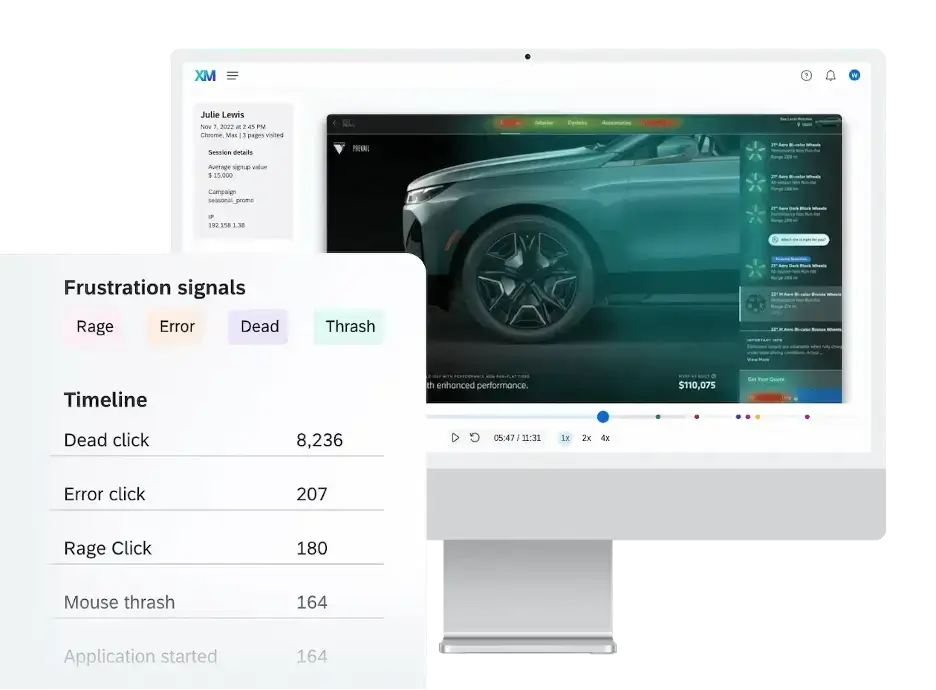
Digital Experience Analytics can identify user frustration signals including rage, error & dead clicks, and mouse thrashes.
2. Map customer journeys and identify data sources across all touchpoints
In general, the more sources you can draw from, the better. True omnichannel analytics involves pulling information together from every single customer touchpoint, so it’s best to use an experience management software suite that can draw from as many channels and platforms as possible.
3. Regularly update customer personas to reflect changing behaviours and preferences
What works for one customer type might not for another, so it’s always wise to run regular customer persona exercises to understand your different audience segments.
Our research, for example, shows that the 18-24 age cohort averages an NPS of just 1 across all industries, compared to significantly higher scores in older demographics. This is a tough crowd to win over, but that skewing means something important: aggregate scores won’t give you the whole picture. So your customer intelligence efforts need to break things down by segment or cohort if they’re going to prove actionable.
4. Collect and unify customer intelligence data
Manual data collection doesn't scale. Most businesses will simply have too many interactions, data points, and nuances in customer behaviour to manage by hand.
Instead, you’ll need an experience and customer relationship management software suite that can gather behavioural data, run sentiment analysis from the content of incoming calls, scour through social media platforms, and more—with AI and natural language processing built in for scale and speed. The result of analysing customer data from a wide array of sources like this will be insights and trends that you’d otherwise miss.
5. Act on insights
Your customer intelligence efforts will no doubt surface a wealth of valuable CX insights. Now comes the most important part of the process: acting on what you’ve learnt in order to drive change.
This should be a business-wide process, where relevant insights are shared across teams and action plans address the customer experience according to what your CI data tell you.
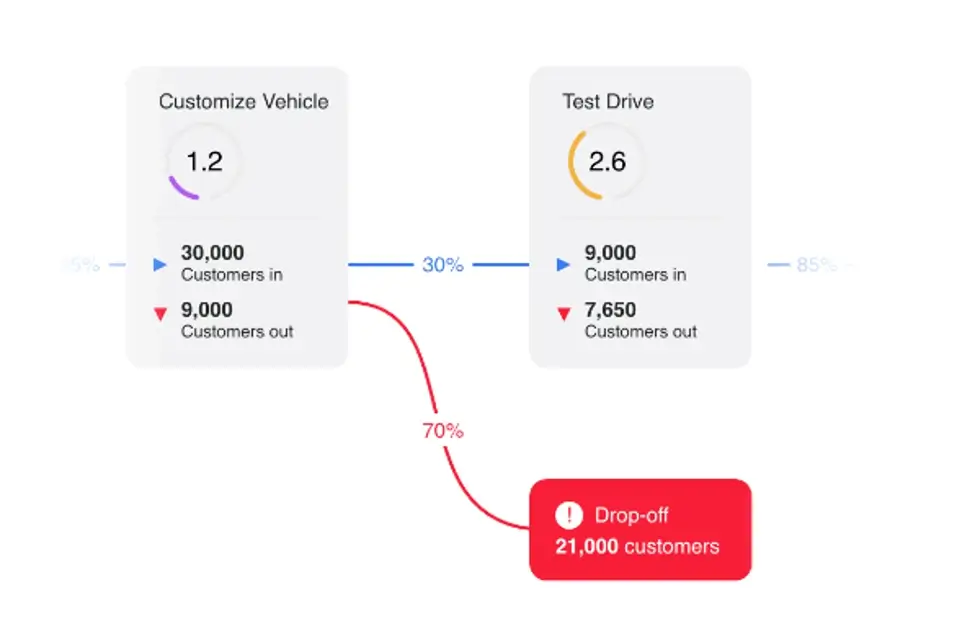
Customer journey reporting allows you to identify and act on customer pain points.
If customers are dropping off in large numbers before checking out, and you learn that they find a specific element of the process frustrating, you’ll want to make UX changes to streamline things. If you learn that your marketing efforts are falling on deaf ears, you’ll need to go back to the drawing board. If you figure out that people love your products but don’t like the price, then you’ll want to fine-tune your position in the market.
Here’s the thing: resolution is the single biggest lever for driving customer satisfaction; when issues are resolved, the gap between channels narrows dramatically. That’s why it’s so crucial to act on what your customer intelligence are telling you.
6. Measure, iterate, and repeat
Once you’ve taken action, you’ll need to measure the impact of those changes—and hopefully see an upward trend in the metrics that matter most, like Overall Satisfaction (OSAT).
Static KPIs are important to track, but leading businesses in this space think in terms of ‘outcome-driven’ measurement. Try to build a single, provable link between a given experience signal and a specific business outcome (like retention or cost-to-serve) for one segment. Then expand from there.
It’s also worth noting benchmarks for your industry. Our research, for example, shows that in-store and mobile apps score highest for OSAT, while virtual agents and call centres tend to score lowest. And, while the cross-industry NPS standard is 28, this swings as high as 37 (for retail) and as low as 13 (for utilities).
The future of customer intelligence
Customer intelligence is never a one-and-done process; it leads to actions that require measurement, iteration, and further data gathering. Similarly, the industry around customer intelligence is always moving—with new capabilities and tools arriving all the time.
Reality check: AI and machine learning in customer intelligence
AI tools can deliver best-in-class customer intelligence reporting, but they can also lead to CX pitfalls that hamper customer loyalty.
Usually, this is because AI is implemented without any clear thinking behind the whys and hows behind its use. We found that while 76% of organisations expect AI to improve the customer experience, only 38% have a coordinated strategy for its implementation.
This results in missed opportunities. When AI is built with natural language processing capabilities, for example, it can understand the content of every customer call, instant message, email, text, social media post, and review; analyse sentiment, effort, and intent; and provide insights that combine the entire pool of customer opinion.
Done right, AI implementation can simultaneously analyse and unify:
- Social media posts
- The content of contact centre calls
- Customer emails, IMs, and SM messages
- Online sentiment from third-party review sites
- Behavioural data from users visiting your website
- How transactional data relate to customer interactions
Likewise, AI that understands customer behaviours along the customer journey, as well as input from transactional data and customer preferences, can surface trends and opportunities that would be impossible to spot otherwise.
But currently, very few businesses are using AI for these higher-level functions. For instance, while 62% are using AI tools for basic data analysis, our CX Catalyst Report finds that only 8% are putting them to work on predicting customer metrics, and just 12% for personalising experiences.
As a result, only 17% of frontline staff currently rate their AI-driven customer channels as ‘good’ or ‘very good’.
These are issues caused by failures that originate upstream and proliferate downstream—and across channels. Here’s how to address them:
- Map the full journey across channels to identify where breakdowns start
- Identify high-volume, high-impact pain points (such as unresolved issues)
- Track cross-channel metrics (e.g., AI-to-phone escalations, repeat contacts)
- Estimate customer and cost impact (number of cases x CSAT impact x cost-to-serve)
- Prioritise projects with high ROI and relatively low implementation complexity
- Run experiments to validate and scale solutions
- Align teams around shared outcomes, not channel-specific KPIs
Predictive analytics and customer behaviour forecasting
Experience management suites with agentic workflows (capable of analysing huge swathes of data and automating resulting actions) are the wave of the future; they’re how CX professionals can make the most of often disparate customer data points to find actionable insights—and use them to build stronger customer relationships.
A big part of this next wave of AI in customer intelligence and customer data collection is predictive analytics.
Whereas traditional customer intelligence programmes have always relied on using historical data to provide a snapshot of how things are now, machine learning algorithms can use that same customer behaviour data to predict what your customers might do next.
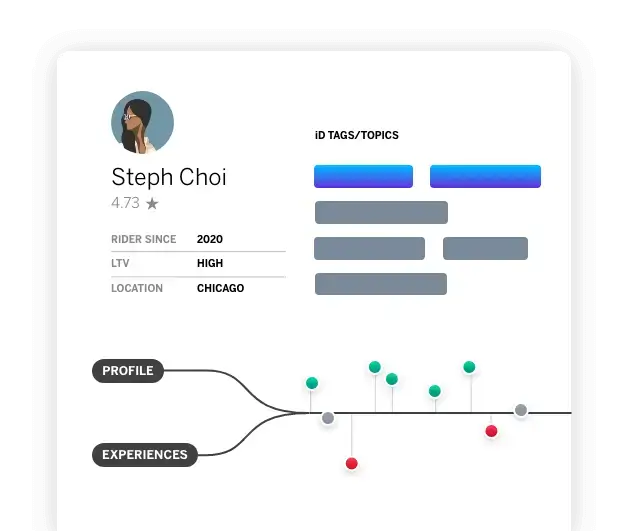
That might mean identifying at-risk customers well in advance of them churning (helping you intercept with a personalised offer), or it might be predicting buying trends in a given demographic that can help steer your marketing efforts.
That might mean identifying at-risk customers well in advance of them churning (helping you intercept with a personalised offer), or it might be predicting buying trends in a given demographic that can help steer your marketing efforts.
Customer intelligence (CI): Key takeaways
Customer intelligence is a customer relationship management strategy that puts behavioural data and customer feedback to work—and that helps CX professionals generate insights for driving positive change.
With an effective CI strategy in place, you can:
- Understand customer preferences and opinions
- Uncover UI and UX inefficiencies and problems
- Discover and fix pain points that would otherwise go unnoticed
- Improve the customer experience and customer journey
- Build stronger marketing plans and more personalised outreach
The organisations that lead on customer experience aren't just collecting more data—they're acting on it faster. That requires an experience management software solution that can collect customer data from every channel and touchpoint, connect the dots, and deliver insights that are smart, relevant, and predictive.
The Qualtrics® XM Platform® turns billions of customer signals into direct, actionable insights that help businesses build stronger customer relationships.
Customer Intelligence FAQs
What are the benefits of customer intelligence?
A robust customer intelligence programme allows businesses to turn behaviours, opinions and feedback from real-world customers into action, resulting in change built on data and insight, rather than guesswork.
Customer intelligence is all about using digital tools (like customer relationship management suites and experience management platforms) to pay attention to the signals and alerts generated from every customer interaction that would otherwise go unnoticed. And, crucially, using what’s learnt to close experience gaps
What are some real-world examples of customer intelligence?
Customer intelligence can impact every department, from marketing to product design. Here are a few examples:
- Predictive personalisation: Using data from previous interactions to surface relevant products or content, as with the Amazon homepage or Netflix recommendations.
- Churn prediction and prevention: Systems that flag repeated contact centre calls can mark customers as at-risk, and raise specific discounts to try and keep them from leaving.
- Customer journey mapping: Customer behaviour tools like session replay systems highlight friction points along the customer journey, letting businesses make improvements to app or website flows.
- Voice of Customer analysis: Natural language processing tools spot patterns form across every customer interaction, highlighting repeated concerns—for example, a slow check-in process at a hotel.
- Behavioural triggers: Cross-referenced purchase histories show that 40% of people who buy a DSLR camera soon go on to buy an SD card. Here, the business could automate a recommended product at checkout.
What are some best practices when getting started with customer intelligence?
It’s important to start with a goal, rather than reams of data. Ask a series of questions—or hypotheses—that you can look to answer and/or prove. That might be “why are customers dropping off at the checkout stage?” or “How can we improve end-of-contract retention?”
This approach ensures that your customer intelligence efforts are focused and effective, rather than open-ended and overwhelming.
Secondly, focus on collecting and uniting good quality, first-party customer data. It’s easy to miss important signals if your data set is small, or if it’s overly siloed—some emergent trends can only be spotted by combining data from different departments and teams. The right tools can help with this, but it also pays to build a cross-departmental team around customer intelligence to help foster a culture of business-wide change.
What customer intelligence metrics and KPIs should I track?
There are a lot of different metrics you can keep tabs on to spot improvements in customer intelligence reporting and optimisation, but here are three of the most important:
Customer satisfaction (CSAT)
CSAT is a standardised measure of overall customer satisfaction. It’s derived from questions that ask how satisfied a customer is with their experience doing business with you, on a scale of 1-5.
Net Promoter Score (NPS)
Similarly, NPS is a standardised, cross-industry score that asks people how likely they are to recommend a business to others—where that likelihood is indicative of an excellent customer experience.
Customer Lifetime Value (CLV)
CLV is calculated by multiplying the amount of money a customer has spent with you by the length of time they’ve been a customer. An upward trend in CLV usually indicates a boost in loyalty.