


What comes to mind when you think about healthcare? Bright, clean hospitals; stethoscope-slung physicians checking charts; crisp-uniformed nurses administering medication; shiny, high-tech machines? All these, of course. But what you probably don’t see is the emotional connection that healthcare employees have to their profession. This emotional connection is employee engagement, and when it’s high, a healthcare organization thrives.
Let’s take an in-depth look at what employee engagement in healthcare means: why it’s so important, current trends shaping it, and how to improve it for the benefit of both employees and patients.
What is employee engagement in healthcare?
We’ll start with a definition:
Employee engagement is an employee’s connection to their work, their role, and their organization, expressed through behavior that contributes to organizational success.
Employee engagement in healthcare differs from other industries because of its intrinsic highly emotional nature. Employees aren’t just producing deliverables to ship out; they’re managing unique humans from pre-birth to end-of-life, their conditions, pain, and recovery. And this may not be direct patient interaction; there are many auxiliary healthcare employees (such as the environment service (EVS), food staff, administrative staff, and others) supporting the vital operations for patient care.
Healthcare employee engagement is the epitome of a ‘mission-driven career relationship’— people who work in healthcare generally do so from a desire to help others and make a difference.
Why employee engagement in healthcare is important
Employee engagement in healthcare is about much more than keeping up staff morale. It has become a clinical, operational, and financial necessity that you ignore at your peril. When healthcare professionals feel valued and connected, patients receive safer, higher-quality care, and clinics and hospitals become better workplaces.
A great employee experience in healthcare will deliver:
Better patient outcomes
Academic research backs this up: increased employee engagement is associated with enhancements in a range of patient safety outcomes. Patients instinctively know engaged employees when they see them, and it influences patient satisfaction scores. A motivated nurse taking the time to explain a procedure clearly and empathetically, and answering questions gives a better patient experience than a disengaged nurse who rushes their patient interactions and appears disinterested.
90% of nurses themselves reported that when they have a positive experience as an employee, they feel they provide a better patient experience.
Reduced burnout
Burnout continues to be high among healthcare professionals. Our research revealed that the doctor/physician burnout rate stands at 32%, and another report from Cross Country found that 65% of nurses report high stress levels and burnout.
The number of healthcare professionals presenting with burnout is a serious and persistent problem. Research shows that the higher nurse burnout, the worse the outcomes for patients. Hospitals that scored more highly for nurse burnout had higher odds of patient mortality, failure to rescue and longer hospital stays.
And when physicians' well-being is taken care of as part of improved employee experience, patient satisfaction and the interpersonal aspects of care improve, leading to a higher quality of care.
Improved safety and increased retention
Everyone should feel safe at work. Healthcare employees not only run the gauntlet of contracting illness or disease, they also risk violent attacks by patients, workplace bullying, and the physical, mental and emotional effects of working daily in unpredictable, stressful, life-or-death situations.
We’re including psychological safety here—a workplace where employees feel they can whistleblow, speak up, and report risks or errors to colleagues and management, without fear of reprisal is a safe workplace.
Our research found that 56% of healthcare professionals did feel safe at work, which is far from ideal. PressGaney research found that employee engagement increases workplace safety. Medical facilities in the top 25% for safety culture rank were on average 68 percentile points higher for engagement than the bottom 25%.

Image 2026 Healthcare Trends Report p.16
Switched-on, engaged employees are more likely to flag up threats and unsafe conditions.
Patient safety outcomes are also impacted by healthcare staff engagement. There’s a significant relationship between engagement and both patient safety culture scores and errors/ adverse events. Increasing staff engagement helps to enhance patient safety.
Safety impacts staff retention too. Employees who view their safety culture unfavorably are 1.74 times more likely to leave their organization. Short staffing, communication breakdowns and a lack of trust and psychological safety create an unsafe environment that can lead to staff turnover. When healthcare professionals leave, team dynamics change. Continuity of care may be disrupted, and workload for the ones left increases. This inevitably impacts patient experience, in the form of longer waiting times, and inconsistency of care.
People stay when the safety culture is strong.
Organizational performance and reputation
Hospitals that deliver top engagement scores are five times more likely to earn 4- or 5-star CMS quality ratings, whereas 88% of hospitals with low engagement scores remain stuck in the mediocre 2–3 star range, and none reaching top-tier status.
And of course patients in high-quality hospitals with empowered, supported and engaged staff are more likely to recommend them, leading to increased revenue for those top facilities.
Current trends in healthcare employee engagement
Our 2026 Healthcare Trends Report is out, and its overwhelming theme this year is trust. Trust is the bedrock of the healthcare industry: there’s patient and care team trust; clinician, nurse and healthcare team trust; trust in safety for all healthcare staff and patients, and even trust in AI to streamline healthcare practices.
We look at what sustains trust, and what threatens it. We examine how burnout and the burden of administrative tasks affect clinicians. And we consider how patients fit into safety culture, and why including them leads to better outcomes.
We discovered:
1. Trust is the primary driver of patient experience—and it’s not one-size-fits-all
Nearly 74% of patients who felt cared for as a person reported high trust in their hospital and clinicians. Among those who didn’t feel cared for, just 18% said the same. Different patient populations experience trust differently, and healthcare organizations need to understand those differences to act on them.
2. Clinician burnout remains a serious and persistent problem
Burnout degrades the entire healthcare experience, with 32% of clinicians experiencing burnout. It’s a problem with the system, not a problem with people. It results from a wide range of factors including unmanageable workloads, a low safety culture, work stagnating, not improving, poor work life balance support, and lack of workplace respect.
3. Top-tier performance in quality, safety, and patient experience will not be achieved unless systems protect the people within them
When safety in a healthcare setting is low, there’s a predicted 93% burnout rate. With a shocking 82% of nurses reporting that they experienced workplace violence in the past year, this is devastating for a caring profession made up of caring, dedicated people. Healthcare professionals must feel psychologically safe, and it’s essential to include patients when creating safety cultures.
4. Healthcare workers are embracing AI, but trust in their organizations’ AI strategy lags behind
AI is reshaping healthcare, and most healthcare workers are buying into its benefits, with 72% of clinicians saying they are comfortable using AI. The stumbling block appears to be the healthcare settings themselves: leaping into AI use before establishing what problems it’s actually solving; a lack of AI tool governance; and the worry that AI may make healthcare less empathetic or humane.
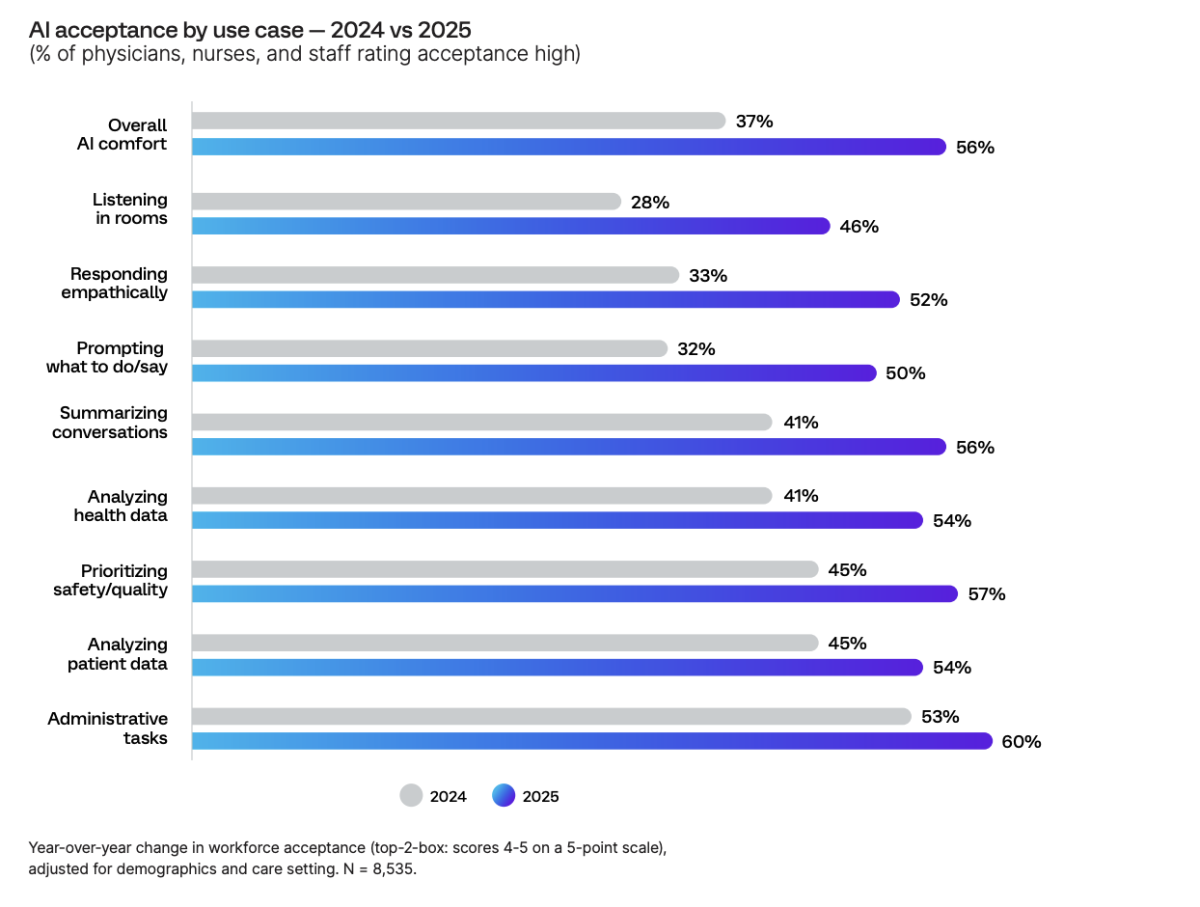
Image from 2026 Healthcare Trends Report p.20
For more detail about these fascinating trends, and—more importantly—how you can apply them to your own employee engagement strategies, download our 2026 Healthcare Experience Trends Report.
How to improve employee engagement in healthcare
Increase trust by acknowledging emotion
When healthcare practitioners feel safe at work, they can focus on their true vocation—caring. At the heart of caring is empathy—putting yourself in your patient’s metaphorical shoes. Practical initiatives include zero tolerance of violence or abuse, de-escalation skills and investment in safety and security. Training programs that focus on emotional intelligence, communication, and culturally sensitive care help staff bring out the emotional side of healthcare —and trust.
Enhance patient care team collaboration
Your care team may be collaborating, but your patients may not see the collaboration. The perception that nurses and staff are working together is the top driver of a good emotional experience for hospital patients:
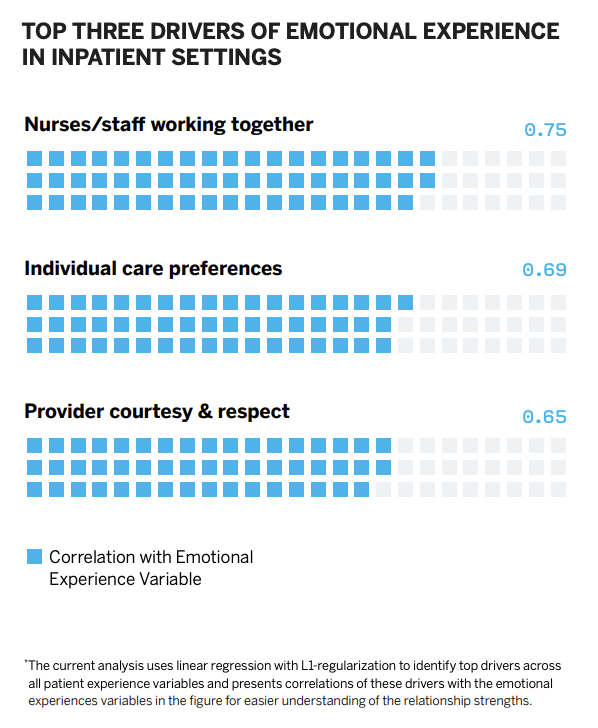
Image: 2025 Health Trends p.9
To reinforce this perception of teamwork in patient care:
- Stress to the patient and their loved ones that they are an important part of the team, and take into account their decision-making processes
- Emphasize that care team members are all working together, whether they can see this or not
- Introduce team members and what they do, including keeping patients in the loop about a change
- Big up other team members in front of the patient!
Give providers the incentive to stay
Doctors and nurses are so dedicated that they’ll go more than the extra mile for their patients, but even they have their breaking point. Pay them what they’re worth and make sure they’re getting the right work life balance to manage mental health, stress and burnout. Professional growth paths give purpose and ambition, and remember to give recognition for a job well done—which it will be.
Make AI trustworthy
Accept that AI is here to stay, but on the organization’s terms. Emphasize that staff must use only secure, governed AI tools for specific purposes, but collaborate with practitioners to get their feedback on the best ways to benefit from AI. Train staff to use AI tools ethically and responsibly, and understand if some people don’t want to participate.
Manage change with communication
Change is inevitable, and even though employees expect it, they still need support and communication through it. Respect for everyone is essential here, with open channels for transparent, two-way conversations while the change is going ahead.
Most importantly—listen to your healthcare employees
You’ve now seen all the benefits that employee engagement brings in a healthcare setting. You’re probably trying to improve trust, patient outcomes, and operational efficiency while balancing budgetary constraints, and wondering how you can improve employee experience.
All the engagement issues in healthcare can be addressed head-on with employee listening. And when organizations listen, an engaged workforce reciprocates with better job attitudes and motivation.
Essentially, healthcare employees are human, just like other employees. Our 2026 Global Employee Experience Trends Report (which also included healthcare respondents) found that employees whose organizations ramped up listening reported higher engagement, stronger intent to stay, better well-being, and greater inclusion. Their experience was noticeably better than those organizations that didn’t change their listening strategy, and they outshone employees at companies that cut back on listening.