The generational breakdown of the workforce: common assumptions and the handoff ahead
Ask what separates the generations at work and you’ll hear familiar claims: Younger workers job-hop, Gen Z doesn’t want to lead, and anyone under 40 wants to work from home. But federal data and the results of large surveys complicate those narratives.
The Qualtrics team brought together Bureau of Labor Statistics and Census data, surveys from Gallup, Pew, and Deloitte, and our own 2026 Employee Experience Trends Report to see which of these claims hold up.
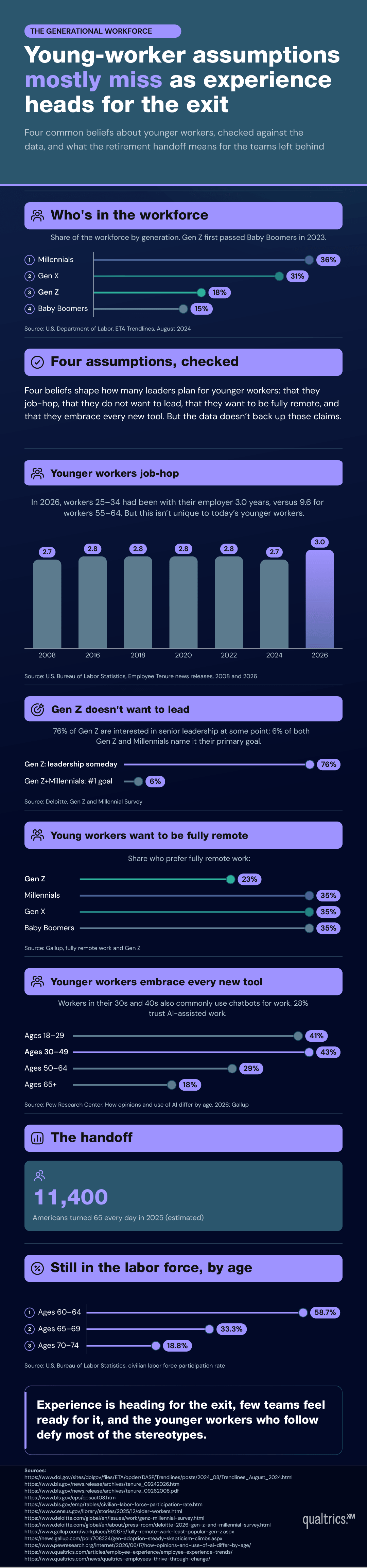
Workers ages 25 to 34 do change jobs more often than older workers, but the pattern isn’t new: their median tenure was 2.7 years in 2008 and has been 2.7 to 3.0 years in every BLS tenure survey since 2016.
In a 2026 Deloitte survey, 76% of Gen Z respondents said they’re interested in a senior leadership role at some point.
And in Gallup’s data, Gen Z is the generation least likely to prefer fully remote work.
Dispelling these assumptions is one thing, but the shift that matters more is still ahead. Gen Z is now a larger share of the workforce than Baby Boomers (18% to 15% in the Department of Labor’s most recent breakdown), and Boomers are turning 65 at a record pace. What happens as experienced workers retire? How well organizations pass their experience to the next group may matter more than any generational label.
Key takeaways
- Median job tenure for workers 25 to 34 has stayed between 2.7 and 3.0 years since 2016. In January 2026, it was 3.0 years, versus 9.6 years for workers 55 to 64.
- Just 6% of Gen Z and Millennials combined name a leadership position as their primary career goal, yet 76% of Gen Z and 67% of Millennials are interested in senior leadership at some point.
- Only 23% of remote-capable Gen Z workers prefer fully remote work, versus 35% in each older generation.
- Workers under 50 use AI chatbots for work far more than older workers (41% of employed adults 18 to 29 and 43% of those 30 to 49, versus 29% of those 50 to 64 and 18% of those 65 and older). But Gen Z workers trust work done without AI more than AI-assisted work.
- An estimated 11,400 Americans turned 65 every day in 2025. In January 2026, 52.6% of workers 60 to 64 had been with their employer 10 or more years, versus 20.3% of workers 35 to 39.
Embed code
Copy and paste the code below to use this infographic on your website or blog.
<center>
<textarea readonly>
<a href="https://www.qualtrics.com/articles/employee-experience/generational-workforce-breakdown/">
<img src="https://www.qualtrics.com/sites/default/files/styles/standard_3xl_retina/public/2026-10/generational-workforce-infographic.webp?itok=-8CHA3vE" alt=" The Generational Breakdown of the Workforce — Infographic" title=" The Generational Breakdown of the Workforce— Qualtrics— Infographic"></a><br><a href="https://www.qualtrics.com/industries/" alt="The Generational Breakdown of the Workforce" title="Qualtrics">By Qualtrics</a>
</textarea>
</center>
Who is in the workforce?
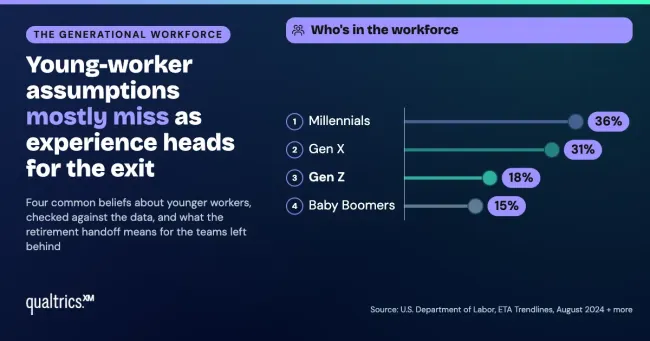
Millennials are the largest generation in the U.S. workforce, at 36%, followed by Gen X (31%), Gen Z (18%), and Baby Boomers (15%), according to the Department of Labor’s most recent generational breakdown, which covers the second quarter of 2024.
|
Generation |
Born |
Age in 2026 |
Share of Workforce |
|---|---|---|---|
|
Millennials |
1981 to 1996 |
30 to 45 |
36% |
|
Gen X |
1965 to 1980 |
46 to 61 |
31% |
|
Gen Z |
1997 to 2012 |
14 to 29 |
18% |
|
Baby Boomers |
1946 to 1964 |
62 to 80 |
15% |
One difference is genuinely generational: education. The same report shows that 43.6% of Millennial workers hold a bachelor’s degree or higher, compared with about 34.4% of Boomers and 38.9% of older Gen Z, many of whom are still in school.
Four assumptions that don’t hold up
“Today’s younger workers job-hop”
Younger workers do change employers more often. In January 2026, the median worker aged 25 to 34 had been with their current employer 3.0 years, compared with 9.6 years for workers aged 55 to 64, according to the Bureau of Labor Statistics. About a quarter of workers 25 to 34 (25.5%) had been with their employer a year or less, versus 9.2% of workers 55 to 64.
What the data doesn’t show is a change based on generation. The median for ages 25 to 34 was 2.7 years in January 2008, 2.8 years in 2016, 2018, 2020, and 2022, 2.7 years in 2024, and 3.0 years in 2026. Workers in that age band today stay at their jobs about as long as workers in the same band did nearly two decades ago, so tenure alone doesn’t support the idea that younger generations are less loyal. BLS notes that short-tenured workers include new hires, people who lost a job and found another, and people who changed employers voluntarily, so the numbers can’t separate job-hopping from simply being earlier in a career.
“Gen Z doesn’t want to lead”
Deloitte’s 2026 Gen Z and Millennial Survey, which polled 22,595 people in 44 countries, found that only 6% of the two groups combined say a leadership position is their primary career goal. Yet 76% of Gen Z and 67% of Millennials are interested in senior leadership roles at some point in their careers.
What gives them pause is the cost. The most commonly cited barriers to leadership are stress and burnout (50% of Gen Z, 49% of Millennials), excessive responsibility (50% and 48%), and concerns about work-life balance (41% and 46%). Most favor steady progress (44% and 45%) over rapid promotions (25% and 21%).
“Young workers want to be fully remote”
Gallup’s May 2025 survey of 19,043 U.S. employees found that remote-capable Gen Z workers are the least likely generation to prefer fully remote work: 23% would choose this option, compared with 35% in each older generation. Seventy-one percent of Gen Z prefer a hybrid arrangement instead.
Millennials show the strongest attachment to remote flexibility. If remote work were no longer offered, 41% of remote-capable Millennials said they would be extremely likely to look for another job, compared with 32% of Gen Z, 28% of Gen X, and 26% of Boomers.
Feelings of isolation may be part of the reason for Gen Z’s preference. Among remote-capable full-time employees, 27% of Gen Z said they felt lonely a lot of the previous day, compared with 21% of Millennials, 15% of Gen X, and 10% of Boomers.
“Younger workers embrace every new tool”
AI chatbot use at work is about even among workers under 50 and lower among older workers. In a Pew Research Center February 2026 survey, the share of employed adults who ever use AI chatbots for tasks at work was 41% for ages 18 to 29, 43% for 30 to 49, 29% for 50 to 64, and 18% for 65 and older.
Across all ages, AI use is growing. In our 2026 Employee Experience Trends Report, a survey of 33,831 employees in 24 countries, 52% said they use AI at work daily or weekly, up 7 points from 2025.
Use isn’t the same as confidence, though. In a Gallup survey of Gen Z conducted in early 2026, about half (51%) of 14- to 29-year-olds said they use AI at least weekly, yet employed Gen Zers placed more trust in work completed without AI (69%) than in AI-assisted work (28%). They were more than three times as likely to say AI’s risks in the workforce outweigh its benefits (48%) as to say the reverse (15%).
The handoff: what happens as experienced workers retire?
Experienced workers are leaving. An estimated 11,400 Americans turned 65 every day in 2025, according to the Alliance for Lifetime Income, and about half of workers 55 and older have been with their current employer for 10 years or more. Meanwhile, in Deloitte’s 2026 survey, only 54% of Gen Zs and 60% of Millennials said their team could maintain performance if a key expert left tomorrow.
Retirements are gradual
The Alliance for Lifetime Income estimates that the U.S. is in a “Peak 65” period running from 2024 through 2027. Turning 65 doesn’t mean leaving work, but it is the age when many people start to.
Most won’t leave at once, though. In BLS’s 2025 data, 58.7% of people 60 to 64 were still in the labor force, 33.3% of those 65 to 69, and 18.8% of those 70 to 74. BLS projects participation in the workforce among ages 65 to 74 to rise from 26.7% in 2025 to 29.1% in 2035.
Experience is concentrated in older workers
In 2026, 26.4% of workers 55 to 64 and 29.7% of workers 65 and older had been with their employer 20 years or more, versus 3.5% of workers 35 to 44. Applying those shares to BLS’s counts, that’s roughly 8.6 million workers 55 and older with two decades at one employer. (That age group includes older Gen X as well as Boomers.)
Some industries are more exposed. Census Bureau research released in December 2025 found that in utilities, 80% of employment in 2022 was at firms where at least a quarter of workers were over 55, up from 35% in 2006. In manufacturing and wholesale trade, that share rose from 14% in 2000 to more than 40%. That measures where older workers cluster, not how many are close to retirement, but it shows where experienced employees could leave around the same time.
Experience doesn’t pass on automatically
In Deloitte’s 2026 survey, Gen Z and Millennials cited limited incentives, time constraints, confidentiality concerns, and high turnover as barriers to effective knowledge sharing.
Other data points to the same weak spots:
- Time Together: Hybrid schedules can cut the overlap that mentoring needs. Among hybrid Gen Z workers in Gallup’s 2025 survey, 66% were required to be on-site a set number of days but free to pick which, and that could mean they come in when coworkers don’t.
- Open Communication: Our 2026 research found that employees with less than a year of tenure reported their lowest engagement since 2021 (65%, down 7 points). Fewer said they can challenge the status quo (50%, down from 64%) or experience open, honest communication (63%, down from 71%).
- Staying Power: The people receiving knowledge tend to be newer to their employers. The median worker aged 25 to 34 has been with their employer 3.0 years, and 25.5% have been there a year or less, while 26.4% of workers 55 to 64 have been with theirs 20 years or more. That means successors are often still new to the organization when knowledge needs to be passed on.
Four ways to plan for the handoff
- Capture knowledge before people leave. Phased retirement and structured mentoring give retiring employees time to document processes and train successors. Use retention analytics to identify where long-serving employees are concentrated, then plan accordingly.
- Make career paths visible. Younger workers say they prefer steady progress and many name burnout as a barrier to leadership. Clear steps and manager support can address both.
- Coordinate flexibility at the team level. Gallup suggests leaders discuss with each team how people work best and coordinate in-person time, so younger employees aren’t working alone in an empty office.
- Set AI guidelines and training. Use is rising, but trust in AI-assisted work is mixed, and only 20% of employees in our 2026 survey use just the tools their company provides. In Deloitte’s survey, about three in ten Gen Z (30%) and Millennial (31%) workers said their organization isn’t prepared for the changes AI will bring.
Want to see how your own workforce compares? Explore Qualtrics employee experience solutions, or see Qualtrics Employee Experience in action.
Frequently asked questions
What is the average employee tenure in the U.S.?
The median U.S. worker had been with their current employer 4.1 years in January 2026, up from 3.9 years in 2024, according to the Bureau of Labor Statistics.
Tenure runs longer in the public sector (5.6 years) than in the private sector (3.9 years), and it rises with age, from 3.0 years for workers 25 to 34 to 9.6 years for workers 55 to 64.
What does it cost to replace an employee?
Gallup estimates that replacing one employee costs between one-half and two times their annual salary.
For a full-time worker aged 55 to 64 earning the median $1,367 a week (about $71,100 a year, per BLS), that works out to roughly $35,500 to $142,200.
Sources:
https://www.dol.gov/sites/dolgov/files/ETA/opder/DASP/Trendlines/posts/2024_08/Trendlines_August_2024.html
https://www.bls.gov/news.release/archives/tenure_09242026.htm
https://www.bls.gov/news.release/archives/tenure_09262008.pdf
https://www.bls.gov/cps/cpsaat03.htm
https://www.bls.gov/emp/tables/civilian-labor-force-participation-rate.htm
https://www.census.gov/library/stories/2025/12/older-workers.html
https://www.deloitte.com/global/en/issues/work/genz-millennial-survey.html
https://www.deloitte.com/global/en/about/press-room/deloitte-2026-gen-z-and-millennial-survey.html
https://www.gallup.com/workplace/692675/fully-remote-work-least-popular-gen-z.aspx
https://news.gallup.com/poll/708224/gen-adoption-steady-skepticism-climbs.aspx
https://www.pewresearch.org/internet/2026/06/17/how-opinions-and-use-of-ai-differ-by-age/
https://www.qualtrics.com/articles/employee-experience/employee-experience-trends/
https://www.qualtrics.com/news/qualtrics-employees-thrive-through-change/