Employee turnover — the rate at which employees leave a workforce and are replaced — represents one of the most significant hidden costs to modern organizations.
Beyond the immediate expense of recruiting and onboarding, businesses lose critical institutional knowledge, suffer productivity gaps, and subsequently degrade the remaining team’s morale.
However, every resignation has a lead-up. Changes in sentiment, workload, and engagement can signal when talent is at risk. Catching these signals early gives leaders a valuable window of time to act.
The team at Qualtrics decided to do some research on this to learn exactly how organizations can spot these critical shifts before a departure becomes final.
Embed code
Copy and paste the code below to include this infographic on your website or blog.
<center>
<textarea readonly style="width:100%; height:100px;">
<a href="https://www.qualtrics.com/articles/employee-experience/predictive-attrition/">
<img src="https://www.qualtrics.com/sites/default/files/styles/standard_2xl_retina/public/2026-11/predictive-attrition-infographic.webp?itok=vikEsKkB" alt="Predictive Attrition: Stopping Turnover Before It Happens — Infographic" title="Predictive Attrition: Stopping Turnover Before It Happens — Qualtrics — Infographic">
</a>
<br>
<a href="https://www.qualtrics.com/" title="Qualtrics.com">By Qualtrics</a>
</textarea>
</center>
Your workforce has one eye on what’s next
Thousands of surveyed workers across dozens of countries have made one thing clear: today’s employees are not shy about exploring their options.
The modern talent market is highly fluid, and employees are acutely aware of their own market value. The data shows that the foundation for an exit is often laid months before an employee hands in a formal notice.
When we look at the current workforce mindset, the numbers present a clear warning to employers who take retention for granted:
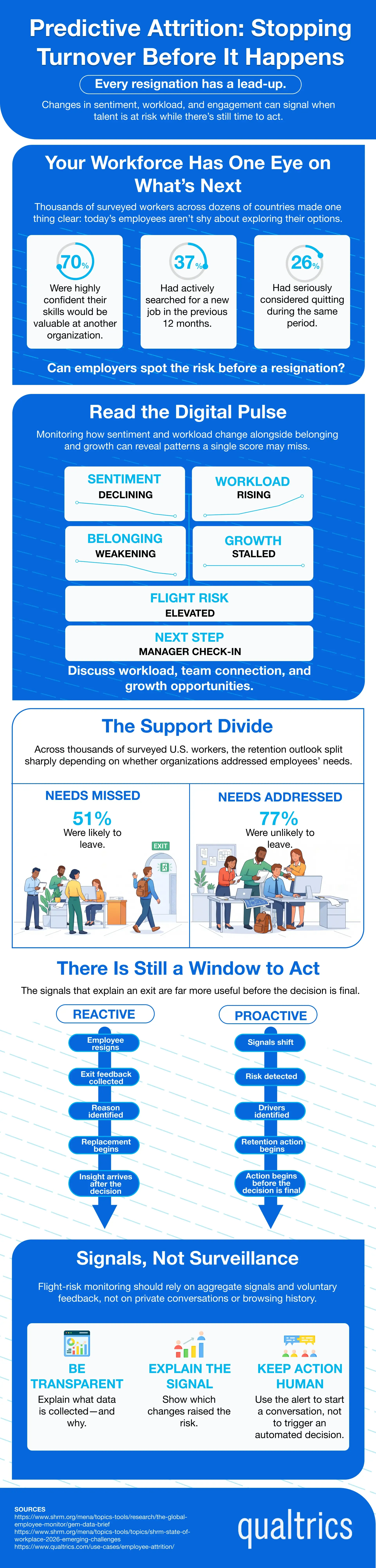
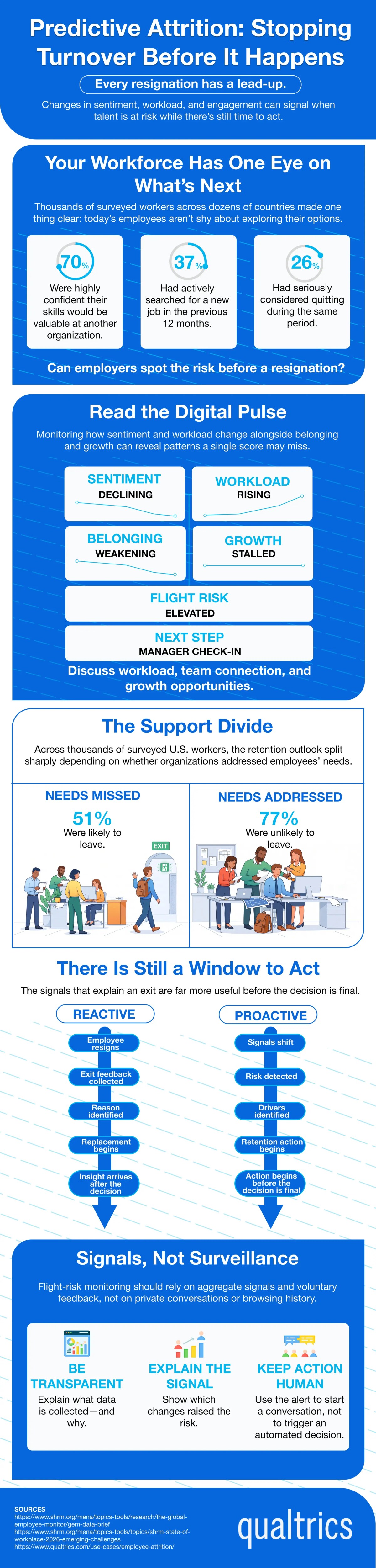
- 70% of surveyed workers were highly confident that their skills would be valuable at another organization.
- 37% had actively searched for a new job in the previous 12 months.
- 26% had seriously considered quitting during the same period.
With such a significant portion of the workforce either passively confident in their mobility or actively looking to leave, organizations must ask: Can employers spot the risk before a resignation?
The answer is yes, if you are tracking the right signals.
What is predictive attrition?
Predictive attrition is a strategic approach to talent management that utilizes early experiential and operational data to identify which employees are most likely to leave.
Instead of waiting for an employee to announce their departure, organizations use predictive attrition analysis to understand the underlying drivers of dissatisfaction and intervene before the turnover happens. It shifts the HR function from a reactive administrative role to a proactive, strategic partner capable of securing top talent.
How do you forecast an employee flight risk?
Forecasting employee flight risk requires organizations to monitor aggregate behavioral and emotional markers that precede departure. Relying on a single annual survey score is no longer sufficient; a yearly snapshot often misses the subtle, rapid shifts in daily work life.
Instead, organizations must read the "digital pulse" of their workforce. This means continuously monitoring how sentiment and workload change alongside feelings of belonging and career growth.
By utilizing predictive analytics on employee attrition data, leaders can identify specific patterns in the employee experience that indicate an individual is beginning to detach from the organization.
Engagement patterns that signal burnout
Burnout rarely happens overnight. It is the result of compounding frustrations that eventually break an employee's commitment to their role.
Certain engagement patterns actively signal this burnout and point to an elevated likelihood of departure. When observing these patterns across workforce data, a very specific and dangerous combination emerges:
- Declining Sentiment: A sustained drop in morale and enthusiasm. This often manifests when typically engaged employees suddenly withdraw from team discussions or stop sharing feedback.
- Rising Workloads: Task volume consistently outpacing available time and resources. This isn't an occasional late night; it's an unmanageable, ongoing operational strain.
- Weakening Belonging: Feelings of isolation or lack of support. When employees disconnect from the team culture and broader organizational mission, their emotional loyalty fractures.
- Stalled Growth: The perception of a plateaued career trajectory. Without visible, accessible paths for advancement or skill development, top talent will look outward.
In short, when an employee feels overworked, isolated, stuck in their career progression, and emotionally detached, flight risk naturally rises.
Most importantly, the immediate next step upon identifying this pattern should be a manager check-in—a supportive conversation designed to discuss workload management, rebuild team connection, and outline clear growth opportunities.
The support divide: Why listening matters
Identifying a flight risk is only half the battle; the organization's response dictates the final outcome. Across thousands of surveyed U.S. workers, the retention outlook split sharply depending on whether organizations actively listened to and addressed their employees’ needs.
The data reveals a stark contrast, showing how unresolved issues drive turnover while proactive support cements loyalty:
- Needs Missed: 51% of employees were likely to leave.
- Needs Addressed: 77% of employees were unlikely to leave.
This support divide highlights a critical business reality: failing to act on employee feedback actively harms retention efforts.
Intervening while the window is open
Signals indicating an exit are far more useful before the employee finalizes their decision. Relying on exit interviews is akin to performing an autopsy; the insight is valuable, but the patient is already gone.
A predictive attrition model fundamentally shifts the timeline of intervention. Consider the structural differences between the two approaches:
|
Reactive Approach |
Proactive Approach |
|---|---|
|
Employee resigns |
Signals shift |
|
Exit feedback collected |
Risk detected |
|
Reason identified |
Drivers identified |
|
Replacement begins |
Retention action begins |
|
Insight arrives after the decision |
Action begins before the decision is final |
Signals, not surveillance
While the ability to forecast departures is powerful, it must be executed ethically. A successful retention program relies on aggregate signals and voluntary feedback, rather than tracking private conversations, keystrokes, or browsing history. Trust remains the absolute foundation of the employer-employee relationship.
To maintain that trust while monitoring for flight risks, organizations must adhere to three core principles:
- Be transparent: Explain exactly what data the organization collects and why it is being collected. Employees should understand that the goal is to improve their daily experience, not to police their behavior.
- Explain the signal: Show leaders and teams which specific changes raised the risk level. Transparency in how the data is interpreted prevents misunderstandings.
- Keep action human: Use the alert to start a meaningful conversation, not to trigger an automated HR decision. The data provides the alert; the manager provides the empathy and the solution.
Stop turnover before it starts
Identifying flight risks should not require guesswork. By connecting the dots between daily engagement, workload, and career development, you can deploy effective employee retention strategies that address burnout before it leads to a resignation.
Ready to build a proactive retention culture? Discover how Qualtrics Employee Experience and our tailored Employee Attrition Solutions can help your organization catch the signals early, support your teams, and keep your top talent happy where they belong.
Sources:
https://www.shrm.org/mena/topics-tools/research/the-global-employee-monitor/gem-data-brief https://www.shrm.org/mena/topics-tools/topics/shrm-state-of-workplace-2026-emerging-challenges
https://www.qualtrics.com/use-cases/employee-attrition/