

Government teams have made good progress in understanding how people experience their services to make policies, programs, and services more human centered. Acting on what they learn, fast enough to deliver outcomes that matter, is the part they're still working through.
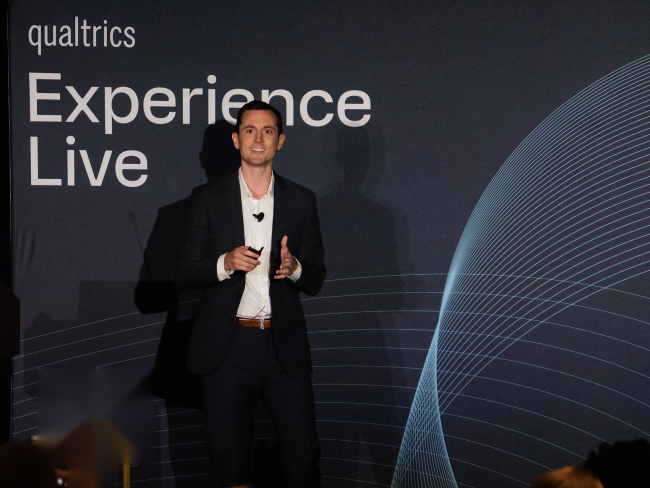
That's only gotten harder as AI resets what people expect from every interaction in their lives, and the gap between those expectations and what an agency can deliver keeps widening. The tension ran through this year's Qualtrics Government Summit, where customer experience, employee experience, and research leaders from state, local, and federal agencies compared what's working.
Feedback is everywhere now and the tools for turning it into outcomes for customers and employees keep improving. The work to do now for government teams is acting on what they hear fast enough to close the experience gap.
Four lessons surfaced again and again.
1. To get feedback that drives change, you have to ask at the moment friction happens across every channel where it does
The challenge: Most feedback programs are built around the organization's workflow rather than the customer’s or employee's. The survey goes out after the process is complete, the service delivered, or the person has already given up. That captures satisfaction scores tied to an internal process while missing what people are actually trying to do, where they struggled, or why they gave up before finishing. By the time the data arrives, the moment of frustration has passed.
The opportunity: The agencies improving experiences have changed when and where they ask to get the context they need to drive meaningful improvements. They trigger feedback collection at the exact moment someone stalls, on a failed step, an abandoned form, or a page that doesn't answer their question. For agencies consolidating programs onto one platform, that shift creates something even more useful: the ability to see where people get stuck across the full landscape of their interactions with government, not just within a single service.
Key actions:
- Move feedback collection closer to the moment of friction, not just the moment of completion
- Build persistent feedback mechanisms across digital interactions
- Consolidate signal across programs and channels so you can see where people switch or drop off
The results: One team found that feedback collected after a completed transaction captured information about logistics and timing, but almost nothing useful about the application itself. When they shifted to surveying people who had started but not finished the interaction, they got their first real picture of where friction was actually happening. This empowered them to act quickly to fix the service failure, resulting in significant improvements in their KPIs.
Another team consolidated feedback across thousands of pages and dozens of programs into one platform. The visibility that created enabled them to find and fix content issues they hadn't known existed.
2. Set up ownership and governance first
The challenge: Many teams underestimated the organizational work required to deliver results. Getting people to adopt new tools. Getting leadership to commit to acting on data before they know what it will say. Getting employees to trust that the process will be used constructively. Getting agencies onto a shared standard. These timelines tend to run longer than the technical setup, and teams that underestimated them often bolted on governance after the fact, adding friction and adoption risk.
The opportunity: Programs that invested early in clear ownership, defined standards, and decision rights before the data started arriving scaled more effectively. A recurring lesson: you cannot consolidate what you have not inventoried. That groundwork is less visible than the listening program itself, but it often decides whether the program takes hold.
Key actions:
- Define who owns what: standards, adoption, program-level decisions, before rollout
- Treat change management as a primary workstream alongside the technical work
- Secure a senior internal champion with enough authority to move things when they stall
The results: An organization building an enterprise-wide platform discovered significant bloat only after starting to look at the current infrastructure: inactive forms, deprecated accounts, duplicated effort with no shared standards. Discovering this disorganization shaped the rest of their rollout: inventory first, consolidate second.
Another team found that in their first year, the organization had a strong customer experience program in place but hadn't built in enough structure to ensure leaders would act on what the data surfaced. Their takeaway: collecting and analyzing data is the easier part; getting organizational commitment from the beginning and building the momentum to act on it consistently is what fuels impact.
3. Closing the loop with customers and employees is what turns data into a program people believe in
The challenge: Several practitioners in the room had run programs that gathered good data but struggled to visibly change anything. Over time, that gap erodes participation, because people stop engaging when they can't see that their input went anywhere.
The opportunity: The programs that build durable participation close the loop as deliberately as they open it. They make feedback visible and actionable: ticketing that creates accountability, action-planning tools that help managers work through team feedback collaboratively, and ways to show people that what they said changed something. When practitioners could point to specific improvements that came from feedback, leadership engagement and participation grew.
Key actions:
- Build visibility into the feedback system from the start so people can see their voice leading to action
- Give managers tools that make acting on feedback easy and visible to their teams
- Tell customers and employees what changed and why
The results: An automated feedback mechanism deployed across hundreds of organizational units changed how leadership received input. Instead of periodic summaries, they were seeing it in real time. Another timed its program so leaders had data in hand before their next all-hands; speed to action became one of its most cited successes. A third iterated continuously based on feedback data, tracking specific friction points and measuring whether changes actually resolved them. The common thread: the programs that kept growing were the ones where participating was visibly worth it.
4. Connect employee experience and customer experience to deliver greater mission outcomes
The challenge: Employee experience and customer experience tend to be managed as separate programs, with separate owners, tools, and definitions of success. In most organizations, the teams running them work independently. The connection between how the people delivering a service experience their work and the quality of that service is understood in principle and harder to demonstrate in practice.
The opportunity: Several agencies have started treating customer experience and employee experience as one connected system. For uniformed services, employee experience data connects directly to readiness, retention, and operational performance, and those relationships are tracked over time. For agencies undergoing transformation, the same logic applies: the people building and managing digital tools are part of the same experience system as the customers using them.
Key actions:
- Map the connection between employee experience data and service delivery outcomes, even informally, before treating them as separate programs
- Use workforce listening data to surface what's getting in the way of a good customer experience
- Consider a shared platform and governance model for employee experience and customer experience as a starting point for connecting the data
The results: The model one organization shared tracks how people experience their work as part of a unified measure alongside mission outcomes, and uses it to inform leadership decisions over time. Another built employee and customer experience programs as parallel tracks under the same platform and governance, because the people building the tools and the people using them are part of the same story.
Your path forward
The organizations making progress are asking better questions sooner, setting up governance before it’s needed, connecting the data they have to outcomes leadership already cares about, and they've stopped measuring themselves against whether they listened, focusing instead on whether the outcome changed.
A few places to start:
- Find where your listening program is timed for your convenience rather than your customers' friction. What would you learn if you asked at the moment someone got stuck, rather than after they finished?
- Identify the governance gaps before they become consolidation problems. What's in your environment right now that you haven't inventoried?
- Find one piece of feedback that drove a visible change, and make sure the people who gave it know you heard them. That visibility is what builds the trust that lets the program grow.