


How is AI used for customer service?
Artificial intelligence (AI) can be used in several ways in your customer service processes to improve customer experiences and expand business capabilities. You can use AI to create always-on, human-like responses to customer questions, streamline agent workflows, generate real-time coaching, and — increasingly — take autonomous action on behalf of customers.
Using AI in customer service allows support agents to make smarter decisions faster, and meet customer needs more effectively. You can provide a more personalized service at scale in a way that simply wasn't possible before. This leads to better business outcomes and strong ROI.
But the revolution in AI-driven customer service comes with a warning. Our research shows that enthusiasm for AI-powered customer support has declined since 2021 — with 13 points more consumers saying they receive no benefits from it at all. The problem isn't the technology. It's how it's being deployed. Read on to understand how to do it right.
How does AI customer service work?
AI technology understands customer sentiment and emotion to trigger actions such as responding or initiating business processes. This allows for the automation of standard customer service tasks — answering queries, sending confirmations, handling post-interaction surveys — while also augmenting your team's ability to interact with customers with better context and insight.
This is enabled by machine learning and Natural Language Processing (NLP), which can recognize customer queries, formulate human-like responses, and take action automatically.
What is natural language processing?
Natural Language Processing (NLP) models human language to allow computers to understand text and speech in a human-like way. It uses rules, statistics, and machine learning to comprehend what customers need — including nuance and context — and formulate the right response. It's also referred to as natural language understanding (NLU).
What is generative AI in customer service?
Generative AI refers to AI systems trained on large amounts of data that can generate human-like text, audio, and more. In customer service, this means AI that can draft responses, summarize calls, coach agents in real time, and handle direct customer interactions — at scale and with human-like fluency.
What is agentic AI in customer service?
Agentic AI is the next evolution. Unlike earlier AI tools that respond to a single prompt or command, agentic AI systems can plan, reason, and take multi-step actions autonomously — resolving a customer issue end-to-end without constant human input. Think: an AI agent that doesn't just suggest a refund, but looks up the order, checks the policy, issues the refund, and follows up with the customer — all on its own.
This is reshaping what's possible in the contact center.
Free eBook: Unlock the potential of AI-enabled CX
What are the benefits of AI in customer service?
AI in customer service delivers benefits across the board — for customers, agents, and the business. Here are the key reasons to invest.
Increased efficiency for your customer service teams
Using AI, your team can become more efficient and spend their time on work that matters. Chatbots handle self-service for common queries. Interactive voice response (IVR) triages inbound calls. AI handles repetitive tasks like post-call summaries and issue logging.
The result: agents spend less time on administrative overhead and more time on complex, high-impact customer interactions — the ones where the human touch genuinely matters.
Personalization at scale
Providing an online customer experience that feels personal is hard at scale. With the right AI tools, you can deliver seamless, personalized experiences to every customer — tailoring responses based on what they're saying, where they're saying it, and how they're feeling.
But personalization comes with a caveat: Qualtrics research shows only 39% of consumers believe organizations use their personal information responsibly. Customers want tailored experiences, but they also want transparency about how their data is used. The brands that get this right treat personalization as a value exchange — not a data grab.
Easier quality control and evaluation
AI also benefits the management layer. With automated quality management, every call, chat, email, or social mention is automatically analyzed and scored. No more reviewing a small sample. Every interaction is evaluated for script adherence, empathy, sentiment, and compliance — giving managers the full picture they need to coach effectively.
Improved customer satisfaction
When customers get the help they need quickly — and it feels genuinely tailored to their situation — satisfaction goes up. Qualtrics research shows that satisfied customers are 4.1x more likely to recommend a brand, 3.8x more likely to trust it, and 2.3x more likely to purchase more. Those numbers only follow from experiences that actually deliver.
The flip side: 1 in 2 bad experiences leads customers to cut spend. AI that erodes rather than improves the human connection doesn't just fail to help — it actively costs you.
Examples of AI in customer service
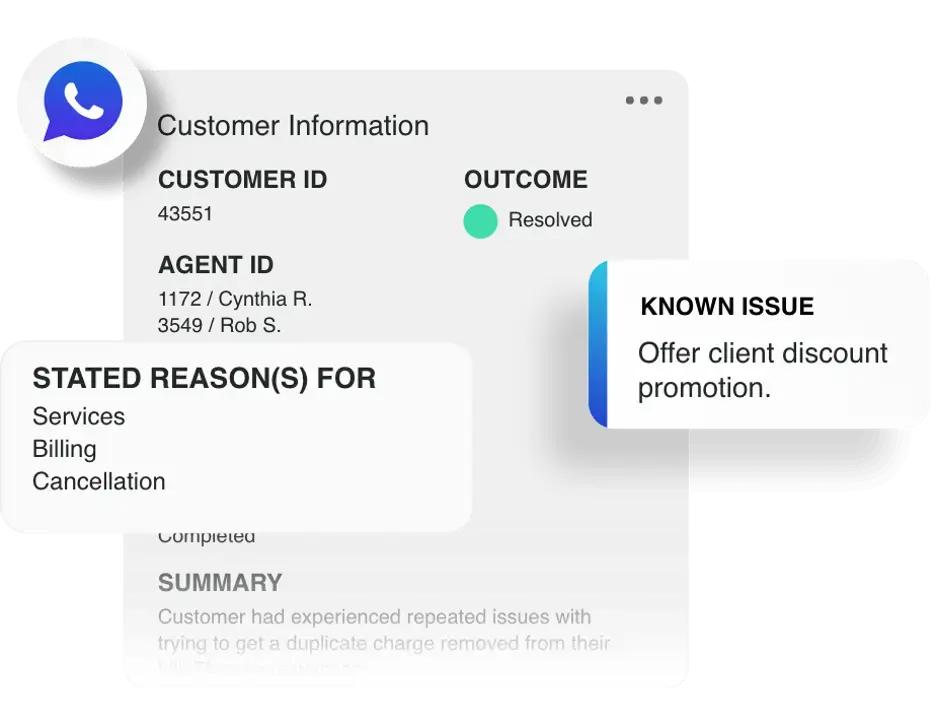
Automated call summaries
Rather than requiring agents to complete time-consuming post-call notes, AI automatically generates call summaries in real time — capturing customer details, next steps, and relevant context the moment a call ends. Agents review, confirm, and move on. Less admin. More focus on the customer.
Real-time agent assist
With real-time agent coaching, agents are automatically delivered guidance and resources mid-call. They can see relevant customer context as the conversation unfolds, with suggested next best actions and knowledge base articles surfaced automatically. AI also evaluates customer intent, emotion, and effort through NLP analysis — so agents always have the full picture.
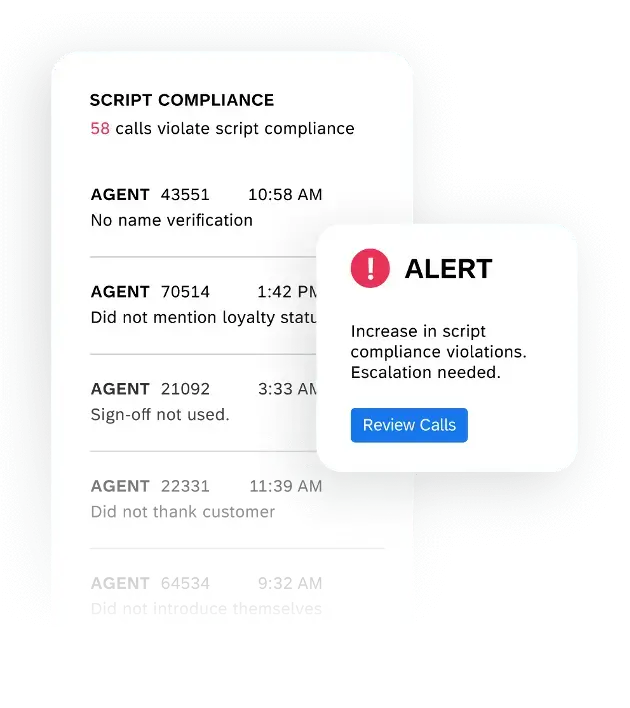
Automated quality management
AI-powered quality management automatically evaluates every interaction — not just a sample. The technology flags compliance issues, tracks script adherence, and generates personalized dashboards for both agents and managers. Agents can track their own performance and flag evaluations they disagree with, creating a culture of transparency and continuous improvement.
Omnichannel insight for business-wide improvement
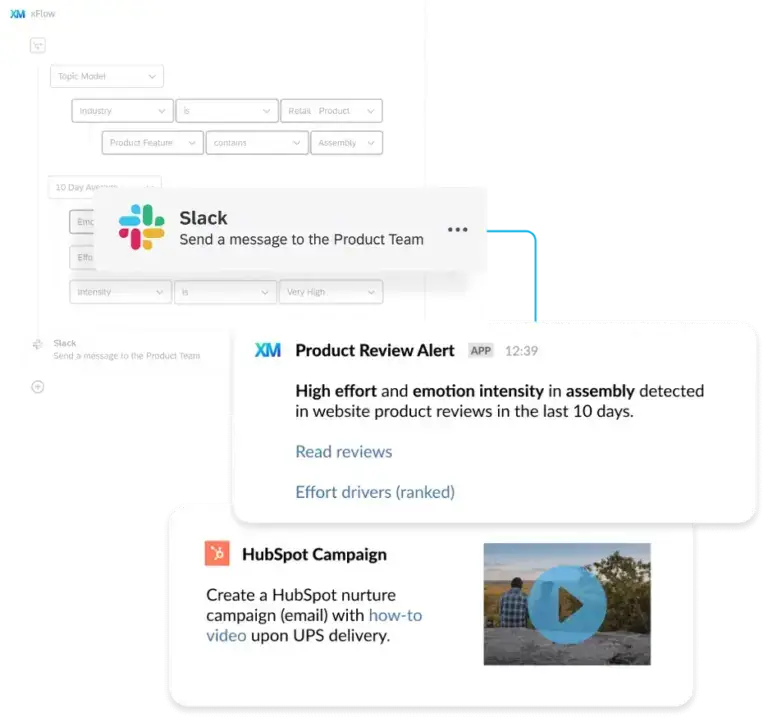
AI in customer service doesn't just benefit the contact center. Insights derived from every customer interaction — across every channel — can be routed to product teams, marketing, and operations to drive company-wide improvement. Automated workflows connect your frontline data to your backend decisions.
AI agents: always-on support at scale
AI-powered chatbots and virtual agents provide human-like conversations at scale, 24/7, across every channel your customers use. They handle common queries, guide customers to the right information, and escalate more complex issues to human agents when needed.
Increasingly, these tools are becoming agentic — capable of completing multi-step tasks end-to-end, such as processing returns, updating account information, or scheduling follow-up appointments, without human intervention at every step. For customers, this means faster resolution. For businesses, it means meaningful efficiency gains without sacrificing experience quality.
Intelligent routing and workforce optimization
AI can analyze historical operational data to predict staffing needs, automate scheduling, and match customer queries to the most appropriate agent. Rather than routing customers to whoever is available, intelligent routing considers the specific issue and the agent best placed to resolve it — a small change that makes a measurable difference to outcomes.
Cross-selling and upselling
Either through prompts to your team or through direct recommendations in conversation, AI can flag relevant cross-selling and upselling opportunities — grounded in that customer's specific purchase history and preferences. This helps turn your contact center from a cost center into a revenue driver.
Generative AI in customer service
Generative AI brings a step change to what's possible in the contact center. Beyond automating tasks, it can generate contextually relevant, human-sounding responses — adapting tone, content, and recommendations to the specific moment of each interaction.
Key generative AI use cases in customer service include:
Drafting responses
Generative AI can draft email and chat responses for agents to review and send — saving time without sacrificing quality or accuracy.
Summarizing interactions
Post-call or post-chat summaries generated automatically from full transcripts — complete with sentiment analysis, key issues raised, and follow-up actions.
Coaching suggestions
Based on real-time interaction analysis, generative AI can prompt agents with suggested phrases, de-escalation language, and product information — in the moment they need it.
Customer-facing chatbots
With the right guardrails, generative AI powers chatbots that can hold genuine, contextually aware conversations with customers — going well beyond scripted FAQ responses.
The key principle: generative AI works best as a co-pilot, not a replacement. Qualtrics research shows 53% of consumers worry AI-enabled support poses privacy risks, and half miss the human touch it replaces. Deploying generative AI thoughtfully — with clear escalation paths to human agents — is what separates experiences that delight from ones that frustrate.
Agentic AI in customer service
Agentic AI represents the frontier of what's possible. Where earlier AI tools handle discrete tasks — answering a question, generating a summary — agentic AI operates with greater autonomy. It can plan across multiple steps, use tools and systems, and take action to resolve customer issues end-to-end.
In customer service, this might look like:
- An AI agent that identifies a delivery problem, checks the order status, proactively contacts the customer, and issues a compensation voucher — without a human triggering each step.
- An agent that handles the full resolution of a billing dispute: pulling account history, calculating the correct adjustment, applying the credit, and logging the resolution.
- A triage agent that handles initial contact across channels, gathers context, and routes the customer to the right human agent with a full case summary already prepared.
Agentic AI doesn't just reduce workload. It changes the economics of service delivery — making it possible to resolve far more issues, faster, at a fraction of the cost.
But agentic AI also raises the stakes for getting it right. These systems operate with greater autonomy, which means the quality of the underlying data, context, and guardrails matters more than ever. Organizations that bring the best context to their AI — built from real customer signals, real interaction data, and real experience intelligence — are the ones that will get this right.
AI customer service best practices
Make AI work with your teams, not against them
AI should make your support team's experience easier — handling repetitive tasks, surfacing better customer data, and freeing agents for high-value interactions. Customers who prefer human agents shouldn't feel penalized for it. The best AI implementations enhance the human experience on both sides of the interaction.
Build on trust
Trust is the underlying condition for AI-powered service to work. Qualtrics research shows that 53% of consumers worry about privacy risks from AI-enabled support. Being transparent about where and how AI is used, and giving customers the choice to engage with a human agent, is not just good ethics — it's good business.
Deliver AI insights across your business
AI in customer service isn't only for the frontline. Insights derived from customer interactions can — and should — inform product development, marketing strategy, and operational decisions. Predictive analytics can help anticipate demand shifts and experience risks before they escalate.
Integrate into your existing tech stack
AI works best when it's integrated into the tools your teams already use — not bolted on as a separate system. The goal is a cohesive ecosystem where AI amplifies everything, rather than another platform to manage.
Ensure your data can be trusted
AI is only as good as the data it's built on. Data needs to be accurate, up to date, and handled securely. And as Qualtrics research shows, customers are paying attention: only 39% believe organizations use their personal information responsibly. That trust gap is an opportunity — close it by being transparent about data collection and giving customers control over what's shared.
Improve your customer service interactions using AI with Qualtrics
Your AI in customer service strategy should always put your customers and your support agents first. XM for Customer Experience™ uses artificial intelligence and machine learning to optimize workflows and agents' time, while creating memorable, personalized customer experiences — at every stage of the journey.