

What is agent coaching?
Agent coaching is the process of identifying knowledge, ability or performance gaps in members of your customer support team, and taking proactive steps to upskill them.
Agent coaching sessions can be conducted in person or digitally (through e-learning and online guidance), with the goal being to improve agent performance – while also providing encouragement when they’re doing well.
The result of successful agent coaching should be twofold:
- Improve customer support by ensuring that agents are able to do their best work, complying to scripts and processes, conveying on-brand messaging and delivering positive resolutions.
- Enhance agent empowerment and reduce staff turnover. When customer support agents have been skilled up and feel able to do the job to the best of their abilities, they usually enjoy their work more – and become more likely to stay for longer. Customers prefer to deal with tenured agents.
To achieve either outcome, it’s important to remember that agent coaching isn’t a one-and-done process. Instead, contact centers and customer support teams should implement continual monitoring tools that can identify performance gaps and proactively schedule training sessions on an ongoing basis.
Why is agent coaching important?
Over the years we’ve gathered a raft of data showing the link between agent effectiveness, the overall customer experience, and lifetime customer value.
In our State of the Contact Center 2025 report, for instance, we found that while people overwhelmingly want to speak to humans to resolve most common issues, 53% of poor support experiences result in customers cutting their spend.
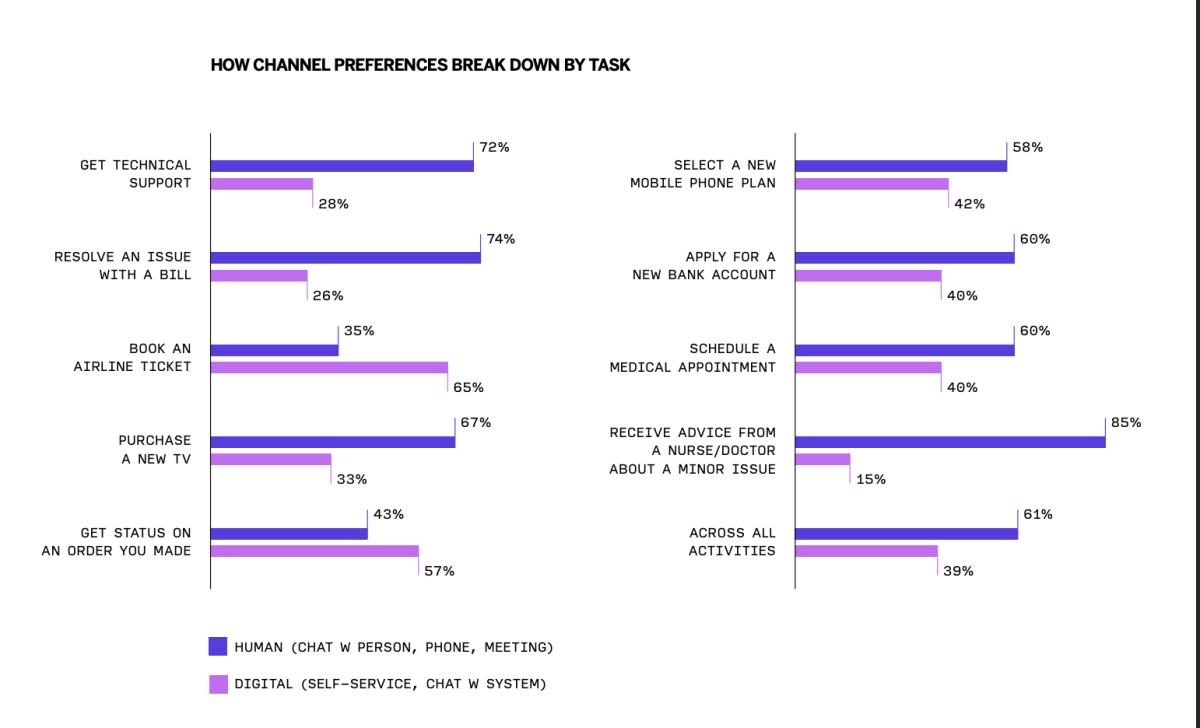
In previous research, we’ve found that 60% of customers cite ‘speaking to a live human’ as their main reason for calling a contact center, but for as many as 78%, a single contact center interaction can permanently change how they feel about a company.
That puts a lot of pressure on agents as both the bastions of customer opinion and potential gatekeepers of future revenue. So ongoing efforts to coach, improve, and maintain quality in the call center is really important.
Well-trained and continually coached agents can:
- Lower cost to serve
Experienced, empowered agents are more likely to be able to solve a customer’s issues using their own knowledge. Our research shows that first-call resolution makes customers 2.1x more likely to recommend a business, so this can make a huge difference.
- Increase revenue
Positive agent experiences translate into positive customer experiences, which in turn increase the overall customer lifetime value (CLV).
- Improve agent retention
As engaged employees, agents who have positive experiences are more likely to stay with your business, maintaining and growing value in your team as they become more expert in their role and gain a deeper understanding of your company.
- Reduce customer effort score (CES)
CES reflects how easy it is for a customer to complete their task. This can be tied directly to how well an agent is able to do their job – whether they can find the information they need quickly and easily, whether they have details about a customer’s previous interactions, and whether they are permitted the time and focus to truly understand the customer’s requirements.
Beyond all this, though, is the fact that agent coaching builds a framework for ongoing improvement. Agents embedded in a culture of development will continue to improve over time – actively enhancing their own skills and those of their co-workers through self-development and teamwork.
Challenges for call center agent coaching
Agent coaching is more science than art – but many contact centers adopt a haphazard approach that misses the mark. There are a few key challenges that, if carefully avoided, can help ensure a coaching framework that’s fair, effective, and encouraging.
Accurately monitoring performance
Traditional agent performance tracking has usually relied on manually sampling a specific range of calls and interactions. The small scale of this approach misses a huge amount of nuance and detail – potentially obscuring times an agent has gone above and beyond alongside more coachable moments.
Tracking improvement
Similarly, manual interaction monitoring often results in ad hoc training that doesn’t really look at the bigger picture – and that obscures progress. Without the right contact center software in place, it’s not possible to accurately see the outcome of any agent coaching measures – nor where there are ongoing knowledge gaps.
Focusing on the wrong metrics
Agents who feel over-pressured to complete calls quickly or influence customers to leave a review rather than listen to them are working towards goals that serve no real function in an experience-led business.
These overly metric-driven ways of working devalue the agent experience – and may even weaken the customer outcomes they set out to support. In our research, 41% of agents said that “being judged on over-simplified metrics” is one of the things they hate most about their jobs.
Agent coaching best practice tips
Remember the human element
It’s important that contact center leaders understand how to blend automated insights with human-led coaching. And that’s because coaching in the contact center is a mix of two very different but complementary factors – human relationships and performance data.
Acting as a coach and mentor, not simply a manager, a contact center leader should use their own knowledge and experience combined with information about agent and team performance to give agents an experience that helps and motivates them to continually strengthen and improve.
That goes for implementing software, too. Remember that the majority of people calling a contact center are doing so because they want to speak to a human. AI and other software solutions are great for enabling self-service, but there should always be the option to speak to a real person, both to drive satisfaction but also as a fallback when a customer’s need is beyond what automation can resolve.
Build balanced scorecards
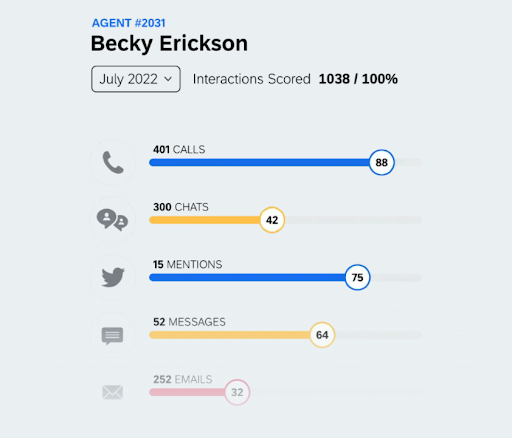
Related to that demand for human insight is the need to build out agent scoring models that mix operational data with experience data. One of the most important ways businesses can mix hard metrics with qualitative insight is in building out balanced scorecards. A balanced scorecard gives agents and managers a means to review every aspect of each agent’s work at a glance – and set goals for future performance.
Every organization will need set up its scorecard based on its sector, strategy and strengths, but try to get a mix of the following:
Experience data
- CSAT (customer satisfaction) scores
- Friendliness
- Agent knowledge
- Understanding the issue
Operational data
- First time resolution
- AHT (average handle time, measured in seconds)
- Transfers (how many and to whom)
- QA score (quality assurance)
Use the right tools
Everything we’ve discussed so far can be accomplished easily with the right contact center software. With AI at their core, suites like Qualtrics® Contact Center Experience software can listen to – and understand – every interaction on every channel, scoring agents based on real-time insight as well as the full history of their work.
That comes alongside automated scheduling for coaching sessions, suggesting tailored sessions whenever agents drop below specific benchmarks for qualities like knowledge and understanding.
AI and agent coaching
Artificial intelligence models – specifically ones imbued with natural language processing and understanding (NLP and NLU) are the secret sauce powering today’s agent coaching software.
Automation and AI can bring significant scale to performance coaching, enabling comprehensive analysis of every single interaction – where previously, insights were limited to isolated examples.
Because of this ability to operate at immense scale, AI and automation allow us to find the patterns driving success, identify areas for improvement, and translate that into actionable feedback for frontline staff. That’s instead of making knee-jerk decisions based on limited data.
Ultimately, blending human and automated insights, alongside constructive coaching, delivers more confident, supported agents who are more likely to be engaged in their roles and stay longer with the organization, significantly cutting staff attrition costs and delivering better experiences to customers.
The future of agent coaching
Agent coaching – and the contact center as a whole – are set to change as AI becomes an ever more common part of efforts to improve the customer experience.
Our State of the Contact Center report outlines three major trends coming down the line:
- AI-powered agent assistance
- Next-level customer intelligence
- 1:1 customer service at scale
Click here to read up one what each one will mean for agent coaching going forward, and use the link below to book a demo with Qualtrics – and ready your contact center for change.