
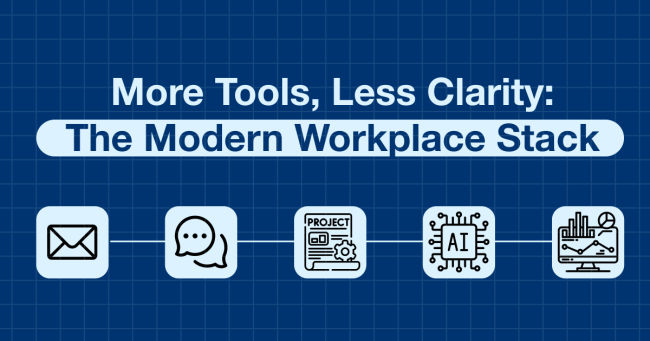
The average employee's workday now runs on dozens of apps, platforms, dashboards, and communication channels. From email and chat tools to project management systems and AI assistants, modern work increasingly depends on navigating a sprawling digital ecosystem.
The team at Qualtrics decided to analyze recent workplace technology data to better understand how these tools are shaping collaboration, productivity, and the employee experience, and what we found was that more tools don't always create better work.
The workplace tech stack keeps growing
Software adoption continues to accelerate across organizations of all sizes. In 2024, the average company deployed 93 applications, up from 89 the previous year.
For larger enterprises with more than 2,000 employees, that number climbs dramatically, with these organizations using an average of 231 apps.
At the same time, employees are becoming increasingly dependent on digital tools to stay productive. Today, 82% of workers say they rely on work and project management platforms to operate efficiently, while 57% report that the number of tools they use has increased over the past year.
The result is a work environment where employees constantly move between systems just to complete everyday tasks.

Use the embed code below to add it to your own website or blog:
<center>
<textarea readonly>
<a href="https://www.qualtrics.com/articles/employee-experience/modern-workday-stack/">
<img src="https://www.qualtrics.com/sites/default/files/styles/standard_3xl/public/2026-05/infographic-tech_tools-qualtrics.png.webp?itok=ClJk0OXq" alt="More Tools, Less Clarity: The Modern Workplace Tech Stack — Infographic" title="More Tools, Less Clarity: The Modern Workplace Stack — Qualtrics — Infographic"></a><br><a href="https://www.qualtrics.com/" alt="Qualtrics Employee Experience Software" title="Qualtrics.com">By Qualtrics</a>
</textarea>
</center>
Communication is now split across platforms
As organizations adopt more tools, workplace communication has become increasingly fragmented.
While email remains the most common primary communication method, no single platform dominates how employees collaborate:
| Primary communication method | Percentage of employees |
|---|---|
| 31% | |
| Online chat tools (e.g., Slack) | 26% |
| Project management tools | 24% |
Instead of operating from one centralized communication hub, employees now divide conversations across inboxes, messaging apps, task boards, and collaborative workspaces. That fragmentation can create confusion, especially as the number of workplace apps grows.
Among employees using 10 or more applications, 54% say they've experienced communication misunderstandings. For workers using fewer than five apps, that number drops to 34%.
AI is adding another layer to the stack
Artificial intelligence has quickly become one of the fastest-growing categories of workplace software.
Currently, 75% of knowledge workers use AI tools on the job, and many employees are adopting these platforms independently. In fact, 78% say they bring their own AI tools into the workplace rather than relying solely on company-approved solutions.
Workers overwhelmingly report positive outcomes from AI adoption:
- 90% say AI helps them save time
- 85% say it allows them to focus on more important work
At the organizational level, several platforms are emerging as clear leaders. ChatGPT is now used by 67% of organizations, while Microsoft Copilot has reached 58% adoption and Google Gemini is used by 49%.
Although AI can improve efficiency, it also contributes to the growing complexity of the digital workplace by adding yet another set of tools employees must manage alongside existing systems.
App overload is hurting focus
As the number of workplace applications increases, many employees struggle to maintain focus and context between tasks.
Among workers using 10 or more apps, 42% report needing at least 15 minutes to refocus after switching tasks.
Frequent context switching can reduce efficiency, interrupt workflows, and increase the likelihood of miscommunication. Fifty-four percent of workers who use 10 or more apps have experienced communication misunderstandings; that number drops to 34% for employees using fewer than five apps.
Over time, this friction can contribute to a more stressful and less productive work environment.
Why digital employee experience matters
The quality of an employee's digital experience increasingly affects broader business outcomes.
IT leaders recognize that smoother, more integrated digital environments can improve both productivity and employee satisfaction:
- 87% say better digital employee experiences improve productivity
- 85% say they improve employee satisfaction
- 77% say they improve employee retention
As companies continue expanding their technology stacks, reducing friction between tools may become just as important as adopting new ones.
The future of workplace technology
Modern organizations rely on an expanding network of digital tools to communicate, collaborate, and stay productive. But as tech stacks grow, so do the challenges tied to fragmented communication, app overload, and constant context switching.
Creating a better digital workplace now depends on reducing friction between tools and making daily workflows easier to navigate. That starts with listening to employee feedback and identifying where technology is getting in the way of day-to-day work. Qualtrics employee experience software helps organizations collect employee feedback at scale and turn everyday signals into actionable insights that improve the digital employee experience. With our tools, you can surface friction in your tech stack, understand how employees actually work across tools, and take targeted action to improve productivity and engagement.
Sources:
- https://www.okta.com/sites/default/files/2024-04/Okta-2024_Businesses_at_Work.pdf
- https://monday.com/blog/product/world-of-work-report/
- https://project.co/communication-statistics-results-2024/
- https://www.microsoft.com/en-us/worklab/work-trend-index/ai-at-work-is-here-now-comes-the-hard-part
- https://ai.wharton.upenn.edu/wp-content/uploads/2025/10/2025-Wharton-GBK-AI-Adoption-Report_Full-Report.pdf
- https://www.zoom.com/en/products/collaboration-tools/resources/collaboration-report/
- https://www.ivanti.com/resources/research-reports/2025-digital-employee-experience-report