
AI, automation, and digital transformation are reshaping the workforce faster than many organizations can adapt. Some jobs are disappearing, new ones are emerging, and the skills employees need are changing in real time.
To better understand how work is evolving and where the biggest pressure points are emerging, the Qualtrics team dug into the data behind automation risk, workforce transformation, skills disruption, and the growing demand for AI-related capabilities. What we found points to a workforce in transition: Employers are facing widening skills gaps, workers are being asked to adapt faster, and traditional career paths are beginning to shift.

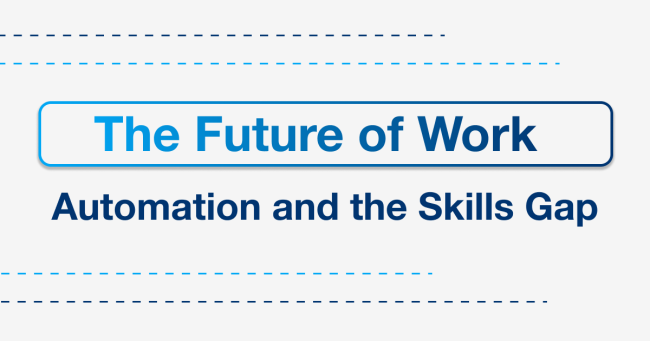
Use the embed code below to add it to your own website or blog:
<center>
<textarea readonly>
<a href="https://www.qualtrics.com/articles/employee-experience/the-future-of-work/">
<img src="https://www.qualtrics.com/sites/default/files/styles/standard_3xl/public/2026-05/infographic-the-future-of-work_0.png.webp?itok=S4u9qxdY" alt="The Future of Work: Automation and the Skills Gap — Infographic" title="The Future of Work: Automation and the Skills Gap — Qualtrics— Infographic"></a><br><a href="https://www.qualtrics.com/" alt="Qualtrics Employee Experience Tools" title="Qualtrics.com">By Qualtrics</a>
</textarea>
</center>
The workforce is being reorganized in real time
By 2030, technology is expected to displace 92 million jobs worldwide. At the same time, emerging technologies and new industries are projected to create 170 million new roles, for a net gain of 78 million jobs globally.
That shift is already underway.
An estimated 28% of jobs worldwide are considered at high risk of automation, while 40% are expected to undergo major task transformation. For many workers, the biggest change won't be losing a job entirely but adapting to a job that suddenly looks very different from the one they were hired to do.
AI systems are especially effective at:
- Data processing and pattern recognition
- Repetitive and rules-based tasks
- Operating at scale and speed
That makes some industries particularly vulnerable to disruption.
Among the most affected roles are:
- Administrative and clerical positions, such as payroll clerks and office administrators
- Manufacturing and production jobs, like assembly line workers and machine operators
- Customer service roles, including call center agents and chat support representatives
At the same time, demand is growing in fields tied to AI, sustainability, and health care, areas where technical knowledge and human-centered skills increasingly overlap.
The career ladder as getting steeper
One of the most noticeable effects of automation is happening at the entry level.
Many early-career jobs are built around repetitive administrative work, like formatting documents, organizing information, answering routine questions, scheduling meetings, and processing basic requests. These are exactly the kinds of tasks AI can now perform efficiently.
As a result, entry-level roles are being automated faster than senior positions.
That shift creates a new challenge for workers trying to gain experience and enter the workforce. Routine tasks once acted as a training ground for developing judgment, communication skills, and institutional knowledge, and as those tasks become automated, employers increasingly expect workers to arrive with stronger analytical, technical, and problem-solving abilities from day one.
The career ladder still exists, but the first rung is getting harder to reach.
For organizations, that creates long-term workforce challenges of their own. Companies still need future managers, leaders, and specialists, but if fewer workers have opportunities to build foundational experience early in their careers, the long-term talent pipeline becomes weaker.
Human skills are becoming more valuable
As AI takes over more routine execution-based work, human capabilities are becoming more important, not less. While AI excels at quickly performing repetitive, pattern-based tasks, human workers continue to have the advantage in areas requiring:
- Analytical thinking
- Creativity and problem-solving
- Leadership and social influence
- Resilience and adaptability
Those strengths are becoming increasingly valuable in workplaces where technology, workflows, and expectations change constantly.
By 2030, 39% of core workplace skills are expected to become disrupted or outdated. In that environment, the ability to learn new systems, adapt to changing responsibilities, and navigate uncertainty becomes a major competitive advantage.
The labor market is already rewarding those capabilities.
Workers with advanced AI skills now command a 56% wage premium, reflecting growing demand for employees who can effectively work alongside AI systems.
Industries with high exposure to AI have also experienced productivity growth that has quadrupled since 2022.
AI handles execution. Humans differentiate through judgment.
The skills gap is becoming an economic risk
Technology is advancing faster than many organizations can retrain and reskill their workforce. That gap is becoming one of the defining economic challenges of the decade.
Today, 63% of employers say skills gaps are their number one obstacle to business transformation. Companies are investing heavily in AI, automation, and digital systems, but many still struggle to find workers with the capabilities needed to fully take advantage of those tools.
The economic consequences are significant. An estimated $6.5 trillion in global GDP growth is at risk by 2030 due to persistent skills shortages and workforce readiness challenges.
Organizations that adapt quickly stand to gain a major advantage. Those that fail to keep pace may face slower innovation, weaker productivity growth, and increasing difficulty competing in rapidly evolving industries.
Fast-growing jobs point to the future
The fastest-growing careers of the next decade offer a clear picture of where the global economy is heading.
Among the roles expected to see the strongest growth are:
- AI and data specialists, such as machine learning engineers and data scientists
- Green energy and sustainability roles including renewable energy technicians and environmental engineers
- Health and care economy jobs like nurses and mental health professionals
These careers span very different industries, but they share common characteristics. They combine technical expertise with communication, adaptability, critical thinking, and human interaction.
Even in highly automated environments, organizations still need workers who can interpret complexity, solve problems, collaborate with others, and make decisions in uncertain situations.
The future of work will increasingly rely on collaboration between AI capabilities and human judgment.
Adaptability will shape the next era of work
The workplace changes driven by AI and automation are already underway. Roles are evolving, skill requirements are shifting, and organizations across industries are being forced to rethink how work gets done.
The future of work will be shaped not only by the technology organizations adopt but by how effectively they help employees adapt alongside it.
That's where employee experience becomes a strategic advantage.
Qualtrics employee experience software helps organizations understand how employees are experiencing workplace change, identify friction points in workflows and technology adoption, and uncover the skills and support workers need to succeed in evolving roles.
By combining employee feedback with actionable insights, organizations can make smarter decisions about workforce development, engagement, and digital transformation, helping teams stay productive, adaptable, and prepared for what comes next.
Sources:
- https://www.weforum.org/press/2025/01/future-of-jobs-report-2025-78-million-new-job-opportunities-by-2030-but-urgent-upskilling-needed-to-prepare-workforces/
- https://www.pwc.com/gx/en/news-room/press-releases/2025/ai-linked-to-a-fourfold-increase-in-productivity-growth.html
- https://www.oecd.org/en/topics/future-of-work.html
- https://www.ibm.com/thought-leadership/institute-business-value/en-us/report/augmented-workforce