


The narrative around younger workers has become familiar, they’re disengaged, entitled, and hard to retain. It circulates in leadership meetings and HR publications, and it’s shaping decisions about how organizations onboard and invest in their people.
But, our data tell a very different story. The Qualtrics 2026 Employee Experience Trends report finds that younger workers are an engagement opportunity.
Here are five things the data actually show.
1. Younger workers are your most engaged employees
Across the past six years of our research, younger employees have scored at or above their older colleagues on engagement every year, including in 2026, when employees aged 18–24 reported an engagement rate of 74%, compared to 68% among those aged 25 and older. The assumption that younger generations are inherently harder to engage is not supported by the evidence.
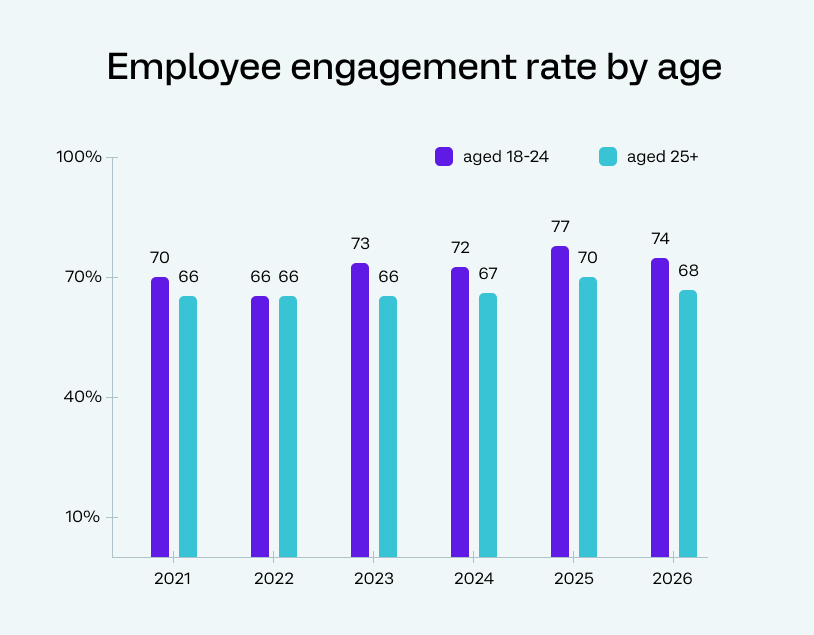
But what happens next? Organizations are starting with a more motivated cohort than they realise, yet our research shows many are underinvesting in exactly the experiences that could earn their loyalty. Despite their eagerness, new hires now report the lowest engagement levels since 2021, with their belief that they can challenge the status quo falling from 64% to 50% since 2025.
2. Intent to stay is lower, but that is not the same as disloyalty
Intent to stay is one metric where younger workers score lower than older workers - around a 20-point gap in five out of the past six years. But, intent to stay is driven by reciprocity and mutual commitment, a bond that takes time and shared experience to build.
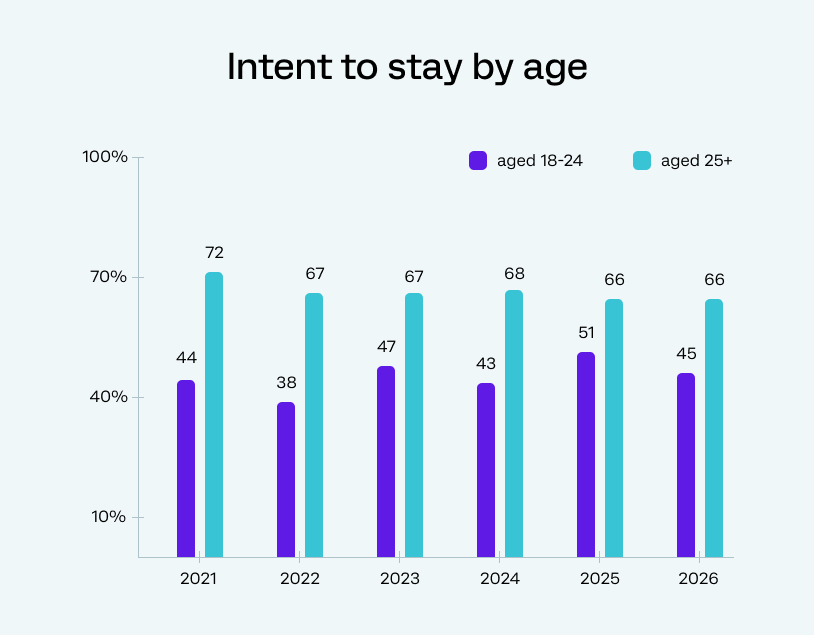
Most younger employees have not been employed by a single employer long enough to develop a deep sense of commitment yet. It is more of a career-stage effect than a reflection of the attitude or character of the younger generation. Understanding that distinction changes how organizations should respond.
3. Early tenure experience has been declining and organizations can change that
New joiner experience has declined consistently since 2023. Employees in their first year at a job are among the least connected to their organizations when we compare this cohort today to the equivalent group in 2023. This isn't a new pattern, our 2025 EX Trends research also flagged hiring and onboarding as two of the most underwhelming employee experiences, and this year's findings show that downward trend has not just continued, but deepened.
These workers did not arrive disengaged. The trajectory of their experience maps directly to what happens in the early years of employment, and this matters. Early experiences color the lenses through which employees interpret all that follows, from how they read a manager’s feedback to how they judge the organization many years later. If there are two moments an organization can least afford to get wrong, they are the candidate and the new hire experiences. These are experiences every organization has the power to influence.
4. What drives engagement is universal and not generational
The top statistical drivers of engagement in 2026 are:
• Feeling there is a promising future at the organization
• Believing personal career goals can be met here
• Trusting in the organization's values and ethics
• Feeling respected and supported in development
None of these are generational preferences and all of them are within an organization's control. This lines up with what we know from human motivation research more broadly: humans are wired to belong and make meaningful contributions to the groups they’re part of. These drives are universal and cut across all generations in the workforce.
5. Listening more is one of the highest-impact actions an organization can take
One of the most actionable findings from our most recent research: employees at organizations that reduced listening frequency over the past year report dramatically lower scores across every job attitude. Employee engagement is twice as high at employers that increased listening compared to those that listened less.
Fewer than one in ten employees want to be listened to less. The appetite to be heard, and to see something change as a result, is far greater than most leaders assume. Organizations that act on this have a clear, measurable advantage.
The opportunity starts before you think it does
Younger workers arrive more engaged, more eager to challenge ways of working, more open to change, and more optimistic than perhaps any other cohort in today's workforce. Organizations that invest in the early experience and encourage new joiners to shape their business will retain that energy and build on it. Investment should include communicating a promising future, developing skills, giving people genuine agency, and simplest of all, listening to them!
Six years of data point to the same conclusion: the popular generational narrative is wrong. The engagement opportunity with younger workers is significant. What organizations choose to do from day one determines whether they’ll capitalize or squander this great opportunity.
See how your organization compares
Qualtrics Employee Experience solutions help organizations listen, understand, and act on what matters most to their people. Learn more at qualtrics.com/employee-experience.