

Intro
You’ll no doubt be using several customer experience (CX) metrics to measure how your customers are interacting with your brand. But what about account health? By account health we mean ascertaining whether a customer is likely to return, upgrade, or jump ship to a competitor.
Predicting this critical part of the customer relationship can be tricky, and account managers or customer success leaders often use their best guesses to estimate it. There is a more reliable way—one that's both accurate and holistic.
It's called a customer health score.
Free eBook: Best practices for B2B CX account management
What is a customer health score?
A customer health score is like taking a pulse. Instead of guessing how a customer feels, you look at a single number that tells you: ‘Are they a satisfied customer, or are they heading towards the exit?’
A customer health score, used for new and existing customers, helps you check:
- What's working well in your customer relationship
- What further support you might need to give
- How your customer success teams can build the relationship further
It’s a single, personalised score for each individual customer that’s derived from multiple metrics—metrics that you choose because you find their outcomes valuable to you.
For example, to gauge a customer’s account health, you might choose to measure:
- The length of time they’ve been your customer
- Their service or product usage rate (e.g., the number of products in a range that they’ve bought)
- How often you’ve successfully upsold them a product or service
- How frequently they contact support
- How their account has grown over time (e.g., more products or services bought)
- Their customer feedback
- Their customer satisfaction score
- Their community engagement; we’re talking social media, customer satisfaction surveys or comments, and recommendations
- How often they take part in marketing efforts (such as giving reviews)
These are just some of the metrics you can use to build a picture of your customer health scores. Your customer health score formula will take all the metrics you find valuable, summarise all the data points, and condense them into a score, with weighting given to each metric.
Your scoring-based system will give you a simple way of understanding which customer relationships are “healthy” ones, and which require some TLC from your customer success team.
Why is a customer health score important for customer success?
We’ve known for ages that it’s hugely important to gather feedback and use the data to measure your customers’ experiences and feelings.
A customer health score is an efficient way of analysing several metrics together and viewing their findings at a glance. Because you can personalise each customer health score to your business’ goals and values, the scoring-based system helps your customer success team easily see where they can make relevant improvements.
Using at-a-glance dashboards, account managers and executives can pinpoint:
- Where they have opportunities to grow
- Where they can increase revenue
- Where to step in to help prevent customer churn
Why should your business measure customer health scores?
It's never been more important to listen to your customers, make them feel heard, and act on what you know they're struggling with.
But that’s getting harder. Our 2026 Consumer Experience Trends Report found that traditional surveys fall short when it comes to understanding customer behaviour.
There’s been a decline in direct customer feedback—only 3 in 10 respondents are now explaining why they leave. We're also seeing:
- 15% fewer consumers posting on social media after a bad experience compared with five years ago.
- 29% are less likely to share feedback directly
- 30% don’t tell anyone; they just switch brands. Silently.
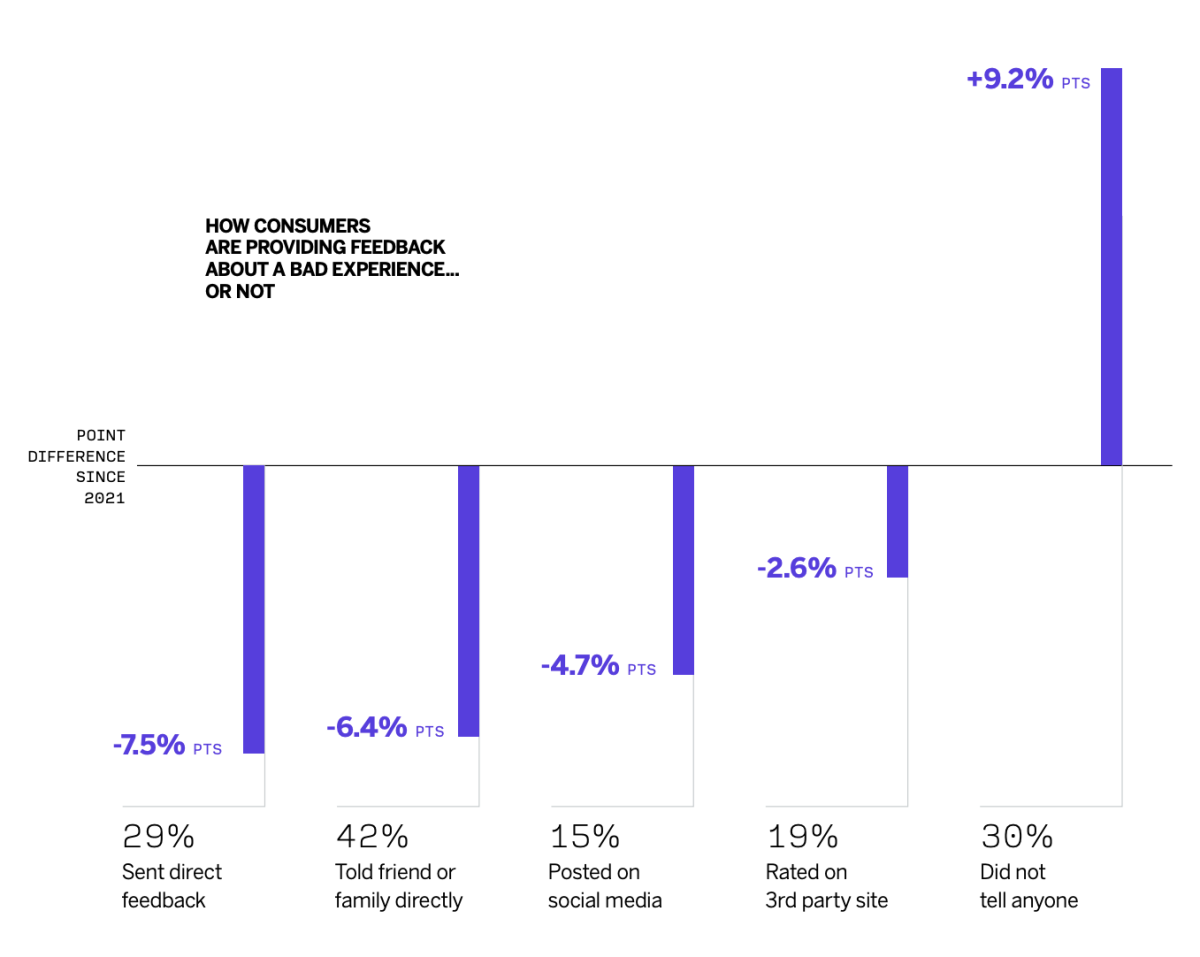
With this decline in direct feedback, it’s now down to you to piece together what’s going on with your customers. You could forensically examine your customers’ behavioural cues, abandoned carts, support call transcripts and customer journeys. These all tell a story, for sure. Or you could use a tool that does all those forensics for you—the customer health score.
Customer health scoring is an incredibly useful tool because it:
1. Highlights patterns
Scoring customer health over time reveals trends and patterns that show whether your CX strategies are successful (or not). If customer health steadily improves, you know you’re doing the right things.
2. Helps slow churn
If you keep your finger on that pulse with customer health scores you’ll be able to identify a customer’s churn risk and step in pre-emptively and proactively to keep their custom.
3. Uncovers your best customers
Your best customers are your brand ambassadors. You just need to identify who they are. Customer health scoring flags up who your champions are, so you can encourage their continuing loyalty.
How do you calculate customer health scores?
1. Establish your valuable customer health score metrics
Collecting customer data across all your platforms, outreach channels and accounts is, of course, useful. But when it comes to creating a meaningful customer health scoring system, you need to narrow down precisely what business outcomes you want to achieve, such as:
- Increasing NPS/CSAT
- Increasing Customer Lifetime Value
- Reducing cost-to-serve
- Reducing churn
For example, if you choose customer satisfaction or customer loyalty as a valuable factor, you could use a customer’s NPS and CSAT responses along with the number of times they contacted support within a given period. This combination gives a helpful indication of whether customers are happy with your product or service.
2. Weight your customer health score metrics
Once the datasets from your chosen metrics are in, apply weighting to calculate customer health scores. Which metrics are crucial to your business, and which ones are less critical (but still helpful) for scoring account health?
Continuing with our example, you might want to prioritise NPS, CSAT, and Service Management metrics as the crucial factors in your customer health calculation, while weighting the rate of customer engagement with user community forums lower.
Your customer health score weighting system can be scaled in any way that makes sense to you. You might want to choose a scale between 0 and 100, with scores from all your metrics given a plus or minus number on the scale.
3. Segment ‘healthy’ customers from ‘unhealthy’ ones
You can now segment the combined health score for each customer. Create customer segments and label them.
For example:
- Score distribution from 75 to 100 = ‘healthy’
- 50 to 75 = ‘at risk’
- 0 to 50 = ‘unhealthy’.
You’ll need to do some analysis with historical data to confirm that customer behaviour is leading to the customer outcomes predicted, e.g., are ‘unhealthy’ customers really churning more, or spending less over time than those in the ‘healthy’ category?
What is a good health score?
There’s no one-size-fits-all way to define great customer health. You choose the parameters of your customer health segments depending on the business outcomes you want, and industry.
There are a few different ways to categorise your customer health scores that make it easier to identify what’s good, what’s not, and what needs to happen next:
Customer health scoring: Numbered or percentage scale
You may have chosen a numbered score that you can easily categorise into ‘healthy’ or ‘unhealthy’ segments. In that instance, 75 to 100 might be what you decide is a ‘healthy’ score.
You can also express this as a percentage—75%. For example, calculate the percentages of customers who make, say, repeat purchases, contact customer support, or leave a 5* review, then create an overall percentage score—your final customer health score—based on the sum of these individual metrics.
Customer health scoring: Marks
You could also use lettered grades—just like a school report card. If you choose letters A (healthy) to F (unhealthy), you have more categories, allowing for more nuance between the customer health profiles.

Customer health scoring: Categories
And finally, you could just keep it simple. Bracket the results into ‘good’, ‘neutral’, and ‘bad’.
It’s a less nuanced approach, but may help you focus on simpler, broader terms, rather than getting lost in the weeds of numerous categories—and different approaches to identifying customer health.
How to improve customer health scores
So you’ve done the tech bit and created your health scores process using your chosen valuable metrics and segmentation. Building the scores is just the start—the real magic happens when those numbers start coming in and you actually start doing something with them.
1. Firstly, get everyone on the same page
Let your customer success managers and customer service staff know how your scoring works; a bit of light training doesn’t go amiss here. It’s even better if you can link your customer health score to the CRM that everyone uses. That way, everything is in one place and the whole team can see at once which customers are wavering and need some extra attention.
2. Take action
Where scores are looking low, take that forensic dive into the issue to see what’s stopping the customer being satisfied. You could step up your marketing reach, or tackle the annoying glitches that are preventing them buying or using your product.
4. Listen to your customer service team
These are your frontline people who know exactly what’s going on. If customers are low scoring because they’re constantly on the phone to product support with a recurring problem, get the details of that problem from the agents and fix it. A better score will follow.
5. Look at the bigger picture
The entire customer journey, from awareness to advocacy is your friend here. You’ll be able to pinpoint which of your measured metrics along the journey actually prove that a customer is going to stick around, and make extra effort to enhance those.
6. Don’t ‘set it and forget it’ with your customer health score
Your first scoring system was, most likely, a series of educated guesses about what metrics were the most useful for measuring customer health. Guesses can be wrong, even educated ones, so you’ll need to keep an eye on the trends. If they’re going in an unexpected direction, acknowledge you’ve miscalculated somewhere.
8. Stay flexible
As you grow, so does your customer base, bringing in new needs and behaviours. Your scoring system needs to evolve alongside them.
Customer health score as part of a wider CX programme
Just knowing which of your customers are satisfied or dissatisfied using a health score does not constitute a customer experience strategy. But add it to other factors, such as customer journey mapping, customer retention, customer engagement, always-on listening and good communication (both internal and external) you’ll develop a complete CX programme that not only improves customer experience but also delivers business outcomes.
Your CX strategy should also include:
Using data to build a customer retention strategy
Losing business clients is a headache for account managers, but it’s not inevitable. You can retain customers just by being smart with your data. When you pay attention to what the numbers are telling you and act on that information, you can keep making their experience better.

Nailing the buyer’s journey
Your B2B buyer’s journey is either going to win over a new customer or send them to a competitor. Understanding what it is, how to map it, notice where the process is broken, and fix those gaps is the difference between a customer signing up with you, or you handing your competitors a new customer.
Learning from your wins—and your losses
Figuring out how and why your business is winning or losing customers is a game-changer for long-term growth, building on success, and improving pain points to increase revenue and avoid customer churn.
To calculate your win/loss ratio, divide the number of won opportunities by the number of lost opportunities over a selected time period. Then act on those lost opportunities.
You don’t need to get too hung up on customer health score, as it’s just one part of a bigger customer experience picture. Think of it as a customer success early warning system. When you can see the start line and the finish line and everything in between, that’s when you’ll spot those ‘Aha!’ moments of concern—the ones that make the scores drop and the customers leave. Fix those moments, and the scores will fix themselves.
While health scores are a neat way of flagging up customers who need some extra attention, and trends, what you need is a wider CX programme that lets you listen, understand, and act.
Transform Customer Health with Qualtrics®
You don’t need to have your valuable customer service teams stuck in front of their screens trying to keep track of everything. A modern CX suite, like Qualtrics Customer Experience Management Software, will do the heavy listening for you—24/7. And it not only listens to what customers are saying across every channel, it turns the data from all that chatter into real-time, useful advice.
With all that information right at their fingertips, your customer support team doesn't have to guess. They can step into every customer conversation armed with the facts and with complete confidence, knowing exactly what to do to keep the customer relationship healthy.