

What is an omnichannel customer journey?
The omnichannel customer journey is the sum of all the touchpoints, platforms and mediums that a customer interacts with throughout their time with a brand and its products or services – both before and after purchase.
Customers explore, buy and experience products and services as a series of moments, which we collectively call the customer journey. What makes a customer journey ‘omnichannel’, then, is the fact that things never straightforwardly start and stop on a single touchpoint.
Instead, customers will jump back and forth between websites, social media channels, the contact centre – over the phone and using email, text, or live chat – the product itself, physical locations, apps, and everything in-between.
Today, the ability to do this channel-hopping seamlessly and without breaks in flow is a key part of customer expectations – and that means getting to grips with each and every omnichannel customer journey has become an important part of customer experience management.
Let's dive in.
The benefits of building omnichannel customer journeys
Customers don’t want to feel limited to a single way of doing things, and they don’t want friction when they need to take things from one channel to another. That means the onus is on brands to deliver exceptionally seamless, truly omnichannel customer journeys.
Facilitate that, and you’re on your way to lasting customer satisfaction.
But here’s the thing: people are already making omnichannel customer journeys, whether you’re ready for them or not. Some 71% of customers will readily switch channels based on their immediate context, while 76% expect that experience to be slick, seamless and consistent.
Importantly, delivering quality and cohesion in those cross-channel customer interactions has real impact. Customers who can move fluidly from channel to channel spend up to 1.5x more, while the omnichannel experience can help drive down churn by as much as 13%.
As McKinsey put it in its research: “A company’s performance on journeys is 35 per cent more predictive of customer satisfaction and 32 per cent more predictive of customer churn than performance on individual touchpoints.”
So this is important stuff. And, as with anything, getting omnichannel customer journeys right begins with nailing the basics…
Omnichannel customer journey examples
Here’s a couple examples of strong, unified and truly omnichannel customer journeys – ones where moving between multiple channels doesn’t slow the customer down:
B2C retail
Sarah is looking to renovate her home office. She’s browsing Instagram when she’s shown a targeted ad for a new desk. The ad link takes her to the store’s page, which uses information from her browser to deliver a version of the homepage showing products matching her tastes.
Sarah clicks a link to download the store’s app, where she uses AR to place a virtual version of the desk in her room.
Later she takes a trip to one of the retailer’s physical stores, and – based on her location – the app sends her a push notification letting her know that the desk is in stock and on offer.
After delivery, Sarah receives a text asking if she needs help with assembly. The text has a YouTube link to a tutorial video as well as a contact number. On finding a part missing, Sarah calls to get help – the agent has her order history, and their system loads up the details automatically, helping them get to a solution quickly.
B2B SaaS
Anvi is on the lookout for enterprise security software. She searches the topic on Google and lands on a high-ranking whitepaper from a security firm. She downloads the paper, giving over contact details in return for access.
That initial interaction triggers a personalised email flow, a LinkedIn ad campaign with case studies in Anvi’s industry, and a link to an onsite price calculator tool. Here, a live chat bot offers to link Anvi with a specialist, and they book in a session.
Anvi gets a personalised demo, including a portal to tailored docs for her procurement team to review. After buying the tool, inbuilt analytics foster the post-sale relationship, with 24/7 customer support built into the product, and automated data flows that highlight pre-approved discounts to account managers if they approach their licence capacity.
Improving the omnichannel customer journey: Where to begin
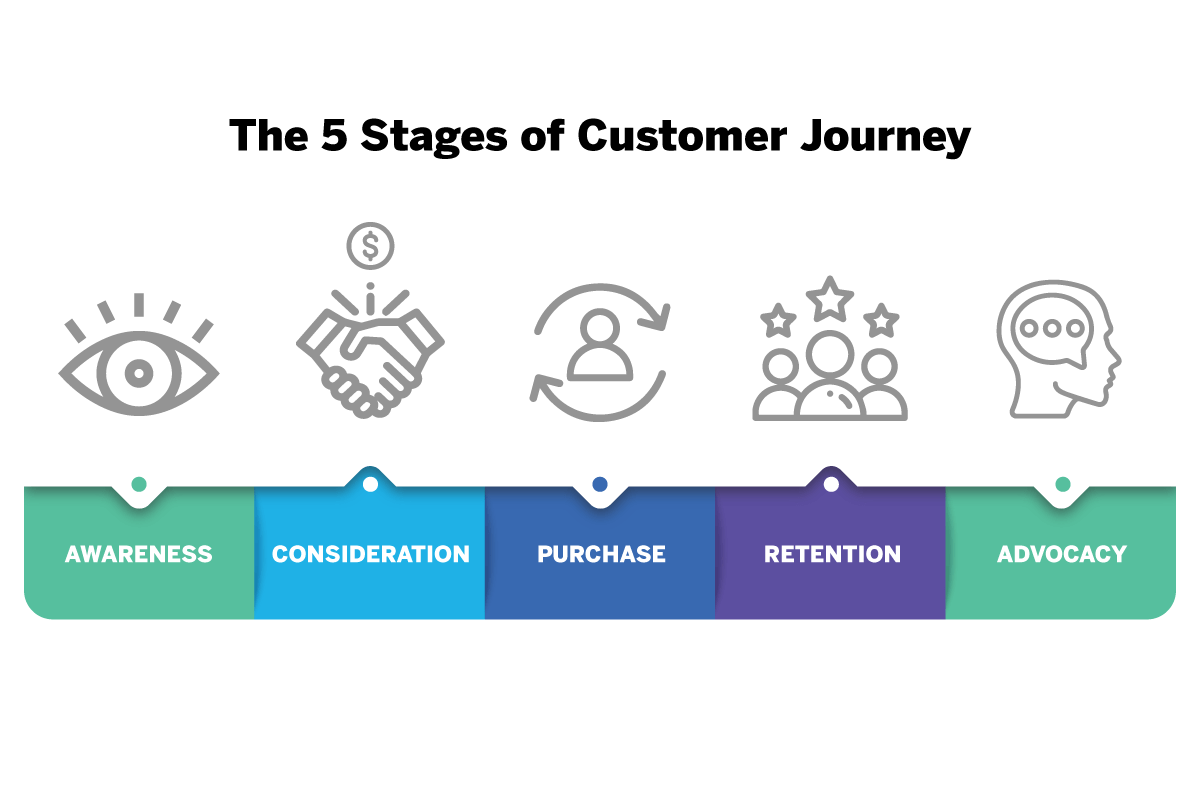
1. Understand the key customer journey stages
As customers move from channel to channel, they generally do so across five established stages that account for pre-sale, purchase, and post-sale:
Awareness stage
Potential customers become aware of a company, product, or service. This might be passive, in that they’re served an ad online, or active in that they’re searching for a specific solution.
Consideration stage
Here the customer is researching and comparing options. Here, they’re receptive to any information that can help them make the best decision.
Decision stage
The customer has all the information they need on the various options available to them, and they make a purchase.
Retention stage
The post-sale phase involves customer support, proactive follow-up communications, personalised offers, information on new products, and rewards for loyalty.
Advocacy stage
If you nail the retention phase, you’ll have yourself a customer who not only wants to keep buying from you, but will also advocate on your behalf.
2. Unify your data
Customer data are the most important part of any omnichannel customer journey optimisation effort – they’ll tell you how your customers behave, which channels they use, and how each one is either working to help them or getting in their way.
So being able to bring data together – from typically disparate sources – is incredibly important. To that end, the right customer experience management software can help. Tools designed to knock down data silos and unify insights from across the customer journey can help businesses identify where some journeys fall short of customer expectations – and pinpoint what needs to change.
The omnichannel customer experience lives or dies on the ability to analyse everything from UX behavioural heuristics to solicited feedback, and from the content of customer support calls to social media posts together – under one digital roof.
To that end, look for tools with AI-powered analytics and natural language processing that can help monitor the effort, emotion and sentiment underpinning every customer interaction.
3. Map your journeys
Customer journey mapping is a tried and tested exercise designed to help demonstrate the ways people might move along the five core journey stages – and the touchpoints they use throughout.
Each resulting customer journey map is a visual representation of a specific route, but by joining multiple maps together, you can start to better understand customers’ needs and perceptions before, during, and after any interaction.
Customer journey mapping helps shine a light on:
- How customers move from awareness through to purchase
- The touchpoints customers use along each journey
- The efficiency of the connections between each stage
- The health of the ongoing, post-sales relationship
- Pain points along each journey
Maps cover interactions and touchpoints leading up to the point of purchase, as well as post-sale phases where support, maintenance and renewal become important parts of the picture.
In the next section, we’ll explore how to build out a robust omnichannel customer journey map.
How to create an omnichannel customer journey map: 5 steps
1. Outline detailed customer personas
Your customer persona is a rich, fictionalised stand-in for a group of people that you do – or want to do – business with. So that could be existing, longstanding customers, people you want to attract, or even customers who’re in danger of churning. Or your focus might be on high value versus low value customers.
You can use market segmentation and customer data to help build out your personas, and you should try to arrive at two or three that you feel confident in exploring from an omnichannel journey perspective.
Whichever kind of customer you’re working with, aim to build out a profile for each persona that feels like a real person and it’ll be easier to put yourself in their shoes.
2. Focus on a specific journey
Your customers will be making tons of different journeys that involve your business all the time, but this exercise relies on being able to isolate one to explore, adapt, and monitor.
Examples might be someone looking to renew their subscription at the end of a trial period, someone looking to open a new account, or someone seeking support with an issue.
3. Involve the right people
You can’t build out a journey map in a vacuum; it needs a diverse team that represents every facet of the business involved in the customer experience. Your assembled group should include frontline staff who interact with customers daily, management, and corporate support functions who can provide perspectives you might otherwise overlook.
By bringing these varied viewpoints together, you’ll ensure that your resulting map reflects the operational reality of the business rather than just the idealised vision of a single department.
4. Go step-by-step
Fleshing out your omnichannel customer journey map is really just a process of answering questions around your chosen journey. Who’s involved? Which stakeholders on the customer’s and your side of things are important, and when? What are the natural steps along the journey your persona might take? And, crucially, which channels would they use to do so?
Then it’s time to think critically across a few key areas:
- What is the most pivotal hit-or-miss moment in the process?
- Are the connections between those channels robust enough?
- Are there any channels currently being underserviced?
- Can the journey be streamlined for the customer?
5. Make proactive changes
You should come away from the mapping process with a clear list of things to work on. It could be, for example, that you think your website chatbot’s messaging history needs to link up better to the contact centre, to save customers having to repeat themselves. Or it might be that you could use website tracking data to help a sales team member deliver different versions of your demo to people at different levels of inquiry.
Whatever the case, you’ll want to formalise your list of hypotheses and get to work on making those actionable improvements to each omnichannel journey.
6. Monitor impact
For any changes you’ve made, outline clear KPIs that you can measure against past performance. That way you’ll be able to test, learn, iterate, and test again.
Improving customer journeys is an ongoing process – one where your learnings from customer behaviour, customer data, and previous improvement efforts only ever feed into the next cycle.
The secret to omnichannel strategy: Unify the entire customer journey
The key to all this is moving from individual, siloed journeys to properly unified omnichannel customer experience. That means thinking big picture, but it also means being able to bring customer data together from across the business.
If you can unite and analyse data from touchpoints like the contact centre, customer behaviour on owned channels, in-app user experience, solicited feedback and even unsolicited social media rants, you’ll be able to pinpoint where customer interactions are causing issues – and where better bridges need to be built between channels to deliver a more seamless experience.
Qualtrics can help here. Ours is an omnichannel experience management solution built on AI insights, and which has been specifically designed to close the experience gaps that lie between your customer touchpoints.
With Qualtrics®, you’ll unify every feedback signal, and use what you learn to finetune customer journeys, boost customer retention, and drive up customer satisfaction across every channel. And, crucially, it’ll help you stay ahead of the pack as we enter the next era of omnichannel strategy.