


What is employee engagement?
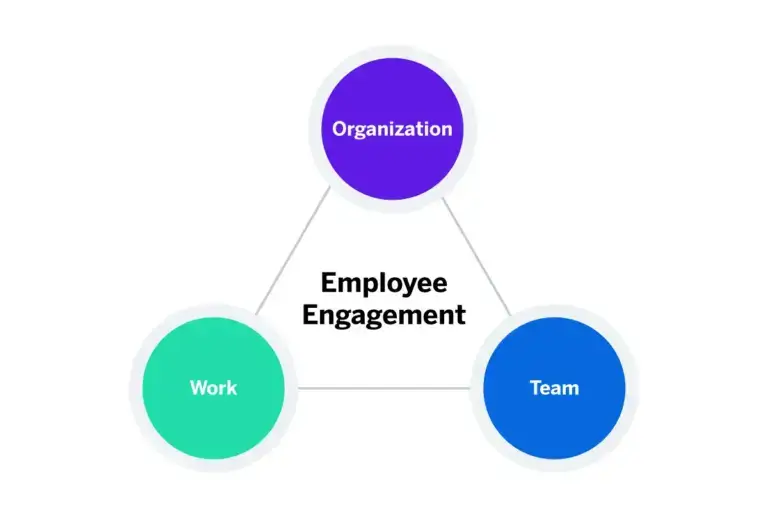
A definition of employee engagement is how much an employee is committed to helping their organization achieve its goals. It’s demonstrated by how employees think, feel, and act, as well as the emotional connection employees, feel towards their organization, their work, and their team.
Our 2024 Employee Experience Trends Report found that 73% of U.S. employees are engaged in their work and workplace. Globally, 68% of employees are engaged at work.
Free eBook: 2026 Employee Experience Trends
Why is employee engagement important?
Research shows that employee engagement makes people more inclined to work harder and solve problems, grow and develop faster, get along with people better, and stay longer at a company. All these factors have a measurable business impact, and contribute to organizational success:
- Increased performance – SHRM research shows that people who are engaged in their work are more likely to help the company achieve its goals
- Higher employee retention – according to the Oxford Handbook of Positive Psychology at Work, an engaged employee is 87% less likely to leave their organization. This means reduced employee turnover costs for HR professionals having to recruit new staff, train them and wait for them to ramp up to full productivity
- Higher job satisfaction – when your workforce is happy it enriches your workplace culture
- Increased revenue – according to Gallup, highly engaged employees contribute to 21% greater profitability and those teams who score in the top 20% in engagement realize a 41% reduction in absenteeism, and 59% less attrition – better business outcomes all round
- A better customer experience – the same Gallup study found that high workplace engagement contributes to a 10% increase in customer ratings and a 20% increase in sales, which in turn can lead to…
- Higher customer loyalty and customer retention result from highly engaged employees
Why employee engagement alone is not enough
Employee engagement is important, and a good thing, for all the reasons listed above. However, it’s not the full picture. When you think about it, employees can be engaged, and:
- still want to leave your organization
- still be at risk of burnout
- still not feel like they belong
- still struggle with unwieldy technology experiences and processes
It’s no longer enough to measure engagement alone. As a metric, it doesn’t give your organization the full picture of the experiences your employees are having at work on a day-to-day basis. An organization needs that full picture – the employee experience (EX) – to drive better business outcomes at the top and bottom lines.
Priorities shift and business leaders, managers and teams need to keep up with them, and an annual engagement survey is no longer enough. You need to solve the challenges of measuring more than engagement, more often, without adding to already busy people’s workloads. More needs to be measured with less. So…
Employee engagement strategies
Shift mindset from employee engagement initiatives to employee experience (EX)
Just as the rise of the service economy opened the door to employee engagement, the experience economy has seen a shift towards ‘employee experience‘ – a more holistic view of employees’ experiences at work all along their employee lifecycle.
And it’s important to remember that it’s up to the company to provide the experience. Your company culture and company mission must now support, encourage and empower a great employee experience.
Today’s most successful organizations are looking not just at an annual or bi-annual snapshot of how their employees feel, but are running employee listening programs that gather feedback throughout the employee lifecycle. We call this experience data (or X-data) as it seeks to understand the complete employee experience.
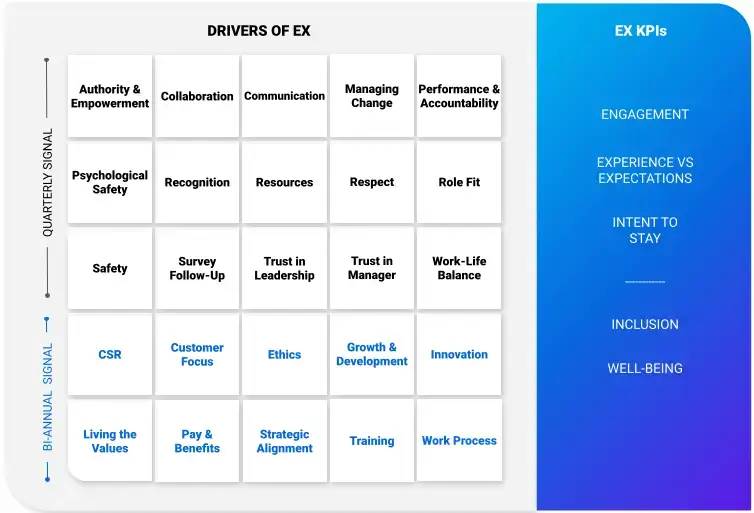
Understand the key performance indicators (KPIs) of employee experience
These are the measurements that a company should track to ensure they are providing a great employee experience:
Engagement (the definitive KPI)
Engagement remains the gold standard employee measurement, strongly linked to organizational outcomes, such as performance, customer satisfaction, retention, strong company culture, and innovation. It measures employees’:
- Likelihood to recommend your organization
- Willingness to go above and beyond
- Sense of accomplishment at work
Intent to stay
Once part of engagement, this measures how long your employees say they intend to stay at your organization.
Experience vs. expectations
Employees indicate to what extent their expectations are met at work. Their answers will provide unique perspectives, reflecting employees’ individual expectations. Once you’ve collected the data, you can easily segment results to differentiate the experiences of employees based on whether the organization is exceeding, meeting, or falling short of expectations.
Inclusion
Inclusion has become a key differentiator between a positive company culture and a negative one. Inclusive organizations are more innovative, productive, and enjoy higher retention. This KPI assesses:
- Belonging
- Authenticity
- Equity
Wellbeing
This important measure is becoming more critical as the lines between work and home increasingly blur, post-pandemic. It’s essential that employers create working environments conducive to well-being, so that employees don’t risk burnout, presenteeism, and/or low productivity.
This KPI measures employees’:
- Energy
- Positivity
- Relationships
Understand the key drivers of employee experience
Drivers are aspects of employee experience that influence the five KPIs. Key drivers of EX include:
Gather employee experience data using surveys
Consider the lifetime of an employee at your organization (the employee journey) – there are key milestones along the way, whether it’s their interview, new job onboarding process, performance reviews as well as other surveys that crop up during their career.
There’s a variety of surveys and employee listening mechanisms you can use to gather data about your employee experience:
- Always-on employee feedback – an on-demand, anonymous avenue where employees can raise issues and provide feedback.
- Ad hoc surveys – just-in-time feedback on specific initiatives eg. organizational changes, job satisfaction
- Employee lifecycle feedback – event-triggered feedback that gets employees’ views at key milestones in their journey with a company. It includes candidate, new hire, onboarding, exit, and training feedback
- Multi-rater assessments – performance and development evaluations that simplify the 360 reviews and feedback from peers, managers, and direct reports
- Census engagement surveys – the annual or bi-annual ‘deep dive’, it covers the widest range of topics and allows you to understand the key drivers of engaged employees and identify areas for improvement
Each survey presents an opportunity to gather feedback and understand the key drivers of engagement and how to improve that experience.
Enlightened employee experience leaders also take into account operational data (O-data) such as employee churn rates, adoption of benefits programs, participation in affinity groups, etc. Combining this with experience data (X-data) allows HR leaders to get an even fuller picture of their people’s experience.
Get the right insights to the right people
It’s essential to map out who gets which insights to action them. The data must go to those stakeholders who can act on the feedback received. There’s little that’s more dispiriting for employees than to give feedback, then nothing gets done as a result. Executives will need different insights to managers, and HR leaders will need different insights altogether.
Employee engagement surveys step by step
1. Start with survey design
Designing an effective survey is part of your employee engagement strategy and requires careful thought to return the best possible results and data.
The first thing is to design with intention. Take a step back and understand what you want to measure, why you want to measure it, and who to collect feedback from to make sure it’s aligned with your wider business and people strategy. Then, the feedback will provide the insights you need to act on, and ultimately improve the employee experience.
To start, keep your survey structure simple and intuitive. Employees will need to understand how to answer the questions and your managers will need to understand how to read the report. Your goal is for as many employees as possible to understand and act on the results of your engagement survey.
Here’s what else you’ll need to think about before you get started:
- Decide whose input you need to include and whose input you don’t need (manage expectations by explaining why you are not consulting them).
- Set clear deadlines for survey responses and turnaround times for the data right from the start
- Establish one person for the final sign-off, and make it clear to everyone in the sign-off process that when they say it’s final, it’s final
- Distinguish ‘nice to have’ questions from ‘must have’ questions
- Avoid having too many people designing your employee engagement survey
2. Devise the right questions to ask your employees
Your employee engagement survey should not only help you address challenges and identify experience gaps at your organization, but also point to what you’re doing right in the eyes of engaged employees. To improve employee engagement, you need to be sure that your questions are going to deliver useful insights into their employee experience.
Your questions should cover three key areas:
Employee engagement
These questions go at the front of your survey, and measure: work involvement, discretionary effort, pride in the company, and willingness to recommend the organization.
Core themes
These ask about the conditions that might cause (or detract from) employee engagement with questions about autonomy and empowerment, career progression, collaboration, communication, leadership, recognition, resources, strategy, management support, and training and development.
Additional themes
Depending on what’s happening in your company or market at the time, you might also want to ask about additional topics. In our employee engagement survey template you’ll find some additional ones you can include. Try to avoid throwing them all in, and only ask them if they’re relevant to prevent your engagement survey from becoming too unwieldy.
3. Identify the key drivers you want to measure
Your next step is to identify the themes you want to measure, and then create employee engagement survey questions that support those themes. As a rule of thumb, aim to ask 30-50 employee experience-related questions. Remember to include a way to record demographics, too.
| Engagement Driver | Description |
|---|---|
| Autonomy / Empowerment | Are people empowered in their roles and able to innovate on the job? |
| Career Progression | Are there opportunities for people to grow and develop in the company? |
| Collaboration | Are they able to easily work with other teams or colleagues without barriers or conflict? |
| Communication | Are they getting enough info from the company about what’s happening and do they feel they’re being listened to? |
| Company Leadership | Do employees believe in and trust their senior leaders? |
| Recognition | Do people feel that they’re recognized and appreciated? |
| Resources | Are they enabled to do their job through the equipment they’re given? |
| Strategy Alignment | Do they buy into where the company is going and how they’re a part of it? |
| Supportive Management | Are managers supporting their teams to be successful? |
| Training and Development | Do they feel they have the training they need to do their job? |
| Customer Focus | Are they in a customer-centric organization and are they empowered to do what's needed? |
| Diversity & Inclusion | Do they feel the organization is inclusive and fair to all employees? |
| Pay & Benefits | Do people feel they're fairly rewarded for what they put in? |
| Quality of Product or Services | Do people believe in what they (and/or the organization) provide to their customers? |
| Safety | Do people feel their safety is critical to the organization? |
| Social Responsibility | Do they feel the company is a good corporate citizen with a worthwhile cause? |
| Work-life Balance | Do they feel the company allows them to achieve the balance they need between work and personal life? |
Tip: In line with the industry standard, we recommend that employee engagement surveys use a 5-point Likert scale for all items:
- Agreement Scale: Strongly Agree to Strongly Disagree
- Rating Scale: Very Good to Very Poor
Examples of great employee engagement survey questions
These effective sample employee engagement survey questions will help you to distinguish the current employee satisfaction level. You’ll notice the questions cover several of the key engagement themes mentioned above.
- My work gives me a feeling of personal accomplishment (Strongly Agree to Strongly Disagree)
- My job makes good use of my skills and abilities (Strongly Agree to Strongly Disagree)
- My workload is manageable (Strongly Agree to Strongly Disagree)
- I have good career opportunities at this company (Strongly Agree to Strongly Disagree)
- I am satisfied with the overall physical environment in which I work (Strongly Agree to Strongly Disagree)
- My manager treats me with respect (Strongly Agree to Strongly Disagree)
- I would recommend this company to people I know as a great place to work (Strongly Agree to Strongly Disagree)
Examples of poor employee engagement survey questions
The point of employee engagement survey questions is to achieve accurate responses and a high employee feedback response rate. By including questions that are obscure, too difficult to answer, too demanding, or too personal, you risk your survey being abandoned or discredited. Some terrible questions about employee experience we have seen include:
- Does traveling for work affect your relationship with your partner (if you have one)? Far too personal and intrusive!
- Does your manager appear to favor some employees over others? Who? Employees will be too afraid to answer this and unwilling to snitch on colleagues
- What has been your experience of working with the company over the last year? Where to begin with this? Do you want an essay? Far too long and demanding.
- On a scale of 1 to 10 how fairly do you think your manager treats the team? (1 being extremely unfairly, 10 being very fairly) Fairness is a subjective concept, particularly when you are being asked to answer for other people as well here, and impossible to pin on a scale of 1 to 10. There’s no definite answer, therefore a pointless question.
- What KPIs do you think we achieved B2B in the YTD? Just what does this mean? (Translation: what key performance indicators do you think we achieved business to business in the year to date?) Avoid jargon and acronyms in your surveys, although even without the acronyms this is a pretty poor question.
Your employee engagement survey checklist
Every organization will have its own needs when it comes to assessing employee engagement. To expedite the process, we’ve created a survey template and outlined the steps to take to get your employee engagement survey up and running. Here are some tasks and tips.
| Task | Tip |
|---|---|
| Get started | Try our free employee engagement survey template. |
| Determine who will review and approve content | While several people and teams should review content, avoid having more than one leader approve content. This will help you eliminate lengthy sign-off processes once you have a final question set. |
| Set clear deadlines and turnaround times | For everyone involved: respondents, data analysts, leaders. |
| Involve key leaders when prioritizing issues | Solicit opinions and ideas from stakeholders to better understand organizational needs. What do the heads of your business really need from their people in order to be successful? |
| Review and customize the engagement categories | Remove any you don’t think are relevant to your organization, and add any new ones you would like to include. |
| Review the questions | Within each of the categories you have left. |
| Distinguish ‘nice to have’ questions from ‘must have’ questions | And adjust the questions to fit your needs. Maintain at least three questions in each category. |
| Include necessary definitions in your survey | For example, many companies include a definition of “Your Manager”, “Your Team”, “Senior Leadership” and “This organization” to ensure people use the same frame of reference when responding. These can be shown at the beginning of a survey or, depending on your survey vendor, as individuals hover over questions. |
| Send your questionnaire for review and approval | Typically you should expect around two to three rounds of iteration which can take at least two weeks. |
Run your survey
To ensure you collect the greatest amount of responses, properly survey employees by inviting everyone in your company to respond, and keep a close eye on response rates. You might need to keep the survey open for two to three weeks to give people the best opportunity to give their feedback.
Analyze your results
Once your data is in, you need to turn it into insights.
With the right analysis, you can see what’s driving key metrics, such as engagement and , so you know where to focus your improvements and make engaged employees.
The latest tools used in employee engagement research include key driver analysis — a statistical test that surfaces the leading factors that have the biggest impact on employee experience.
They show, in an easy-to-read format, the drivers of engagement, how important they are, and how people rated them.
The idea is that by focusing on the high impact/low scoring drivers, you’ll tackle areas with the biggest impact to engage employees in your company.
Tell the story with the data
Nobody feels excited and motivated by a mass of numbers and statistics on a screen. But combine your data with a strong, captivating visual story, and you can engage your audience, sparking enthusiasm and action. When you attach a story to your data, you can make an emotional impact on whoever sees it:
When you make visual storytelling that delivers a real emotional punch to the outcome of your data, there are three things that you need to do to set it up:
1. Start with the right questions: What does the data tell us? Who needs to see this data? How can we communicate that to the right audience? How can we use that to make a difference?
2. Know your audience: How much do they know? How sophisticated are they? How familiar are they with the subject? All of this will help guide you in beginning to design your visual story.
3. Simplify, simplify, simplify: people want information delivered as quickly and simply as possible. Don’t try to do too much all at once. Edit your data and your information down to just give the crucial information needed to make your point. Then create your next visual to make your next point. Think of it as putting your story together one chapter at a time, instead of trying to do it all once.
Measuring employee engagement
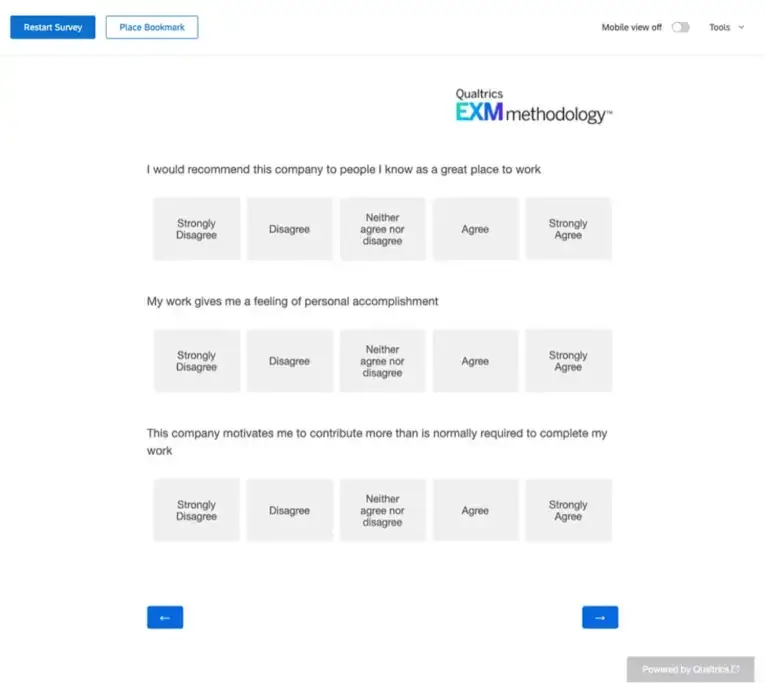
So, what factors lead to engaged employees? We measure employee engagement as a composite score of three factors:
- Recommend: ‘I would recommend this company to people I know as a great place to work’
- Accomplish: ‘My work gives me a feeling of personal accomplishment’
- Motivate: ‘This company motivates me to contribute more than is normally required to complete my work’
Each of these items provides a score which, when combined, gives an overall metric of employee engagement.
How to increase employee engagement
The best way to boost employee engagement is by taking action on the insights. Here’s how to make sure your employee engagement insights result in meaningful change and improvements in employee satisfaction for your people.
There’s a science to improving levels of employee engagement. But unfortunately, there’s no simple cookie-cutter approach — it all comes down to understanding your key drivers and company context so you can take action to improve what will have the biggest impact.
There are two strategies you can use to approach your improvements – create changes at an organizational level and changes within individual teams.
In most cases, you’ll need to do both.
- At an organizational level, work with your leadership team to identify the key drivers that affect everyone.
- At a team level, this is where you’ll make the biggest impact. The vast majority of key drivers are things direct supervisors can impact, such as career growth, resolving issues at work, or clarifying objectives.
Evolving your employee engagement program
An employee engagement program is not static — it will evolve over time as your workforce changes or as your employee engagement strategy matures. If you’ve been running your employee engagement program for a while, you may find it’s no longer getting the responses or results it used to. This may just mean that it needs a refresh. Here’s what you can do.
Review your questions
Look in detail at the questions you’re asking. Some of them may now be redundant or irrelevant and need to be removed.
Keep an eye out for questions that:
- score very highly year-over-year
- are frequently skipped (this could be because they’re either not relevant or the question is confusing)
- are not actionable or answerable – every item should have an action and resources connected to it
- now seem irrelevant or outdated to your organization
Take a look at your reporting review
Assess the effectiveness and impact of your executive and team reporting so that it can be improved. Make sure that you:
- know who your audiences are for reporting, and so that you can reach each one
- have resources in place for your managers to facilitate necessary change
- consider other forms of reporting, such as videos and animations to communicate your results in an impactful way
Reconsider frequency
The timing of your engagement survey is critical to getting a good response rate. If you usually do an annual survey, also consider:
- The huge benefits of running employee surveys more than once a year (A lot changes in a year)
- Would shorter, more frequent employee surveys be better for the rhythm of your business?
Employees whose employer turns feedback into action “really well” are twice as engaged as those whose employer does not act on their feedback well, according to our 2020 Global Trends Report.
Personalize engagement
Think about ways you can engage better with individual employees on the survey. You could have:
- individual reports for each employee to view a summary of their results upon completion
- a central place for employees to view results, or a general sharing of results
- other channels of communication – do you rely solely on email, are there other platforms you can use?
Refresh branding
Make your survey look up to-the-minute and relevant by freshening up the design with colors and features.
If you have a creative team, let them loose on designing a new brand and theme for your program. Do you have a strong name for the initiative?
Refresh the online branding and site coding where necessary. If you have internal resources that design your website in CSS, they can help design a theme for your survey that feels consistent.
The future of employee engagement
Employee engagement software
Don’t leave your employees’ experience to chance or guesswork – invest in an employee engagement program. Employee engagement software is a digital tool specifically designed to help you measure, track and ultimately improve your employees’ satisfaction, engagement, involvement, motivation and productivity.
Sometimes known as ‘experience management (XM)’ programs, the best engagement programs make running complex analysis easy – whether it’s identifying the key drivers of engagement or automatically surfacing the actions that have the biggest impact on engagement.
The best programs also map the results back to the organizational hierarchy, delivering them straight to managers’ inboxes so they can get stuck in immediately and start improving things for their teams.
They include:
- employee feedback surveys
- employee recognition tools
- communication platforms
- engagement analytics
- actionable insights
Qualtrics® EX25 XM Solution
Our EX25 solution is the next generation of employee engagement. EX25 is a guided employee engagement program that measures the holistic employee experience. It uses Qualtrics’s practical, actionable EX25 framework to help you understand what drives the full employee experience, empower your managers to act on real-time insights, and help you make continuous improvement across your entire organization.
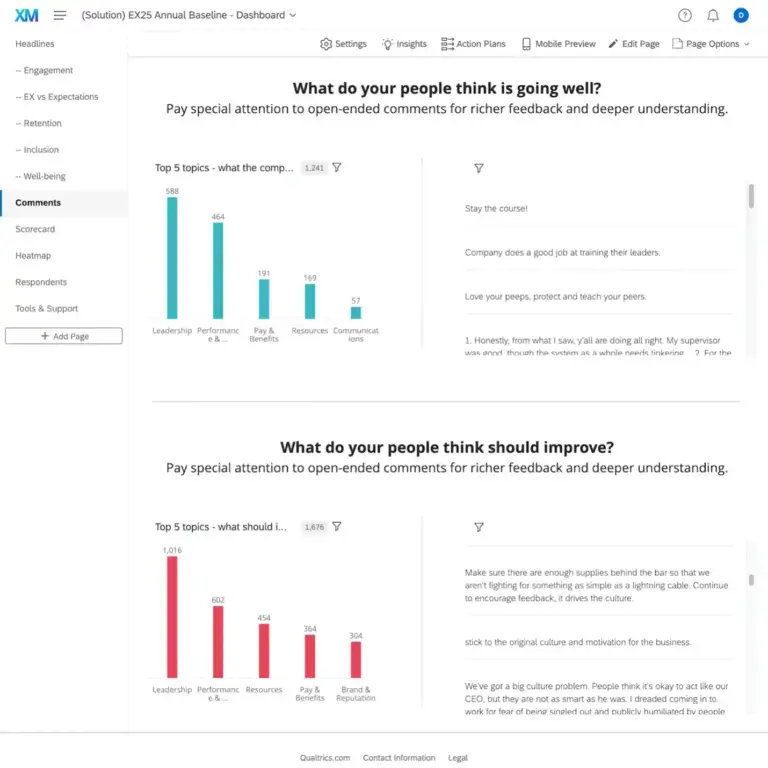
Quick to launch, EX25 is an employee listening program with pre-built survey design, standardized datasets for ongoing analysis and benchmarking, and backed by our validated EX25 methodology. It’s comprehensive, but agile and scalable enough to meet employees’ needs as they evolve.
A pre-built dashboard, which comes with advanced text analysis as standard, will give you a real time view of employee feedback as the data flows in from your EX25 listening program – no waiting around for reports.
Managers will be able to access their team’s results and easily identify what they can do to improve the holistic employee experience. With built in focus areas, action planning tips, and status reporting, you empower your managers to stay on track, driving continuous improvement and business outcomes.
With EX25, you’ll be able to empower every manager in your business to survey, improve and measure employee engagement with real-time insights. These insights show exactly where leaders can direct their efforts to increase employee performance – and experience.