


Key takeaways
- A pulse survey is a short, recurring employee survey that tracks sentiment and engagement drivers over time, usually monthly or quarterly.
- Pulse surveys work alongside annual engagement surveys rather than replacing them. The annual survey gives you a detailed baseline, and pulse surveys show what’s changing between those points.
- Match length to frequency. The more often you run a pulse survey, the shorter it should be. Aim for 10–15 questions for a monthly pulse and 15–20 for a quarterly one.
- Use the 70:20:10 rule to structure questions: 70% driver questions, 20% outcome questions, and 10% open-text questions. Keep core questions the same each cycle so you can track trends.
- Acting on results prevents survey fatigue more than asking less often does. Employees keep responding when they see their feedback lead to change.
What is a pulse survey?
A pulse survey is a short, recurring employee survey (typically 10–20 questions, run monthly or quarterly) that tracks sentiment and engagement drivers over time. Unlike an annual engagement survey, pulse surveys give organizations a continuous read on how employees feel, so leaders can act on issues as they emerge.
Pulse surveys give organizations the freedom to measure whatever they think is important on a regular basis, and are particularly effective as part of an employee listening program.
In our experience, the term “pulse” is often used to refer to everything that’s not an annual or bi-annual engagement survey. Pulse surveys are different from engagement surveys, lifecycle surveys (onboarding, exit, candidate reaction, etc.), and ad-hoc employee surveys.
Pulse surveys are a mechanism for measuring feedback using shorter, more frequent check-ins that aren’t limited to specific topics.
This means that the content being measured can (and should) change from organization to organization and even from one survey to the next.
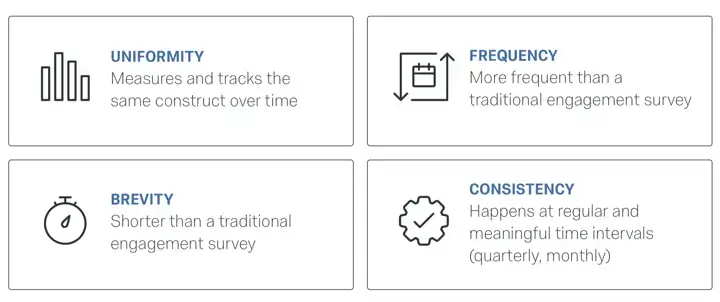
Pulse surveys:
- Track the same item over time, e.g. “How likely are you to recommend your company as a place to work to people you know?”
- Are shorter than an engagement survey, and easier to complete
- Are more frequent than traditional surveys (more than once a year)
- Happen at a regular interval (most organizations use them quarterly or monthly)
Pulse surveys are just one of a number of different employee feedback mechanisms you could choose to use outside of an engagement survey.
Learn about our employee pulse survey solution
What are the advantages of pulse surveys?
Pulse surveys are popular, not only because they are shorter and reduce the amount of time it takes employees to give their feedback, but also because they introduce a new dimension to results analysis: tracking over time.
Where an annual engagement survey is a once-a-year snapshot of your employees’ engagement, pulses allow you to track items month-to-month or quarter-to-quarter so you can:
- check in (and react) more regularly
- plot trends over time
- start to link improvements back to actions
Pulse surveys are also more agile than traditional, infrequent survey methods. Asking for feedback once a year means it’s incredibly difficult to check in on the progress of action plans, as well as being difficult to align feedback measurements with business outcomes.
With pulse, employees have the opportunity to provide feedback more frequently, and organizations have the chance to react more quickly to that feedback.
Our 2026 Employee Experience Trends research shows employees want to be heard more often:
- 42% of employees want their companies to listen more frequently
- Less than 10% want their companies to listen less
What can pulse surveys measure?
The short answer is: anything! Pulse surveys are a non-content-specific feedback method. What you ask can be tailored to your organization’s priorities, goals, and what you need to track.
In fact, the only content-related mandate for a pulse is to have some consistency, so you’re able to track the same item over time and see how it changes from one month or quarter to the next.
That said, we do see synergies in the types of content organizations choose to measure with their employee pulse surveys.
Common uses of pulse surveys
- Engagement pulse: this can replace the annual engagement survey, and is a shorter (maybe only 2-3 items) measure of employee engagement, along with measures of the core drivers of engagement, such as autonomy, career progression, or alignment to strategy
- Action planning follow-up pulse: run in conjunction with the annual engagement survey, this monitors the action plans set after that survey, with structured, regular feedback to help you measure progress and make changes to your plans, should you need to.
- Company values pulse: some organizations choose to track whether their company values are truly being “lived” in the organization (sometimes forming part of a broader company culture initiative)
- Change pulse: used to check in on employee sentiment more regularly through an organizational change program.
Once you’ve identified your need for pulse surveys, they can be a valuable tool to bring the voice of employees into business decisions more regularly, which will enhance the overall employee experience.
What questions should a pulse survey include?
There’s no fixed list of pulse survey questions. The right ones depend on your priorities. Use the structure below, then see our 40 example questions.
Any pulse survey program requires an investment of time from your employees and your resources, so you should focus on only asking about things that are relevant, and important to your organization.
Start with the organization’s strategic priorities, then consider the HR department’s goals. One of the biggest mistakes organizations make is failing to include either outcomes or drivers in the survey.
For example, measuring only engagement will tell you nothing about why employees are engaged or disengaged, thereby making the survey unactionable.
When structuring your survey, we recommend using the 70:20:10 rule of thumb:
- 70% driver or actionable items
- 20% outcome questions/items
- 10% open-text questions/items
From there, consider including the following measurements:
- Engagement: most employee pulse surveys include some measure of engagement, e.g. “I am proud to work for this company” or a single item such as eNPS.
- Action planning themes: used to gauge the effectiveness of action plans that were implemented following the traditional engagement survey, e.g. ‘To what extent do you agree with the statement, “I have seen positive changes taking place as a result of previous surveys?”’
- Strategic initiatives, change, or product enhancements that would benefit from employee feedback e.g. “This company does a good job of helping me understand how changes will affect my work”.
- Low scoring or surprising survey items
- Employee reactions to new programs or initiatives
- Measurements that matter to executives
Pulse survey questions: 40 examples by topic
The best pulse questions are ones you can act on. Most pulse surveys combine a few outcome questions (such as engagement or intent to stay) with driver questions that explain why scores move, plus one open-text question. Keep your core questions identical from one pulse to the next so you can track trends over time.
Use the examples below as a starting point, then choose the questions that match your organization's priorities. Unless noted, each question uses a 5-point agreement scale (Strongly disagree to Strongly agree).
Engagement questions (outcomes)
- I am proud to work for [Company].
- How likely are you to recommend [Company] as a place to work? (0–10 scale, used for eNPS)
- I see myself still working at [Company] in two years' time.
- I am motivated to go beyond what's expected in my role.
Manager support questions
- My manager gives me useful feedback on my work.
- My manager cares about my wellbeing.
- My manager keeps me informed about decisions that affect my work.
- I have regular, meaningful one-to-one conversations with my manager.
- I trust my manager to act on what our team shares in this survey.
Wellbeing and workload questions
- My workload is manageable.
- I can balance my work and personal commitments.
- I have the tools and resources I need to do my job well.
- I have the flexibility I need to do my best work.
- I have the energy I need to do my job well.
- [Company] shows that it cares about employee wellbeing.
Communication and change questions
- I understand how my work contributes to [Company]'s goals.
- I have confidence in the direction leadership is taking [Company].
- Leaders explain the reasons behind major decisions.
- I understand how [recent change] will affect my work.
- I know where to go when I have questions about [recent change].
Career growth questions
- I have opportunities to learn and grow at [Company].
- I can see a clear path for my career here.
- I've had a meaningful conversation about my development in the last [3] months.
- I know how to find new role opportunities within [Company].
Recognition, belonging, and psychological safety questions
- I receive recognition when I do good work.
- I feel a sense of belonging at [Company].
- I can be myself at work.
- I feel safe speaking up, even when my view differs from others'.
- People here are treated fairly, regardless of their background.
Action planning follow-up questions
- I have seen positive changes as a result of previous surveys.
- Leaders have shared what they learned from our last survey.
- I believe action will be taken on the results of this survey.
AI in the workplace questions
- I understand how AI is expected to be used in my role.
- I have the training I need to use AI tools effectively.
- I trust [Company] to use AI responsibly.
- AI tools help me spend more time on meaningful work.
Open-text questions
- What's one thing we should start doing to make [Company] a better place to work?
- What's one thing getting in the way of you doing your best work?
- What has changed, for better or worse, since our last pulse survey?
- Is there anything else you'd like leadership to know?
Example: a 10-question monthly pulse survey
This sample follows the 70:20:10 rule: seven driver questions, two outcome questions, and one open-text question. It takes most employees under five minutes to complete.
| # | Question | Type |
|---|---|---|
| 1 | How likely are you to recommend [Company] as a place to work? | Outcome |
| 2 | I see myself still working at [Company] in two years' time. | Outcome |
| 3 | My manager gives me useful feedback on my work. | Driver |
| 4 | My workload is manageable. | Driver |
| 5 | I have the tools and resources I need to do my job well. | Driver |
| 6 | I have confidence in the direction leadership is taking [Company]. | Driver |
| 7 | I have opportunities to learn and grow at [Company]. | Driver |
| 8 | I feel safe speaking up, even when my view differs from others'. | Driver |
| 9 | I believe action will be taken on the results of this survey. | Driver |
| 10 | What's one thing getting in the way of you doing your best work? | Open text |
Tips for writing your own pulse survey questions
- Ask about one thing at a time. "My manager is supportive and communicates well" is two questions. Split it so the answer tells you what to fix.
- Keep core questions fixed. Changing even a few words can break your trend line. Rotate topical questions (like a change program or a new policy) around a stable core.
- Write neutral statements and avoid leading wording such as "How much do you enjoy…," which assumes a positive answer.
- Only ask what you'll act on. If you can't respond to the results, leave the question out.
- Set a minimum group size for reporting so no individual's answers can be identified. Employees answer more candidly when they trust the process.
How long should a pulse survey be?
The more often you run a pulse survey, the shorter it should be. Most employees will spend a few minutes a month on a survey if they see results, but long surveys sent frequently quickly lead to lower response rates.
| Pulse frequency | Number of questions | Suggested completion time |
|---|---|---|
| Monthly | 10–15 | 3–5 minutes |
| Quarterly | 15–20 | 5–7 minutes |
| Twice a year | 20–30 | 7–10 minutes |
These times assume mostly rating-scale questions with one or two open-text questions. Rating questions usually take a few seconds each, while open-text questions take longer, so each one you add increases the total time.
To keep your pulse survey within these limits:
- Ask a few colleagues to complete the survey and time how long it takes.
- Include an accurate estimate in the invitation, for example “This survey takes about 4 minutes.”
- If a question doesn’t connect to a decision or action, it’s adding time without adding value.
How often should you use pulse surveys?
Two questions to ask are:
- How frequently does the business need to see results from the surveys?
- How quickly can the business respond to the results?
There are then four things to consider:
1. Fluctuations
How much does what you’re measuring fluctuate? Something like employee mood may fluctuate frequently, so you could measure daily or maybe more than once per day. However, if you’re measuring employee engagement, and its drivers, levels are unlikely to fluctuate in a short period of time, and daily or weekly measurements do not make sense.
2. Absorption and communication of results
An employee survey sets the expectation that leaders will use the results to take action. Failure to do this creates feelings of distrust and disengagement among employees and is a surefire way to decrease future survey response rates.
How often can your organization react to survey results? You should be prepared to review each set of results and aim to understand them. When considering a suitable cadence for your pulse survey, think about how you’re going to be able to process and use the findings.
3. Time to implement action plans
Action does not necessarily follow from every pulse survey (a pulse check on the effectiveness of earlier action plans may show that additional action is not needed) but it’s important to plan for possible actions following each pulse survey. A business needs to at least factor in time to review, communicate, and decide on actions.
4. Cadence of other organizational metrics
Some organizations work quarter-to-quarter, some month-to-month and for others, everything revolves around the annual meeting.
In your pulse planning ask what the business needs the data for.
- If you’re simply reporting data to the board at the annual meeting, pulse might not be the right mechanism and you might choose an annual engagement survey instead.
- If you’re reporting monthly, however, you might want to match that cadence so you can provide fresh data each time and update the board on the improvements.
We find that quarterly is a popular pulse cadence because:
- Most organizations run their reporting on a quarterly cycle already
- It leaves time to review the data and put actions in place
- It allows surveys to be slightly longer, allowing for more topics to be included
What about survey fatigue?
Some organizations have reservations that their employees will suffer from survey fatigue by receiving surveys more frequently.
We have found that the biggest impact on fatigue is not so much survey frequency, it’s program communication: if employees don’t hear back about their feedback, or if communication is not managed well.
Pulse survey FAQs
What’s the difference between a pulse survey and an engagement survey?
An engagement survey is a detailed survey, usually run once a year, that measures engagement and its drivers in depth. A pulse survey is shorter and runs more often, typically monthly or quarterly, and tracks a smaller set of questions over time. The engagement survey sets your baseline, and pulse surveys show how things change between those points.
Can pulse surveys replace an annual engagement survey?
In our experience, most organizations use both. Some organizations run frequent engagement pulses instead of one annual survey, with a few engagement questions and their key drivers each time. Others keep the annual survey for depth and use pulse surveys in between to check progress on action plans. The right choice depends on how often your business reviews results and acts on them.
Are pulse surveys anonymous?
It depends on how you set them up. Anonymous and confidential surveys work differently: An anonymous survey collects no identifying information at all. A confidential survey links responses to employee data, such as department or tenure, but only reports results for groups above a minimum size, so no individual can be identified. Confidential surveys allow more detailed analysis, while anonymous surveys can encourage more candid answers.
How do you improve pulse survey response rates?
Response rates for pulse surveys are often lower than for annual surveys because they run more often. The biggest factor in keeping participation high is showing employees that their feedback leads to action. Share results quickly, explain what will change, and keep each survey short and relevant.
How many questions should a pulse survey have?
Most pulse surveys have between 10 and 20 questions, and the more often you run one, the shorter it should be. A monthly pulse works well with 10–15 questions, and a quarterly pulse with 15–20. Whatever the length, keep a set of core questions the same each time so you can compare results from one pulse to the next.
How do you analyze pulse survey results?
Start with trends: compare each question’s score with previous pulses to see what’s improving or declining. Then compare results across teams, locations, or tenure groups, and look at which driver questions are most closely linked to outcomes like engagement or intent to stay. Review open-text comments for themes, and share what you found, and what you’ll do next, with employees.
Can pulse surveys be used with customers?
Yes. Many organizations also run short, recurring surveys with customers to track how sentiment changes over time, such as a regular relationship survey. The same principles apply: keep the survey short, keep core questions consistent, and act on what you learn.