


Students enter college, whether on campus or online, community college or four-year university, with a lot of expectations. Expectations about their classes and what they’ll learn, about their social lives and the people they’ll meet, and about the job they’ll get after graduation and the various ways in which they expect to succeed.
Expectations help students define value; but when those expectations go unmet, and universities aren't doing enough to support students in key areas, students leave. Proactive experience management is what changes that.
What is student retention?
Student retention is the rate at which students return from one period of time to another. It is most commonly measured year to year but can also be measured term to term or within a specific program over a defined period of time.
Why is student retention important in universities?
Student retention plays a significant role in keeping educational institutions thriving. First and foremost, educating and graduating students is core to the mission of higher education. When a student drops out, they often leave with more debt and no credential or degree. High dropout rates can signal that a university is failing to provide the support, resources, or academic quality it promised during the admissions process.
Retention rates also serve as an indicator of institution quality to employers and prospective students. As part of the ranking formula in national rankings, such as the U.S. News & World Report, low retention rates can damage brand perception. Additionally, students who leave are often detractors of the institution’s reputation whereas happy, successful graduates become alumni who recommend their alma mater to future students.
Retention also has significant financial implications. According to the NSC Research Center, an average of 31% of postsecondary students don’t return for their second year. That’s a drop off of almost one in three, with an estimated knock-on revenue impact of more than $10B per year.
Free Webinar: Modern Student Retention: Stop Churn Before It Starts
What is modern student retention?
Modern student retention is about proactively identifying students in need to drive early intervention that supports the whole student. Traditional retention strategies are reactive, diagnosing students at risk when it’s too late to get them back on track, or worse, after they’ve left the institution. Legacy support systems identify students at higher risk of departure based on a limited set of indicators (e.g., grades, pre-college characteristics). While critically important, these indicators paint a limited picture of student need.
In reality, student experience is highly complex and multifaceted. It includes but is not limited to academic, social, and career experiences as well as well-being, financial, and logistical needs. For example, the most common reasons students consider stopping coursework are stress, mental health, cost of living, and a lack of belonging (State of Higher Education). Identifying social, emotional, and financial needs is often more difficult than recognizing academic needs.
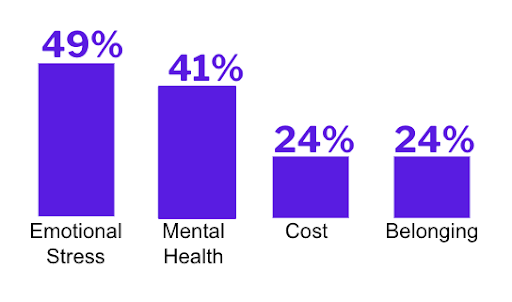
Modern retention programs are designed to represent the student’s lived experience, helping to close the gap many institutions face today. This approach enables listening across the entire student journey rather than relying on reactive measures. The goal is a dynamic, proactive system for monitoring retention, instead of simply reporting the number of students who already left and then scrambling to understand why.
Closing the student experience gap
A critical part of the student retention and engagement puzzle is understanding student experience. Most schools rely on periodic surveys to do all the heavy lifting. But surveys alone are blunt instruments; they offer reactive input, rather than proactive, ongoing insight, and they rely on what students are willing or able to articulate, rather than what they're really thinking or feeling.
Experience management in higher education requires tools that go deeper.
That means acting on data that goes beyond what your operational platforms capture. Your student information system (SIS) tracks academic and financial transactions; your learning management system (LMS) tracks how often students log in and click through course materials; your CRM platform tracks communications—but none of these interactions reveal how students feel at key moments. The right tools close that gap by automatically monitoring and unifying the content of calls, emails, reviews, social posts, surveys, and digital behavior signals as they happen.
Experience management software with these capabilities surfaces emotion, sentiment, intent, effort, satisfaction, and loyalty––giving institutions a clear picture of what drives retention, and where the risks are.
5 top student retention strategies
Here are practical ways universities can better understand student experiences and improve student retention.
1. Elevate the student voice
Understanding student satisfaction reveals where your institution is meeting expectations and where it isn't, which in turn affects student retention.
Measuring how students perceive their learning experience is important because it shapes the broader view of your institution. Students are investing in their education. Like any consumer, they look to peers to validate that investment—and their perceptions spread.
To collect student feedback, leading institutions administer both student and employee satisfaction surveys to understand the experiences their students have with them. Short, regular pulse-checks on student engagement and satisfaction build a more complete picture than relying entirely on long surveys once or twice a year.
Learn more on how to measure the student experience in our guide.
2. Don’t rely on one source
The student journey spans hundreds of interactions across departments, websites, and facilities. Relying on a single source of data misses the full picture and limits an institution's ability to understand and improve student satisfaction.
Surveys are the right starting point. They're a valuable baseline for understanding student experience—but not every student responds, and survey data alone can't capture what's happening between feedback moments. Institutions that build a more complete picture layer in additional data sources:
- Digital interactions: Website visits, app usage, and self-service portal behavior reveal friction and intent that surveys can't capture.
- Phone calls: Call recordings and transcripts surface sentiment and recurring issues at scale.
- Chats, email, case notes, and support tickets: Service data—structured and unstructured—shows where students are struggling operationally.
- Social channels: Organic student conversations provide unsolicited, unfiltered feedback in real time.
Most of these data sources already exist. The challenge is bringing them together. Platforms that unify data, surface insights, and enable action in one place give institutions the complete view they need to intervene earlier.
3. Rethink course evaluations as a strategic asset
The academic experience is one of the most direct levers institutions have on student retention and course evaluations are one of the most underutilized tools for improving it.
Course evaluations are a familiar and trusted form of student voice and an impactful way to gauge how a student feels about their academic work. Treating them as a rich data source, rather than a routine compliance exercise, unlocks meaningful improvements in both student experience and faculty development.
Well-designed course evaluations help identify gaps in the learning experience and surface which actions have the biggest impact on experience, engagement, and performance. They also give faculty a repeatable, actionable feedback loop to improve curriculum, learning activities, and teaching methods—one that can be tracked and built on over time.
Best practice is to evaluate every class, every semester, with formative assessments mid-semester, as well as summative assessments at the end. The challenge is volume: labor-intensive processes mean most institutions can only cover some classes, some of the time.
The right course evaluations software changes that, capturing the right data in a repeatable format that provides results in real-time.
4. Don’t limit student experience to the classroom
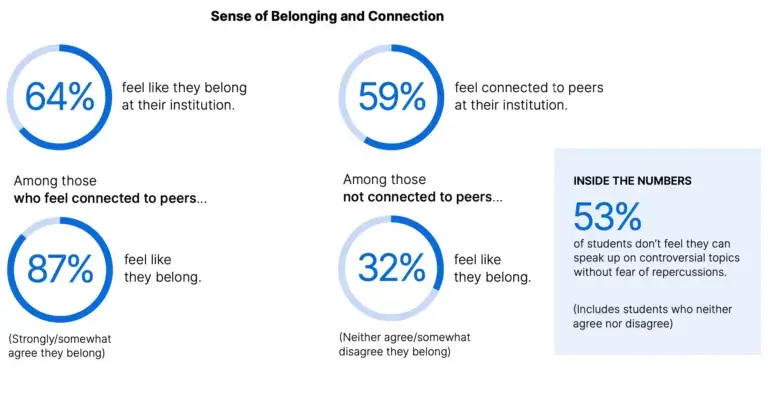
While the classroom experience is a common starting point, it is a small portion of a student’s overall experience. Ask graduates what they remember from college, and you’ll often hear about people—classmates, professors, coaches, and advisers. Connecting with peers and mentors is fundamental to the student experience, and central to building a student's sense of belonging and purpose in their education.
Student retention has a direct correlation with connection.
In a survey conducted by College Pulse and Qualtrics, data showed that a sense of belonging increases with active learning and engagement. When asked what they’d change about the student experience if they were president of their university for a day, one student said “Have more opportunities for people from different backgrounds to interact with each other.”
This suggests that, beyond what they’re learning in the classroom, students in higher education crave community. 87% feel like they belong to an institution when it can connect students in meaningful ways. And if students feel like they would have to leave something or someone important behind, they are less likely to leave.
5. Make action the norm
Understanding student feedback is the starting point but without action, it won’t drive change. No matter how good the insights, they won’t improve student experience or retention if they aren’t acted on.
There are four types of action: immediate response, process improvement, process integration, and strategic decision-making. Time sensitive actions should be facilitated by alerts to student-facing teams to follow up with students in a timely manner as well as workflows that help automate resolution. Broader changes should be considered as part of regular and ongoing systemic transformation that addresses root cause so that there are fewer issues in the future.
Here’s what that looks like in action:
The situation:
A large public university is losing $10k per churned student. Early warning signs of academic performance and engagement aren’t available until the end of term, making them ineffective for intervention. Moreover, student risk signals (like belonging, financial stress, and mental health) are scattered across surveys and systems with no unified view. Students leave without warning.
The experience layer:
With experience management tools in place, the university brings disparate data sources into one centralized system that unlocks new insights. Through open text analytics, they learn that scheduling appointments with financial aid is a significant driver of negative sentiment (and an early indicator of retention risk). Signals from across social channels and internal systems, meanwhile, identify a group of academically high-performing students who don’t feel like they belong at the institution.
Intelligent response:
Insight only creates change when it turns into action. The university's digital platform automatically escalates the highest risk students to success coaches, surfaces the magnitude of the financial aid scheduling issue so it becomes a clear priority, and personalizes outreach to students struggling with engagement.
The outcome:
By fixing systemic issues, like access to financial aid, and intervening where it matters most, the university tracks real changes in its risk segments, with a marked decrease in the number of students at risk. This leads to a 3% first-year retention increase within one year—and $2M in protected tuition revenue.
Retention doesn't end at graduation
Student retention is a specific metric designed to measure success for those who enter postsecondary education. It's an important benchmark, but it's only part of the equation. What institutions do to prepare students for life after graduation is equally critical.
Workforce Outcomes
97% of higher education leaders say workforce outcomes are their top priority.
Improving workforce outcomes for graduating students is central to the mission of higher education and a critical part of the value proposition of a postsecondary degree or credential. Prospective students consider workforce outcomes when deciding where to enroll (or whether to apply at all). Workforce preparation also serves state and local economic development needs, and recent policy developments increasingly link student workforce outcomes to institutional funding.
Institutions can improve workforce alignment by assessing students’ perceived value of their degree and career preparation throughout the student journey. Waiting until a student's final semester leaves insufficient time to close the gaps students need to bridge before entering the workforce. Starting earlier integrates workforce preparation into ongoing student success strategies and leaves time for course correction.
Institutions should also continue to assess student workforce outcomes after graduation. This should include employment, salary, and student perception of their workforce experience (e.g., level of preparation, alignment with goals). It’s also important to assess employers' perception of student readiness through an annual employer perception study.
How can Qualtrics help with student retention?
Qualtrics® XM® for Education was built to handle everything listed in the example above.
XM for Education combines natural language processing with automated workflows, helping institutions surface deeper, more actionable insights in real time.
The platform offers an integrated, enterprise solution that brings student and staff insights from every channel into an actionable, single source of truth—adding an experience layer to existing systems. A predictive intelligence engine continuously analyzes that data, turning signals into breakthrough insights before gaps become reputational risks.
Moving from insights to action is what enables higher education institutions to close experience gaps faster.
With Qualtrics, you’ll:
- Listen: Get to know every student individually, with always-on listening tools.
- Understand: Using all forms of experience data, XM for Education helps you understand the emotion, effort, and intent behind student interactions—whenever and wherever they happen.
- Act: Make taking action an automatic response across your entire institution.
Qualtrics’ XM Platform® gives institutions the tools to support students and improve retention at every stage of the journey.
Student retention FAQs
How do you calculate student retention rates?
Student retention is most commonly calculated as fall-to-fall retention for first-year students. Other retention metrics include term to term, first to second year, and program specific. Predictive retention uses past retention data to estimate a probability of retaining current students.
What are the primary drivers of student retention risk in higher education?
Retention is one of the most widely studied research topics in higher education. Across decades of research and countless studies, six sets of drivers consistently emerge: academic support and success, financial aid and stability, connection and belonging, well-being and mental health, career readiness, and operational effectiveness.
What is student engagement in higher education?
Student engagement measures how involved, enthusiastic, and committed a student feels toward their institution. It's widely used as a proxy for educational quality and as an early indicator of retention risk. Tracking engagement early is what gives institutions the window to act.
What is student satisfaction and why does it matter for retention?
Student satisfaction captures how students perceive the quality of what their institution offers, including its instruction, services, facilities, and support. Research consistently shows that satisfaction breeds loyalty: satisfied students are more likely to stay enrolled, participate in alumni activities, and recommend the institution to others.